Overview
Blind Magazine’s latest feature traces a photographic history of UFOs as something more than a catalog of unexplained lights in the sky. In curator Philippe Baudouin’s view, these images are also cultural evidence—documents that reveal how public imagination, belief, and skepticism have evolved alongside changing ideas about extraterrestrial life. Presenting “Nous ne sommes pas seuls. Images extraterrestres” (“We Are Not Alone. Extraterrestrial Images”) at Espace Croisière through October 4, 2026, Baudouin frames the subject not as proof of alien visitation, but as a visual archive of humanity’s enduring uncertainty about its place in the universe.
Photography as a Record of Belief
Baudouin begins from a cosmological premise that many scientists and philosophers would recognize: with “billions of galaxies, billions of stars, and probably as many planets as there are grains of sand on a beach,” he argues, “what would be unreasonable is to think we are alone in the universe.” Yet he is careful to distinguish between possibility and evidence. Whether that life is microbial or intelligent, he says, “I’m simply incapable of telling you.” That uncertainty is precisely why the exhibition focuses on UFO imagery rather than definitive extraterrestrial proof. Photography, in this context, becomes a stand-in for scientific knowledge that remains elusive, offering a record of what people have seen, believed, or wanted to believe at different moments in time.
A Cult Image, and the Mystery Behind It
Among the exhibition’s standout images is a striking 1993 photograph by Yves Bosson, Jean-Claude Ladrat, constructeur de soucoupes volantes (“Jean-Claude Ladrat, Builder of Flying Saucers”), which captures a man seated beside his homemade flying saucer as if it were an ordinary piece of furniture. The image evokes a distinctly French episode of amateur ufology and popular television memory: Ladrat’s appearance on the cult documentary program Strip-Tease in La Soucoupe et le perroquet (“The Saucer and the Parrot”), where viewers saw him building a craft in his mother’s garden in Germignac, apparently destined for the Bermuda Triangle. Baudouin notes that Bosson’s photograph had “never been published or shown” before, sitting for years in the photographer’s archives. The story underscores one of the exhibition’s central ideas: some UFO photographs survive not because they solve a mystery, but because they preserve a memorable encounter between obsession, eccentricity, and belief.
From Science Fiction Icon to Archive
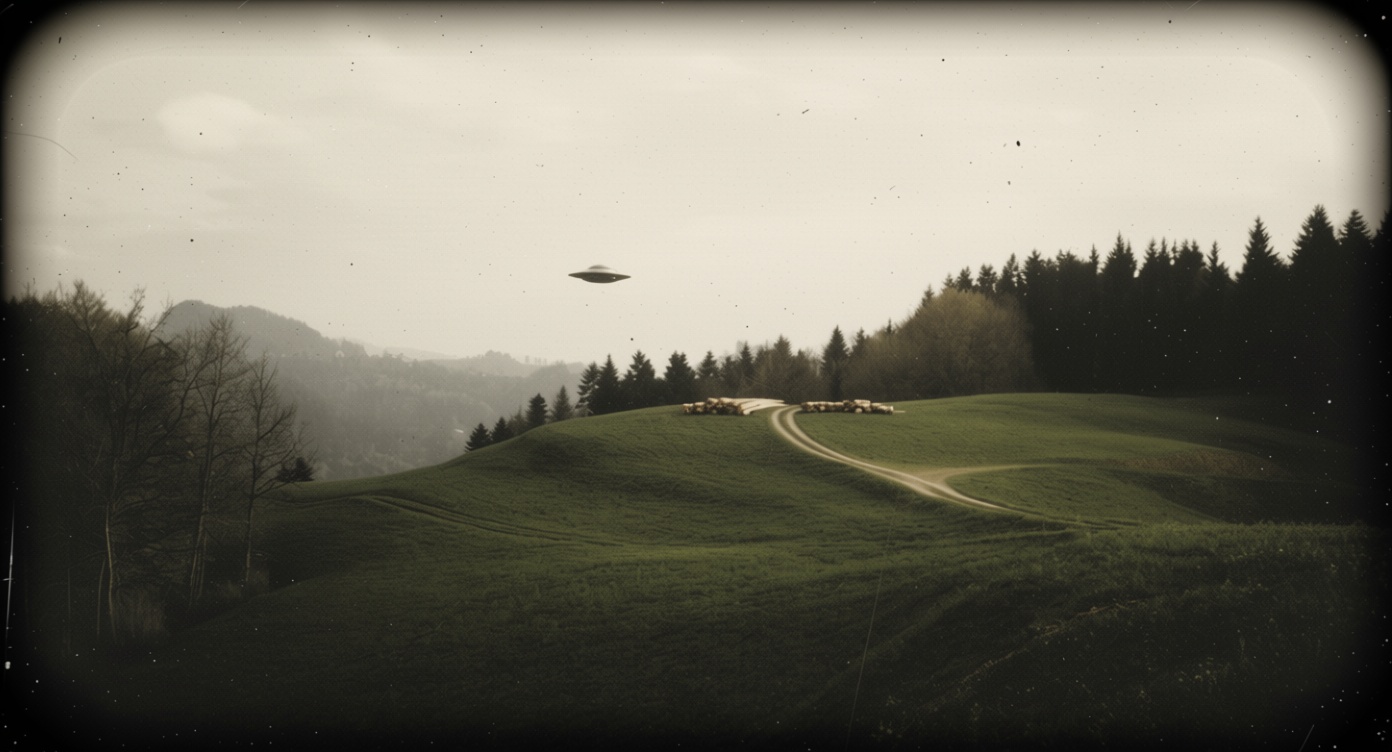
The exhibition also opens with a familiar cultural touchstone: the I Want to Believe poster made famous by The X-Files. Baudouin points out that the image behind that emblem was itself lifted from a real photograph taken in 1975 by Swiss farmer Eduard Albert “Billy” Meier, who claimed to have photographed more than 1,400 UFOs in the Swiss countryside between 1975 and 1980. One of Meier’s images was reportedly used without authorization to create the poster. That detail is revealing: even one of television’s most iconic symbols of UFO skepticism and wonder is rooted in a contested photograph. In Baudouin’s telling, this is where the exhibition’s logic becomes clearest—beneath the popular myth lies an image, and beneath the image, an unresolved mystery.
Why These Images Still Matter
Baudouin insists he is not a ufologist, but his curatorial approach suggests that the history of UFO photography is inseparable from broader questions about media, memory, and belief. These pictures do not merely illustrate a fringe topic; they show how societies have tried to visualize the unknown. In that sense, Blind Magazine’s feature presents UFO photography as both artifact and argument: a body of work that captures not only alleged objects in the sky, but also the enduring human desire to find meaning in what cannot yet be explained.