Overview
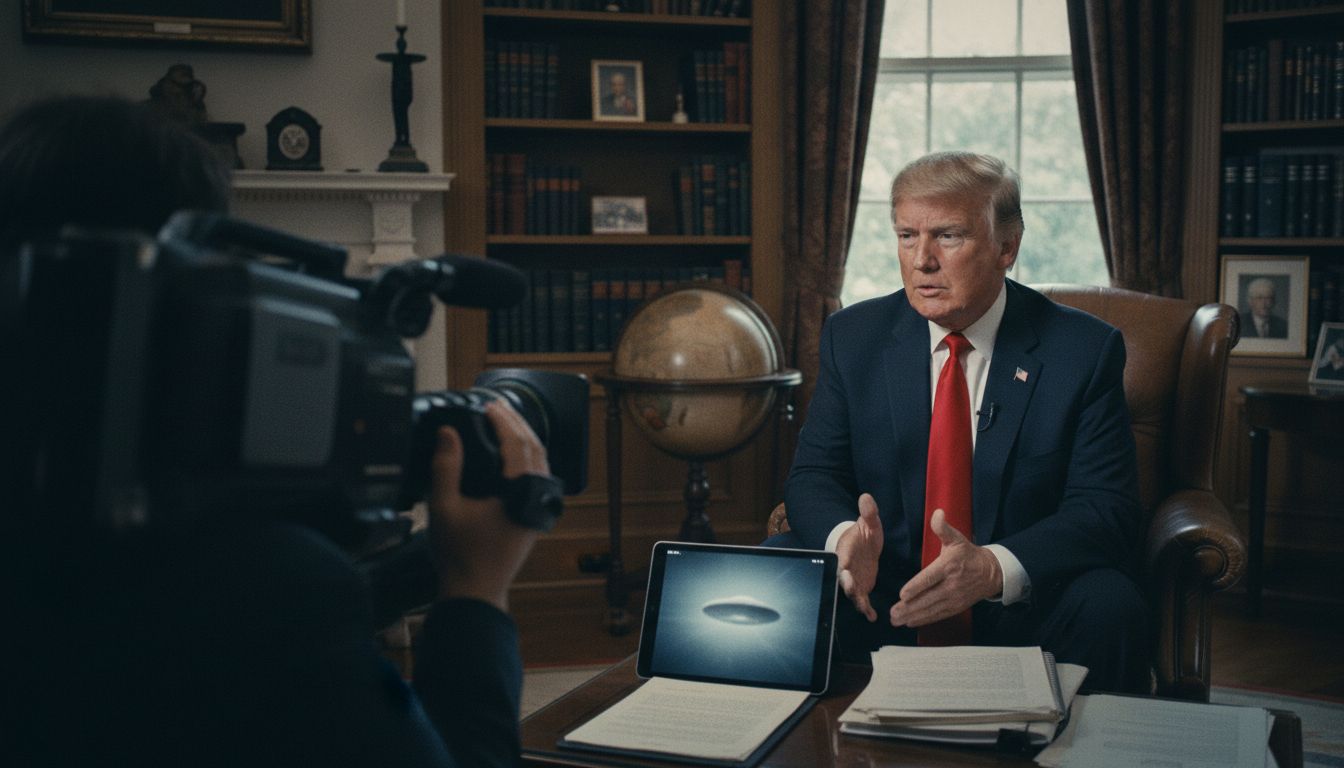
In a recent NewsNation “Reality Check” segment, investigative journalist Ross Coulthart and producer Meagan Medick fielded viewer questions about UAP transparency, government oversight, and alleged lunar anomalies. The conversation centered on a familiar tension in the disclosure debate: growing public demand for answers versus what Coulthart described as a slow, heavily managed release of information. He argued that the new UAP Governance Board and related advisory structures could end up functioning less as tools for accountability than as filters that delay meaningful disclosure.
Oversight and the Limits of Declassification
The discussion was prompted in part by reporting from Liberation Times on a new U.S. government interagency UAP governance board. Coulthart was sharply skeptical, calling it a “bureaucratic impediment” and a “toothless tiger.” He compared it to Project Blue Book, the Air Force’s Cold War-era UFO investigation, suggesting that current reforms may serve as a “brake on disclosure” rather than a mechanism to accelerate it. A central issue, he said, is that neither the board nor Harvard professor Avi Loeb’s Science Advisory Council has subpoena power, leaving both dependent on the cooperation of the Department of Defense and intelligence agencies.
Coulthart also argued that the most sensitive UAP material may not sit within government archives at all, but in the hands of private defense contractors and federally funded research organizations. He named firms such as Northrop Grumman, Lockheed Martin, Raytheon, and Boeing, along with entities including Aerospace Corporation and MITRE Corporation, as likely repositories of information that current declassification efforts may not reach. In his view, that creates a major accountability gap, especially if future disclosure efforts are limited to traditional government channels.
Whistleblowers, Amnesty, and Accountability
A significant portion of the segment focused on whistleblowers and the political mechanics of disclosure. Coulthart addressed whether former intelligence official David Grusch was part of a “controlled disclosure” effort, saying Grusch acted independently through the formal DOPSR review process. He described Grusch as the figure who has “rocked the boat” more than anyone else in the public UAP debate. Coulthart also urged former intelligence official James Lacatski to testify under oath before Congress, citing Lacatski’s reported claim that he had entered a craft of non-human origin.
The question of amnesty for those who may have been involved in past secrecy programs was another major theme. Coulthart said a Truth and Reconciliation Commission model, similar to post-apartheid South Africa, may be necessary to uncover the full history without deterring testimony. He noted that Rep. Anna Paulina Luna has discussed the issue with former White House official Stephen Miller. Coulthart also referred to an alleged case involving the “deliberate murder” of a JSOC operative to protect UAP secrets, using it to argue that full disclosure may require legal protections for insiders willing to come forward.
Lunar Claims and What Comes Next
The segment also ventured into more speculative territory, including discussion of newly released Apollo 16 debriefing audio. Coulthart cited references in the recording to unusual gravity readings, gamma-ray peaks, and unexplained features on the far side of the Moon. He linked those claims to recent remarks by former Pentagon UAP official Lue Elizondo, whom he said has acknowledged awareness of non-human intelligence on the Moon. Coulthart suggested that renewed interest in the lunar poles by space agencies and entrepreneurs such as Elon Musk could reflect strategic interest in potential artificial structures or artifacts, though such claims remain unverified.
Outlook
Coulthart concluded that the current approach amounts to a “slow drip” of information that is unlikely to satisfy public expectations or resolve the broader secrecy question. He warned that if institutions continue to withhold information, disclosure could eventually come in a more chaotic form — what he called “catastrophic disclosure.” For now, the segment framed the issue as both political and institutional: whether the U.S. government and related private-sector actors will allow a credible accounting of what they know, or continue to manage the debate through limited, incremental releases.