Overview
A recent documentary turns attention to one of North Africa’s least appreciated archaeological legacies: the ancient Kingdom of Kush in present-day Sudan, a civilization that built more pyramids than Egypt but remains far less known to global audiences. The film argues that this imbalance is not only a matter of public awareness, but also of preservation, as Sudan’s pyramids and museum collections now face severe risks amid the country’s ongoing war. The report frames the story as both an archaeological revelation and a warning about how easily heritage can disappear when conflict and neglect converge.
A Kingdom in Egypt’s Shadow
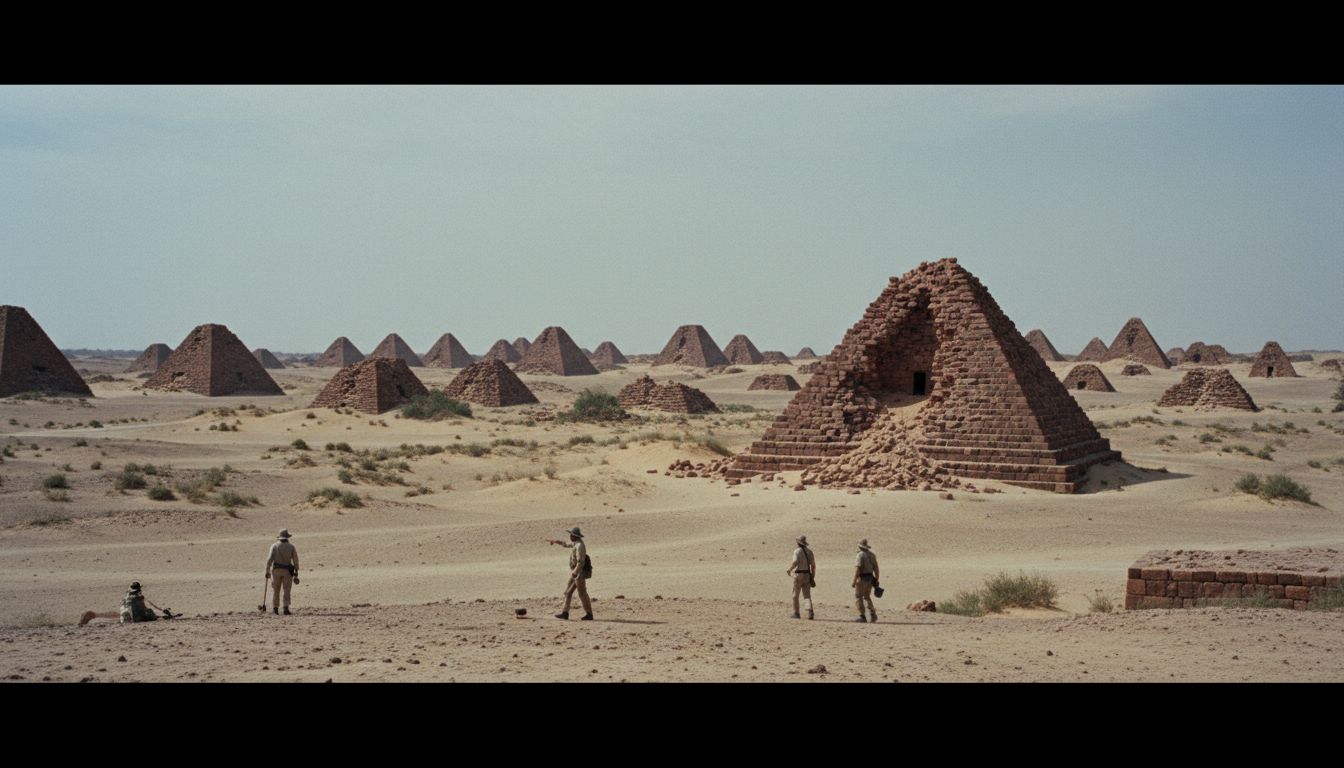
The video emphasizes that Sudan is home to more than 200 confirmed pyramids, with the most famous concentration at Meroë in the ancient Nubian heartland. These monuments are visually distinct from the better-known pyramids of Giza: they are typically steeper, narrower, and smaller in scale, but no less historically significant. Historians featured in the documentary stress that the Kushite pyramids were not imitations of Egypt’s tomb architecture so much as part of a related but independent royal tradition that evolved along the Nile.
That tradition reached its political peak during the 25th Dynasty, when Kushite rulers known as the “Black Pharaohs” governed both Nubia and Egypt for nearly a century beginning in the 8th century BCE. The documentary highlights King Piye, who conquered Egypt and was later buried at El-Kurru; King Shabaka, who preserved sacred Egyptian texts on the Shabaka Stone, now held at the British Museum; and King Taharqa, remembered for temple-building campaigns and monumental pyramids at Nuri. Together, these rulers illustrate the scope of Kush’s influence across the ancient Nile Valley.
Defiance, Trade, and Cultural Sophistication
The film also presents Kush as a politically resilient and culturally sophisticated power long after it lost control of Egypt. One of the most striking episodes centers on Queen Amanirenas, a Kandake or ruling queen, who reportedly resisted Roman expansion in the 1st century BCE and brought the conflict to a stalemate. In a symbolic act of defiance, Kushite forces allegedly buried a bronze head of Emperor Augustus beneath temple steps at Meroë, ensuring that visitors would walk over the Roman ruler’s likeness.
During Meroë’s golden age, roughly 300 BCE to 350 CE, the city became a major center for iron production and trade. Yet much of the Kushite story remains difficult to reconstruct because of the Meroitic script. Scholars can identify its phonetic values, but the language has not been fully translated, leaving large parts of the historical record still inaccessible. As one expert in the documentary notes, the kingdom’s legacy is visible in stone and metal, but its written voice remains partly unheard.
Heritage Under Siege
The video places this ancient history in direct conversation with a long record of destruction. It recalls the 19th-century looting campaign of Giuseppe Ferlini, who used explosives to tear open dozens of pyramids in search of treasure, and the flooding caused by the Aswan High Dam project in the 1960s, which submerged many Nubian sites even as UNESCO rescued Abu Simbel. The documentary argues that Sudan’s heritage has repeatedly been treated as expendable, first by colonial extraction and later by development projects and war.
That pattern is now being repeated under even more urgent conditions. Since fighting erupted on April 15, 2023, between Sudan’s armed forces and the Rapid Support Forces (RSF), the country has descended into what humanitarian agencies call the world’s largest displacement crisis, with 14 million people uprooted. The report says the Sudan National Museum was occupied for two years and that as much as 60% to 90% of its collection — potentially up to 8,000 artifacts — was looted or destroyed after the site was retaken in 2025.
A Vanishing Future
At Meroë itself, the documentary finds a site left vulnerable by war, poverty, and the collapse of tourism. Mostafa Ahmed Mostafa, described as a 65-year-old guardian, is portrayed as one of the few remaining custodians watching over the pyramids as sand advances and structures deteriorate. UNESCO listed Meroë as a World Heritage site in 2011, but the report says the site has received no direct support during the current conflict. The film’s final message is stark: objects can sometimes be recovered, but a collapsed pyramid cannot be restored to history.