Overview
A recent presentation by researcher and author Randall Carlson drew attention to new scholarship on the Hopewell earthworks of Eastern North America, arguing that these monumental sites may have been built within a far shorter period than previously believed. At the center of the discussion is a 2023 study published in American Antiquity, “Building the Ohio Hopewell Chronology: An Incremental Approach to Historical Reckoning,” by Mark F. Seeman of Kent State University and Kevin C. Nolan of Ball State University. The study revisits the timeline of Hopewell construction and use, and Carlson used its findings to suggest that the civilization behind the earthworks may have been more socially organized—and possibly more technologically sophisticated—than conventional accounts have recognized.
New Chronology for the Hopewell Sites
To refine the chronology, the researchers evaluated 424 radiocarbon dates from six major Ohio sites: Hopewell Mound Group, Liberty, Mound City, Seip, Tremper, and Turner. They applied a process known as chronometric hygiene, which filters out samples with weak context or possible contamination in order to produce a more reliable dating framework. The result, according to the study’s Bayesian model, was a compressed period of peak earthwork construction and activity lasting roughly 250 years, rather than the 700-year span often cited in earlier interpretations. The study places the beginning of this peak around AD 90 to 120 and its end around AD 395 to 430.
For Carlson, that narrower window is significant because it implies that the monumental works of the Hopewell were not spread gradually across many centuries, but instead were produced during a concentrated era of cultural intensity. He argued that this faster timeline points to a level of coordination and planning that may have been underestimated in standard archaeological narratives.
Geometry, Astronomy, and Monumental Design
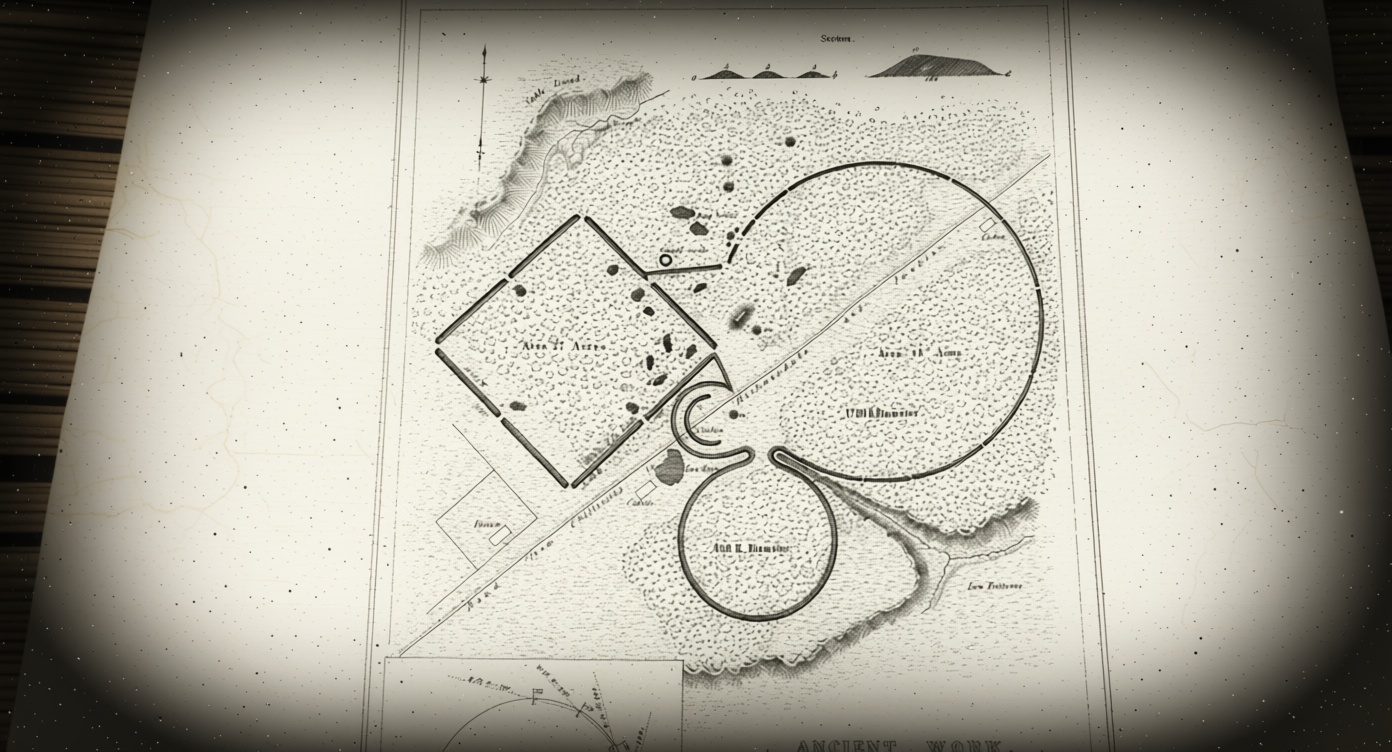
Carlson’s remarks focused heavily on the possibility that the Hopewell earthworks were part of a system of geometry and astronomy. He pointed to the scale and precision of features such as the Long Enclosure, nearly half a mile in length, and the Elevated Circle at the Turner site as evidence of deliberate design principles. He also cited artifacts including Ross barbed obsidian blades from the Yellowstone region, copper breastplates, effigy boatstones, and carefully crafted pottery as signs of extensive exchange networks and advanced craftsmanship.
In addition, Carlson referenced woodhenges—circular wooden structures analogous to examples found elsewhere in the ancient world—as possible indicators of shared astronomical knowledge or standardized measurements. While such claims remain interpretive, they reflect a broader debate in archaeology over whether the Hopewell earthworks were primarily ceremonial landscapes, astronomical observatories, or some combination of the two.
The Lost Turner Site and Its Significance
A major part of Carlson’s presentation was his concern over the destruction of the Turner site in Hamilton County, Ohio, much of which was lost to gravel quarrying after World War II. That loss, he suggested, has made it harder to fully assess the scale and organization of Hopewell engineering. Historic records, including the 1887 Turner Group survey, remain important because they preserve details from sites that no longer survive in full.
The broader conclusion of the study is cautious: Seeman and Nolan describe the Hopewell phenomenon as a “socio-religious movement” centered on specific cultic places. Carlson, however, pushed the interpretation further, arguing that the speed, scale, and precision of the works challenge assumptions about what ancient North American societies were capable of achieving. Whether viewed as sacred architecture, astronomical planning, or both, the new chronology is prompting renewed scrutiny of a culture whose achievements may have been more complex than previously understood.