Overview
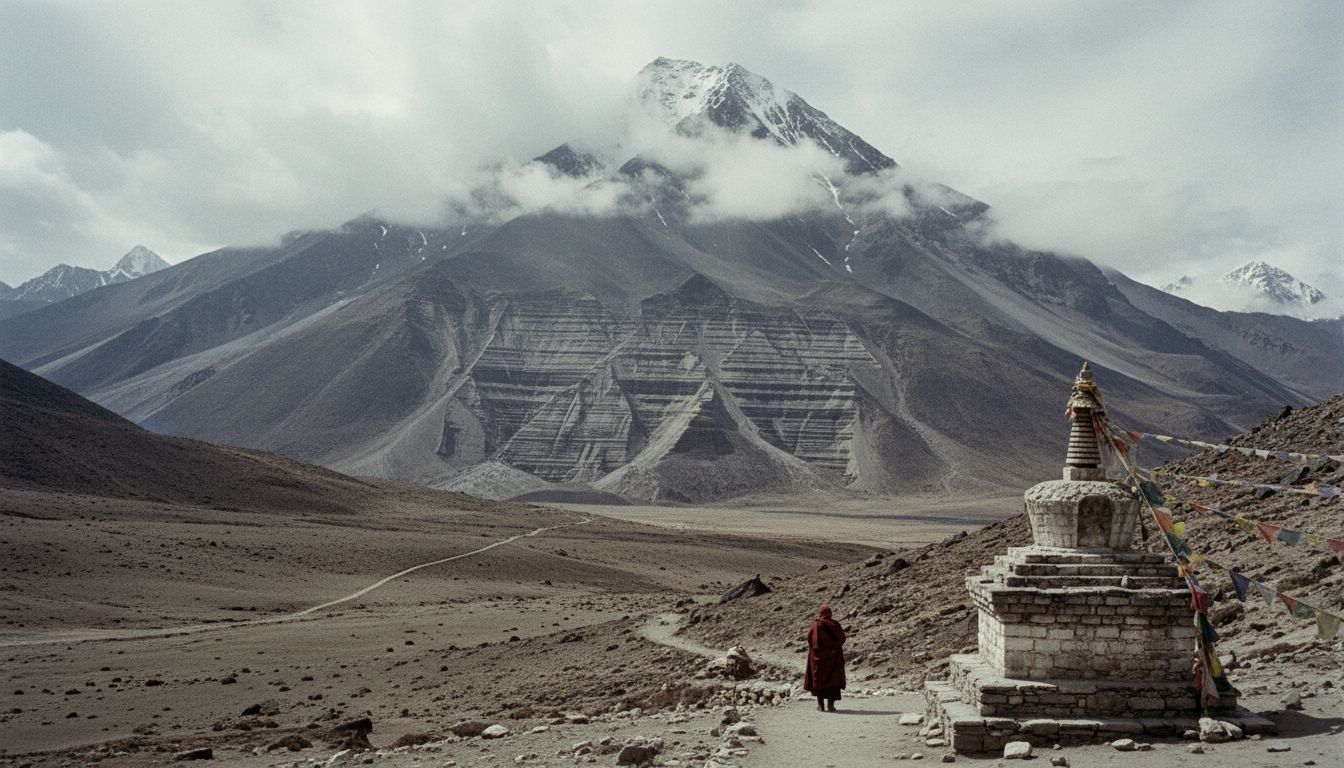
Mount Kailash, a 6,638-meter peak in western Tibet, has long occupied a rare place at the intersection of geography, religion, and folklore. The mountain is revered across Bon, Tibetan Buddhism, Hinduism, and Jainism, and it remains one of the world’s few major peaks that has never been summited. That status has only deepened its reputation as a site of mystery, with some writers and researchers attributing unusual geometric and magnetic properties to the mountain. At the same time, the claims surrounding Kailash remain unverified as proof of anything supernatural or extraterrestrial, and much of the discussion sits at the edge of science, faith, and speculation.
Claims of Unusual Geometry and Magnetic Effects
A central part of the fascination with Mount Kailash is its shape. Observers have long noted that, unlike many Himalayan peaks sculpted by erosion and glaciation, Kailash appears to have four nearly flat faces aligned with the cardinal directions. Russian geologist Ernst Muldashev drew attention to this symmetry in surveys conducted in the late 1990s, and the mountain’s pyramid-like profile has since been discussed in the context of modern photogrammetry and LiDAR scanning. Supporters of these claims argue that the mountain’s regularity is unusual for a natural formation, though geologists generally remain cautious about drawing broad conclusions from visual symmetry alone.
The mountain is also frequently associated with reports of compass drift, electronic glitches, and equipment malfunctions. Expedition accounts have described GPS devices, satellite phones, and cameras failing near the mountain, then functioning normally after teams moved away. Some travelers have also repeated more anecdotal observations, including reports of fatigue, accelerated hair and nail growth, and discomfort at high altitude. These accounts are part of Kailash’s lore, but they are difficult to separate from the well-known physical strain of extreme elevation and harsh environmental conditions.
A Geographical and Hydrological Crossroads
Beyond the mystery stories, Mount Kailash is significant for a very concrete reason: it sits near the headwaters of four of Asia’s major river systems. The Indus, Brahmaputra, Karnali, and Sutlej all originate within roughly 100 kilometers of the mountain, flowing in different directions to sustain large parts of the subcontinent. That unusual hydrological arrangement has led ancient geographers and modern commentators alike to describe the area as a kind of “center of the world,” a notion supported by the mountain’s visual prominence and its centrality in regional water geography.
Sacred Meaning Across Four Traditions
What makes Kailash especially distinctive is the breadth of its spiritual significance. In Bon, the mountain is known as Tise and is described as the soul of the world. In Tibetan Buddhism, it is associated with the deity Demchog. For Hindus, it is the eternal seat of Lord Shiva, while Jains regard it as the place where the first Tirthankara attained liberation. Despite the distinct theological frameworks, all four traditions place Kailash at the center of a cosmic order, often referring to it as the Axis Mundi, or world axis. Some texts, including the Kalachakra Tantra, go further by portraying the mountain not merely as symbolic, but as a point where higher spiritual forces intersect with the physical world.
Why the Mystery Persists
Despite the volume of claims, Mount Kailash has never been the subject of a large-scale, sustained international scientific investigation. That is due partly to geopolitical restrictions, as Chinese authorities have not issued a permit to summit the mountain, and partly to the difficulty of conducting research in such a remote, high-altitude environment. There is also an institutional reluctance among some scientists to engage with a subject often framed in mystical or sensational terms. As a result, Kailash remains a place where documented geography and enduring belief overlap, leaving open questions that have yet to be resolved by modern science.