Overview
A new analysis by astrophysicist Avi Loeb asks whether some reported UAP orbs — long treated by many observers as potentially exotic or even extraterrestrial — may instead be adversary drones or other human-made technologies. In the piece, Loeb frames the question less as a matter of speculation than as a national security issue, arguing that unidentified objects in sensitive airspace should be evaluated first through the lens of possible surveillance, deception, or hostile capability.
The discussion centers on a set of orb-like encounters described in Pentagon-related reporting systems, including the Presidential Unsealing and Reporting System for UAP Encounters (PURSUE). Rather than assuming a single explanation for all sightings, Loeb emphasizes that Unidentified Anomalous Phenomena are a mixed bag, and that investigators must separate truly anomalous events from cases that may be explained by conventional technology or sensor limitations.
The Gulf of Oman Case
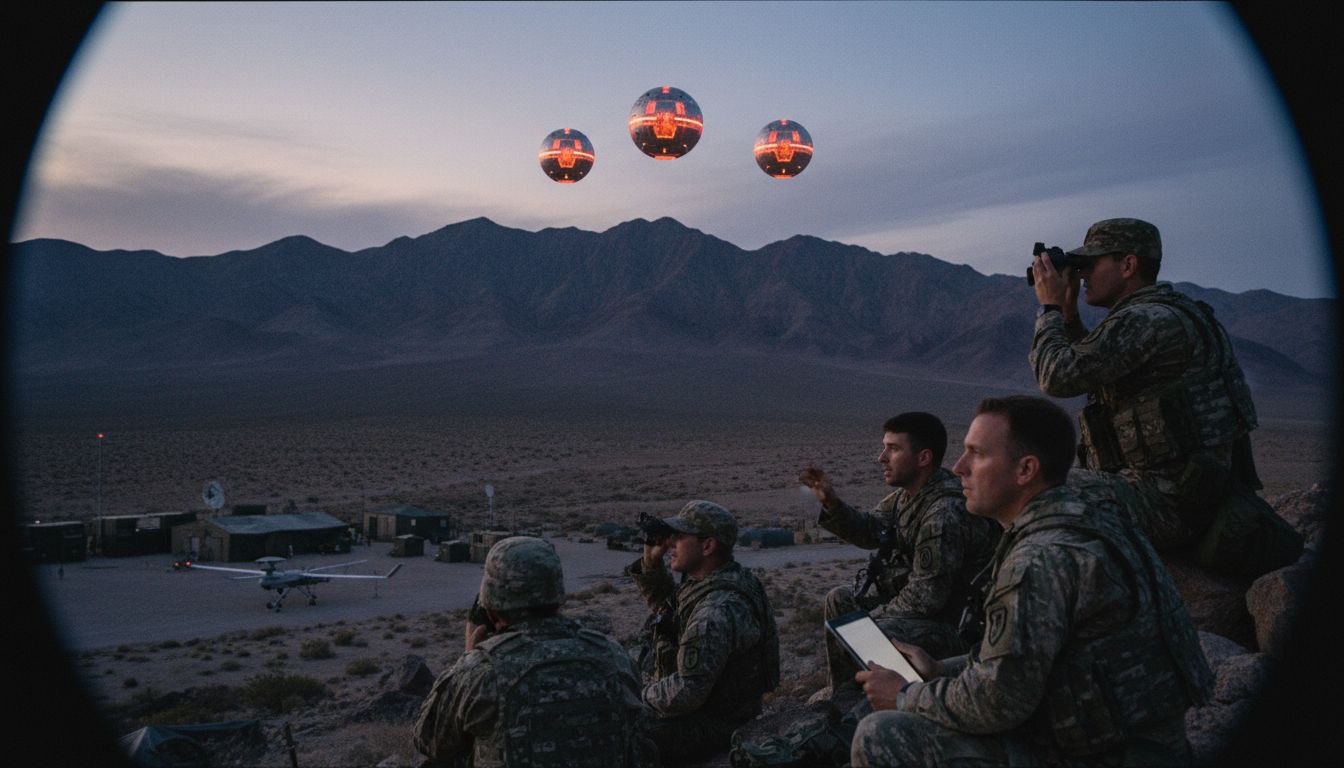
One of the most detailed examples cited is the September 8, 2021 Gulf of Oman incident, where a U.S. AC-130 gunship reportedly observed multiple orb-like contacts during nighttime live-fire training. According to the account, the aircraft first detected the objects after dropping a water-activated flare, which served as a mock target. Crew members then used the aircraft’s electro-optical/infrared sensor to scan the area and reportedly saw two cold orbs, each about 4 feet in diameter, hovering over the flare for roughly 15 seconds.
The report says the objects then rapidly moved away just as the gunship fired its 105mm cannon, departing the sensor feed without changing altitude. The crew also reportedly observed about 25 instances of similar objects during the sortie, including orbs flying in loose formation and maneuvering in coordinated, wave-like patterns. The report notes that attempts to preserve the video were unsuccessful because the aircraft’s digital video recorder failed and the footage became corrupted.
Why the Orbs Raise Questions
Loeb points to several characteristics that make the cases difficult to dismiss, while still stopping short of claiming a non-human origin. The reported objects were said to be roughly one meter in size, traveling at estimated speeds of 100 to 600 meters per second — fast enough to raise questions about propulsion, energy use, and heat signatures. Yet the orbs were described as cold on infrared, meaning they appeared cooler than the surrounding environment, which is the opposite of what one would expect from combustion engines or the aerodynamic heating associated with high-speed flight.
Some of the contacts were reportedly tracked by multiple radar systems, while others were identified mainly through optical and infrared sensors, making them more vulnerable to artifacts such as lens flare, out-of-focus imagery, or other instrumentation effects. The visual descriptions also vary, with reports of black, white, and metallic or reflective appearances, suggesting that not every “orb” case is necessarily the same kind of object.
National Security Implications
The possibility that some UAP orbs could be hostile drones or advanced reconnaissance platforms changes the stakes considerably. If even a fraction of these incidents reflect real objects operating in restricted military environments, then the issue is not simply whether the objects are alien, but whether they represent foreign surveillance technology capable of evading detection and interacting with U.S. assets.
That framing has become increasingly common in UAP discussions: before reaching for extraordinary explanations, analysts must consider whether the phenomenon could reflect classified human technology, adversary systems, or sensor misinterpretation. Loeb’s argument is that serious investigation requires treating the unknown as a threat assessment problem first, and an origin question second.
The Need for Better Data
The article ultimately argues for more rigorous collection and preservation of evidence. The lack of recoverable footage from the Gulf of Oman case underscores a broader problem in UAP research: without consistent multi-sensor data, definitive conclusions remain elusive. For Loeb, the central question is not whether all orb sightings are adversary drones, but whether some of them could be — and whether the defense and intelligence communities are prepared to distinguish such cases from anything more extraordinary.