Overview
A new look back at some of ufology’s most discussed historical cases suggests that the field’s most enduring episodes are also its most complicated. At the center of the discussion is the 1956 Lakenheath incident, a Cold War-era radar alert over East Anglia that remains officially unresolved, alongside later episodes that drew in military personnel, police officers, and civilian witnesses. The article argues that these cases still matter not because they prove an extraterrestrial explanation, but because they capture the tension between credible testimony, incomplete records, and the ever-present risk of hoaxes.
The 1956 RAF Lakenheath case
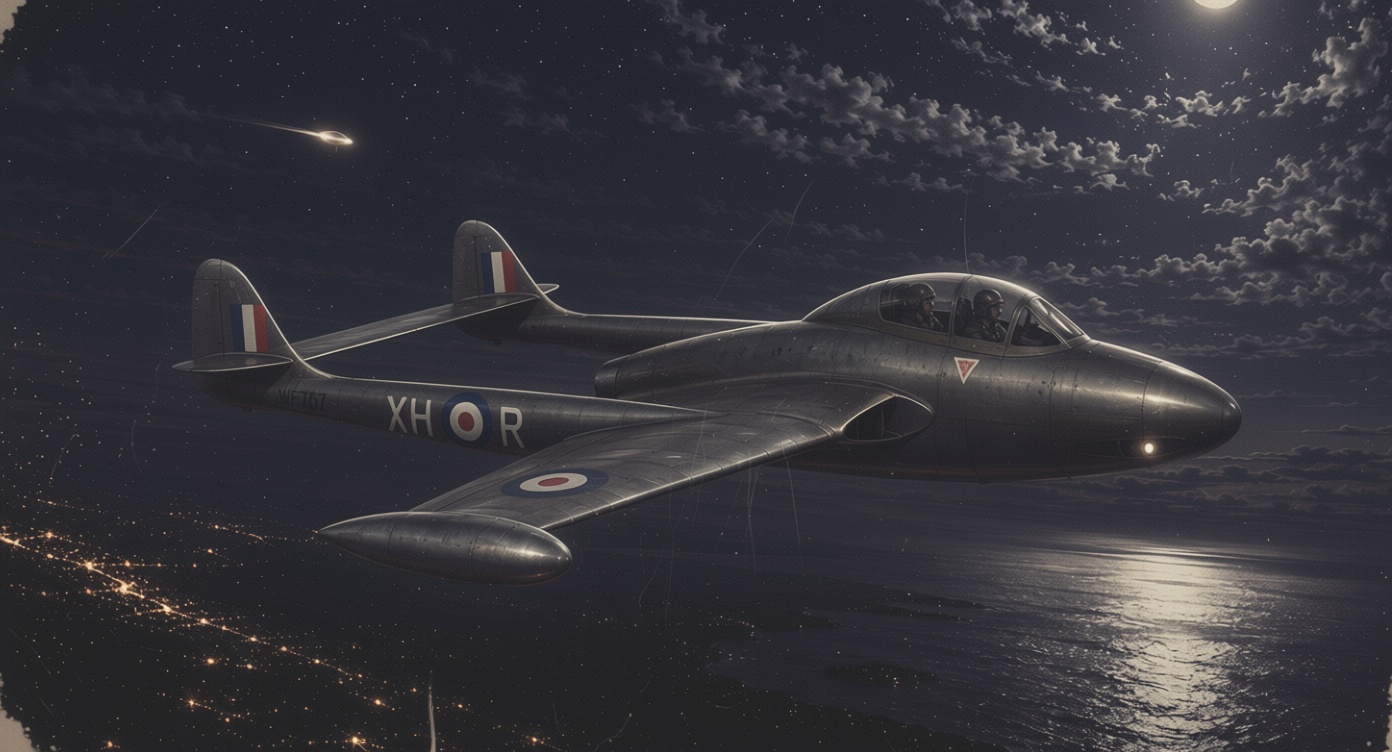
The Lakenheath incident took place in the early hours of 13/14 August 1956, when fighter jets were scrambled after radar operators detected unidentified objects near the US airbase at RAF Lakenheath in Suffolk, then hosting nuclear weapons. According to files released through the U.S. Air Force’s Project Blue Book, airfield radars reported fast-moving targets, while personnel at nearby RAF Bentwaters detected formations of slow-moving objects and saw bright lights crossing the sky. A C-47 transport pilot also reported a blurry light moving “east to west at terrific speed,” adding to the sense that something unusual was unfolding over eastern England.
One of the most striking accounts came from Freddie Wimbledon, a senior fighter controller at RAF Neatishead, who later recalled seeing a target on radar that behaved unlike anything he had encountered. “It travelled at tremendous speeds at an altitude of between 10 and 20,000 feet and then suddenly stopped,” he said. “I couldn’t believe what I was seeing.” That testimony has helped keep the case alive in UFO research circles, especially because the event occurred in a sensitive military environment where radar performance, air defense readiness, and Cold War anxiety all intersected.
Cold War secrecy and the nuclear backdrop
The case is often discussed in the context of the broader strategic climate of 1956. Just two weeks before the radar incident, a B-47 bomber crashed into a storage silo at Lakenheath containing three nuclear weapons, causing an explosion that spread burning fuel over the bombs. General Curtis LeMay later described it as “a miracle” that the exposed detonators did not explode. The proximity of the UFO alert to that accident has made the episode especially notable in historical retrospectives, as has the presence of secret U.S. military programs in Britain, including the covert arrival of U-2 spyplane parts at Lakenheath in banana boxes earlier that year.
The Ummo hoax and the problem of evidence
The article also points to the 1966 Ummo hoax as a reminder that not every UFO case can be taken at face value. Unlike Lakenheath, Ummo is remembered as a deliberate fabrication that nonetheless influenced UFO culture for years, demonstrating how easily elaborate stories can mimic authenticity. The inclusion of such a case alongside unresolved radar events underscores a core problem in ufology: the same subject area contains both genuine mystery and convincing fraud, often side by side.
Why these cases still matter
That mix helps explain why historical UFO cases remain so influential. Events involving military radar, police observers, and civilian witnesses can offer compelling data, but they also expose the limits of what can be verified after the fact. In that sense, the Lakenheath case and the Ummo hoax serve as complementary lessons: one shows how a serious unexplained incident can survive for decades, while the other shows how easily misinformation can spread when documentation is thin. Together, they continue to shape the debate over what UFO evidence can—and cannot—tell us.