Overview
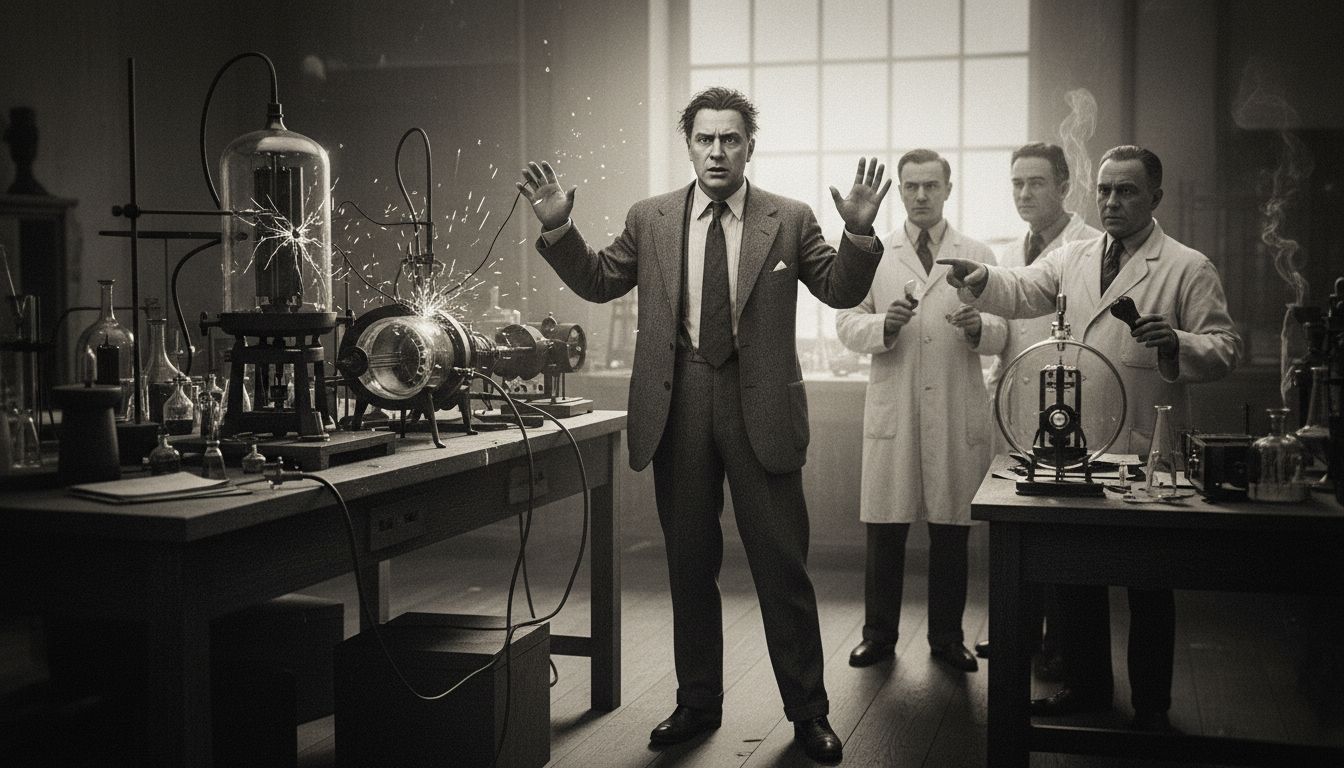
A recent article has brought renewed attention to one of physics’ more enduring pieces of folklore: the “Pauli Effect,” the tongue-in-cheek notion that the mere presence of theoretical physicist Wolfgang Pauli could cause laboratory equipment to malfunction. Pauli is, of course, best known for the Pauli exclusion principle, a foundational law of quantum mechanics. But among his colleagues, he also acquired a second, far more playful reputation — the idea that “a functioning device and Wolfgang Pauli may not occupy the same room.”
The story persisted because it was told by scientists themselves, often with a mix of amusement and genuine unease. One of the most cited episodes occurred at Göttingen, where an expensive measuring device reportedly failed for no apparent reason. Institute director James Franck wrote to Pauli in Zürich to assure him that, in this case, he was not the culprit. Pauli had been traveling by train that day and happened to change trains at the Göttingen station around the same time the instrument stopped working, which only deepened the legend rather than dispelling it.
Pauli, Synchronicity, and Scientific Folklore
What makes the Pauli Effect more than just an office joke is that Pauli himself took the phenomenon seriously enough to engage with it philosophically. He corresponded with psychiatrist Carl Jung about synchronicity, Jung’s idea that meaningful coincidences can connect events without a direct causal explanation. For Pauli, the anecdotal pattern around his visits to laboratories seemed worthy of reflection rather than simple dismissal.
The folklore surrounding him became part of scientific culture. Otto Stern, a friend of Pauli’s, is said to have banned him from his Hamburg laboratory, underscoring how the joke traveled through physicists’ circles. Later, at the founding festivities of the C.G. Jung Institute in Zürich in 1948, a china vase reportedly fell as Pauli entered, an incident that only reinforced his reputation among those already predisposed to see a pattern. At another reception, physicists reportedly rigged a chandelier to drop on him as a parody of the effect — only for the chandelier to stick. The absurdity of the moment became, fittingly, part of the myth.
Continuing Interest in Anomalous Experience
The renewed attention to the Pauli Effect arrives at a time when universities and researchers are still exploring the borderlands between psychology, consciousness and reported anomalous events. The University of West Georgia has named writer and paranormal researcher Courtney Block as the 2026 Ingo Swann Research Fellow, a position intended to support scholarship in parapsychology and consciousness studies. The appointment signals that, despite long-running skepticism within mainstream science, there remains institutional interest in examining unusual claims through a research lens.
Named for Ingo Swann, a central figure in remote viewing and related parapsychology discussions, the fellowship reflects a field that continues to draw both criticism and curiosity. In that context, the Pauli Effect sits in an interesting place: not as evidence of paranormal influence, but as a historical case study in how scientists interpret coincidence, reputation and unexplained events. The line between joke, myth and meaningful pattern has always been thin, and Pauli’s story remains a vivid example of how that boundary can blur inside even the most rigorous intellectual communities.