Overview
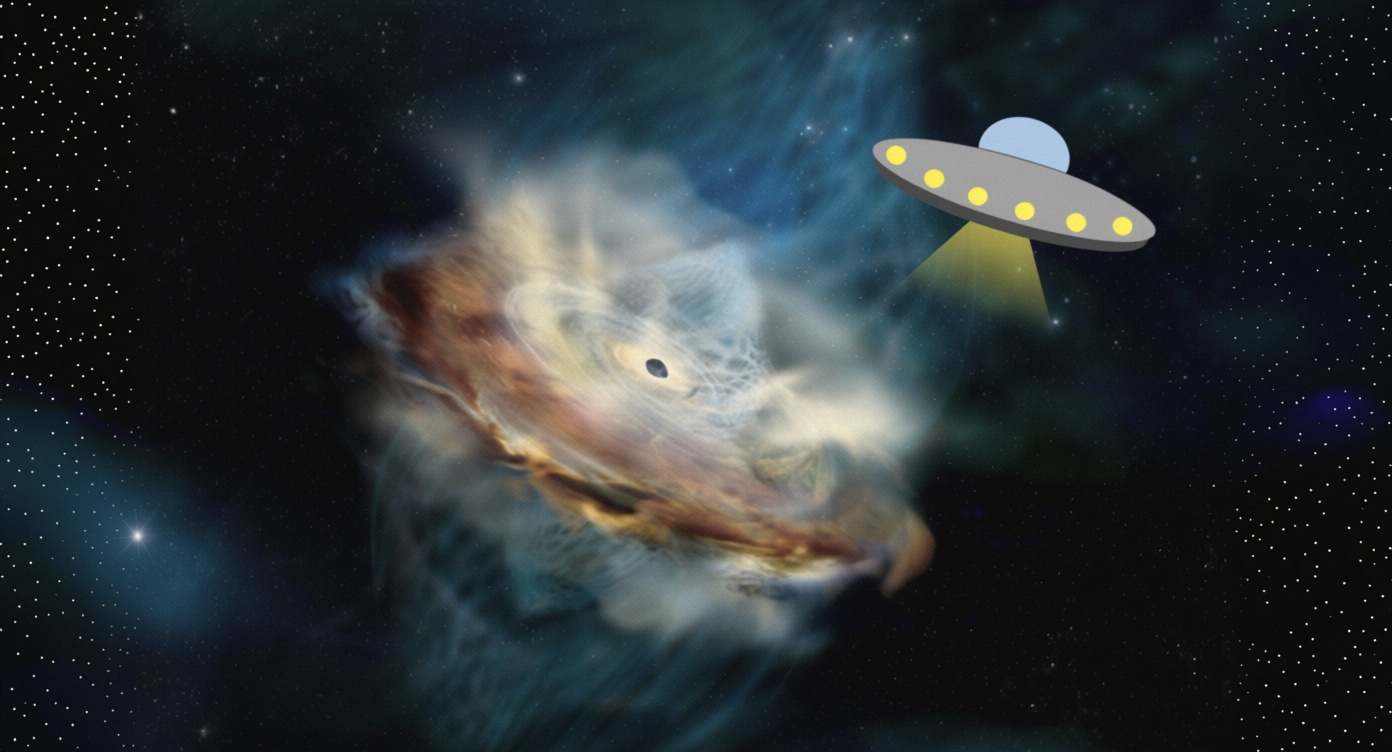
Astrobites has highlighted a new astronomy study reporting what it calls a “UFO sighting in a dead galaxy”—though in this case, UFO stands for ultra-fast outflow, not anything extraterrestrial. The paper, titled “First detection of ultra-fast outflows in a quiescent galaxy,” has been accepted for publication in Astronomy & Astrophysics and is available as open access. The work focuses on KUG 1208+386, a quiescent galaxy that no longer forms stars, making the detection notable because these high-speed winds have previously been identified only in gas-rich, star-forming galaxies.
What Astronomers Found
The study argues that the galaxy hosts an active galactic nucleus powered by a supermassive black hole feeding on surrounding gas and dust. Using observations from XMM-Newton and NuSTAR, the researchers collected five X-ray spectra and compared them with a model of what a normal AGN spectrum should look like. That model accounts for the expected X-ray emission from the accretion disk, along with the effects of material that can absorb or reflect X-rays along the line of sight. When the observed data were subtracted from the model, the residuals showed features that may indicate both an iron (Fe-K) emission line and a strong absorption signature consistent with an ultra-fast outflow.
Why This Matters
Ultra-fast outflows are among the most energetic phenomena associated with black holes. They can launch material at thousands of kilometers per second, injecting energy into the host galaxy and influencing whether stars continue to form. In active galaxies, these winds may expel gas and suppress star formation, helping to “quench” the galaxy over time. In some circumstances, they may also compress gas and briefly trigger new star formation. In a quiescent galaxy, however, the role of such winds has been less clear, which is why this detection could help astronomers better understand how black holes shape the later life of galaxies after star formation has largely shut down.
A New Piece in the Galaxy-Evolution Puzzle
The result is important not because it suggests anything mysterious in the popular sense of a UFO, but because it points to a previously unconfirmed stage of black hole feedback. If verified, the finding would extend the known reach of ultra-fast outflows into a new type of galactic environment and provide a useful test case for theories of galaxy quenching. Researchers are still working out exactly how common these winds are in dormant galaxies and whether they play a decisive role in keeping them inactive. For now, KUG 1208+386 offers a rare laboratory for studying how a black hole may continue influencing its host even after the galaxy has stopped making stars.
Looking Ahead
As presented by Astrobites, the study is a reminder that some of the most dramatic “UFO” headlines in astronomy have nothing to do with alien craft and everything to do with high-energy astrophysics. The detection remains a scientific claim subject to further scrutiny, but it adds an intriguing data point to the study of AGN feedback and galactic evolution. If future observations confirm the outflow, this “dead galaxy” may prove to be far more active than its label suggests.