Overview
A new hypothesis from an astronomer is adding a scientific twist to one of the best-known UFO episodes of the Cold War era. Beatriz Villarroel, whose work has drawn attention in the field of astronomical anomaly research, has proposed that reports of missing stars in archival sky data may help explain at least some of the UFO sightings reported in 1952. The idea does not settle the long-running debate over what witnesses saw that year, but it does offer a fresh way to think about a period when unusual lights in the sky captured public attention and sparked official concern.
A scientific lens on an old mystery
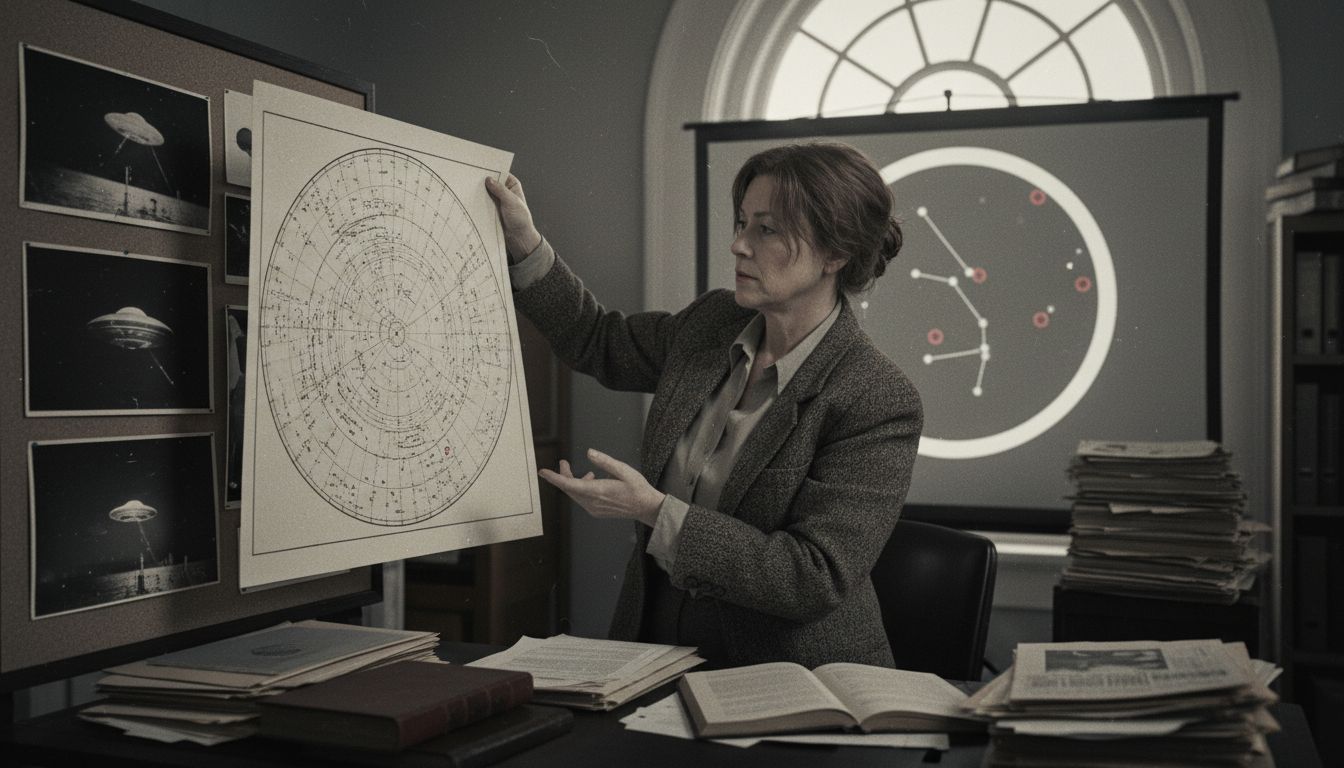
The proposal centers on the possibility that objects or events recorded in older astronomical observations may line up with accounts from witnesses who described strange aerial phenomena. In this view, what later became part of the UFO record may not have been purely anecdotal at all, but could have corresponded to something observable in the night sky that was not fully understood at the time. The key appeal of the theory is that it attempts to connect historical eyewitness reports with archival astronomical evidence, bringing a more data-driven approach to a subject often dominated by speculation.
Villarroel’s work is part of a broader effort by researchers who study transient events and unresolved anomalies in old sky survey plates. Those efforts have increasingly attracted interest from scientists and UFO investigators alike, especially as archives from the mid-20th century are reexamined using modern tools. While such findings do not automatically point to extraterrestrial craft, they can help narrow the range of explanations for historical sightings by identifying whether there were changes in the sky that contemporaries may have noticed but could not explain.
Why 1952 still matters
The year 1952 occupies a central place in UFO history. It was a period marked by a wave of sightings, heightened media coverage, and growing official attention in the United States. The summer of that year, in particular, produced some of the most widely discussed reports of unidentified objects over American cities, including incidents that were later scrutinized by military and civilian investigators. Because those reports came during an era of limited imaging technology and incomplete recordkeeping, the question of what people actually saw remains unsettled decades later.
That uncertainty is part of what makes Villarroel’s idea noteworthy. By suggesting that missing stars or related astronomical anomalies may correspond to some sightings, the theory offers investigators a new category of evidence to examine. It also underscores how modern astronomy can revisit older mysteries with tools that did not exist when the reports were first made. In practical terms, that means historians, astronomers, and UAP researchers may now be able to test old narratives against new forms of analysis.
An open debate, not a final answer
Even so, the hypothesis should be treated cautiously. A connection between missing stars and UFO sightings is not proof of alien visitation, nor does it automatically invalidate other explanations such as atmospheric effects, misidentification, or errors in observation. What it does provide is a plausible scientific framework for reexamining a famous chapter in UFO history. For researchers and the public alike, the significance may lie less in reaching a definitive conclusion than in showing that unresolved sightings can still generate serious inquiry when approached through careful evidence and historical context.