Overview
Harvard theoretical physicist Avi Loeb says he is developing a new observatory designed to investigate Unidentified Aerial Phenomena (UAP) through continuous, automated monitoring of the sky. In a recent NewsNation interview with host Blake Burman, Loeb described a system that would combine radar surveillance with a high-resolution optical telescope, allowing researchers to collect more reliable data on objects that currently remain unidentified.
The proposal comes amid renewed political and public interest in reports from military personnel, including accounts attributed to Air Force pilots. The discussion also followed references to former President Donald Trump’s reported conversations about UFO stories. Loeb emphasized that the central goal of UAP research should be the collection of verifiable evidence rather than reliance on testimony or speculation.
Proposed Observatory
According to Loeb, the observatory is planned for the former residence of astronomer Carl Sagan in Ithaca, New York. The project has received approximately $1.5 million in funding, and Loeb said he recently presented aspects of the proposal at the Pentagon while discussing ways to improve the government’s collection of UAP data.
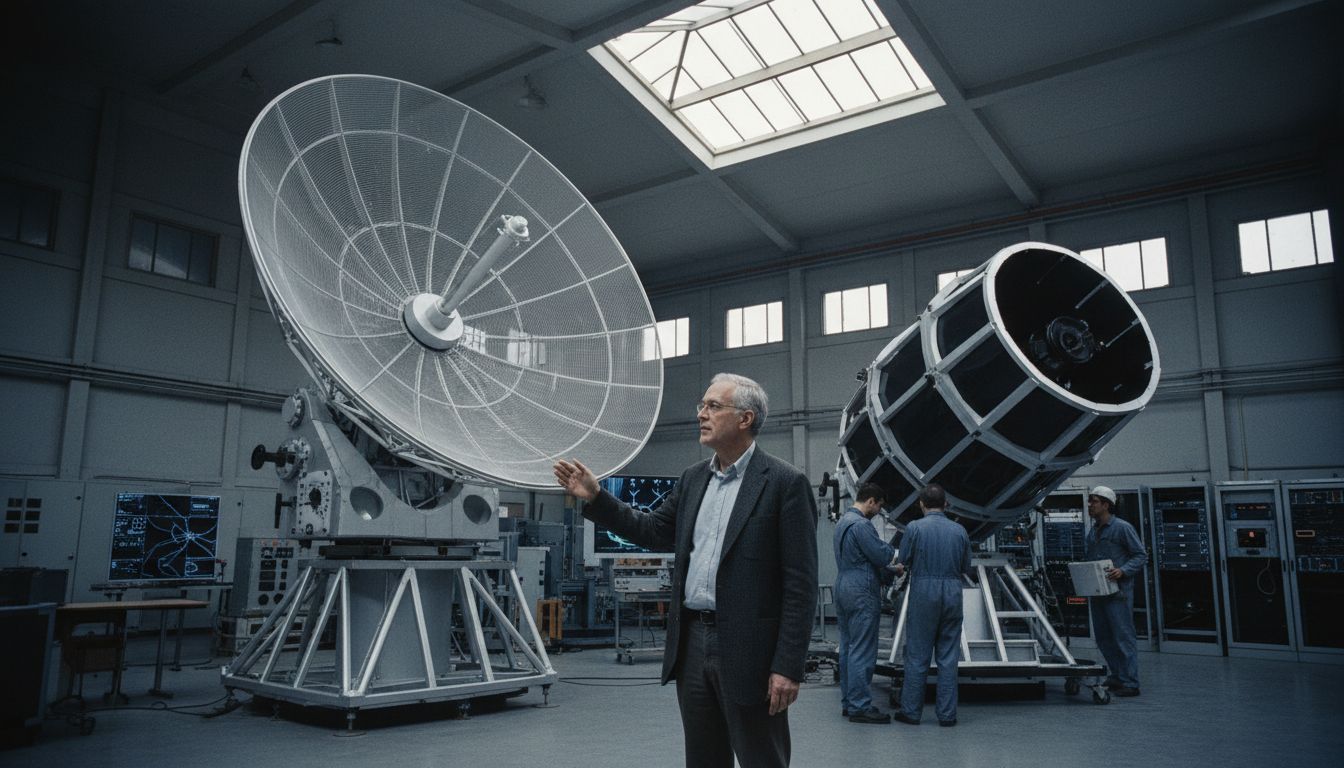
The planned system would continuously scan the sky with a specialized radar. When the radar identifies an unusual object, it would automatically direct a large telescope toward the target. Researchers would then seek to obtain high-resolution images and spectral data, which can reveal information about an object’s physical composition. Loeb has also discussed eventually deploying similar sensor arrays near military installations where personnel have reported recurring unidentified sightings.
Government Claims and National Security
Loeb said allegations that the U.S. government possesses recovered alien spacecraft are familiar to him, but he stressed that he has not personally seen evidence confirming such claims. He also offered a more conventional explanation for some reports, suggesting that unidentified objects could include classified military systems or advanced technology developed by foreign adversaries.
That possibility, he said, makes the issue relevant to national security even when extraterrestrial explanations are not supported by evidence. Loeb characterized UAP research as a bipartisan concern, arguing that the subject combines scientific curiosity with the practical need to identify unfamiliar aircraft and surveillance technologies. He said that any major discovery would ultimately give the sitting president the “privilege of informing all of humanity,” a step he believes could attract support across the political spectrum.
Related Search for Radio Signals
Separately, researchers examining possible signs of extraterrestrial communication have narrowed a large dataset to 25 radio signals from approximately 168 million candidates. The signals originated from 10 regions of the sky considered favorable for communication between technological civilizations. The SETI Institute plans to reexamine the candidates using the Allen Telescope Array.
The signals are not evidence of extraterrestrial activity, and follow-up observations are necessary to determine whether they resulted from astrophysical sources, human-made interference, or data-processing artifacts. As with Loeb’s observatory proposal, the effort reflects a broader move toward systematic, repeatable measurements rather than conclusions based solely on unusual reports.
Scientific Approach
Loeb’s proposal illustrates the growing emphasis on applying conventional scientific instruments to UAP investigations. Automated radar tracking, optical imaging and spectroscopy could help distinguish aircraft, satellites, atmospheric phenomena and sensor errors from objects that genuinely defy immediate explanation. The project’s stated objective is not to prove an extraterrestrial origin, but to produce data capable of testing competing explanations.