Overview
Harvard astronomer Avi Loeb is making a simple but consequential case about unidentified anomalous phenomena: without a reliable distance measurement, it is nearly impossible to determine what a UAP actually is. In a recent Medium post, Loeb argued that the same brief image or video can represent wildly different realities depending on how far away the object is — a nearby bird, a distant balloon, a drone, an aircraft, a meteor, or, in Loeb’s more speculative framing, something of non-human origin. “An unknown object moving across the sky in a fraction of a second could be a nearby bird or a distant artifact of a non-human origin,” he wrote, underscoring how quickly observers can misread apparent motion when range is unknown.
The timing of the argument matters. Loeb pointed to the surge of public interest generated by recent U.S. government UAP releases, which he said have drawn more than 2 billion views, while also highlighting a major limitation in the available data: public UAP reports generally do not include distance estimates. Without that information, he said, it is impossible to calculate speed with confidence — and speed is one of the main clues scientists use to assess whether an object falls within the range of natural events, human technology, or something else entirely. In Loeb’s view, a lack of distance data leaves analysts vulnerable to flawed conclusions based on distorted appearance and perspective alone.
Why Distance Changes Everything
Loeb’s central claim is that distance is the key variable that turns a puzzling sighting into a scientifically useful measurement. He wrote that a single case with an accurately measured distance is “worth more than many cases” of unidentified objects because it allows researchers to infer speed, size, and acceleration with far greater confidence. By contrast, cases without range information can rarely be excluded from ordinary explanations such as bugs, birds, ball lightning, meteors, drones, balloons, aircraft, satellites, or reflections and laser spots. That ambiguity, he said, is exactly why UAP science has struggled to move beyond anecdote and into reproducible analysis.
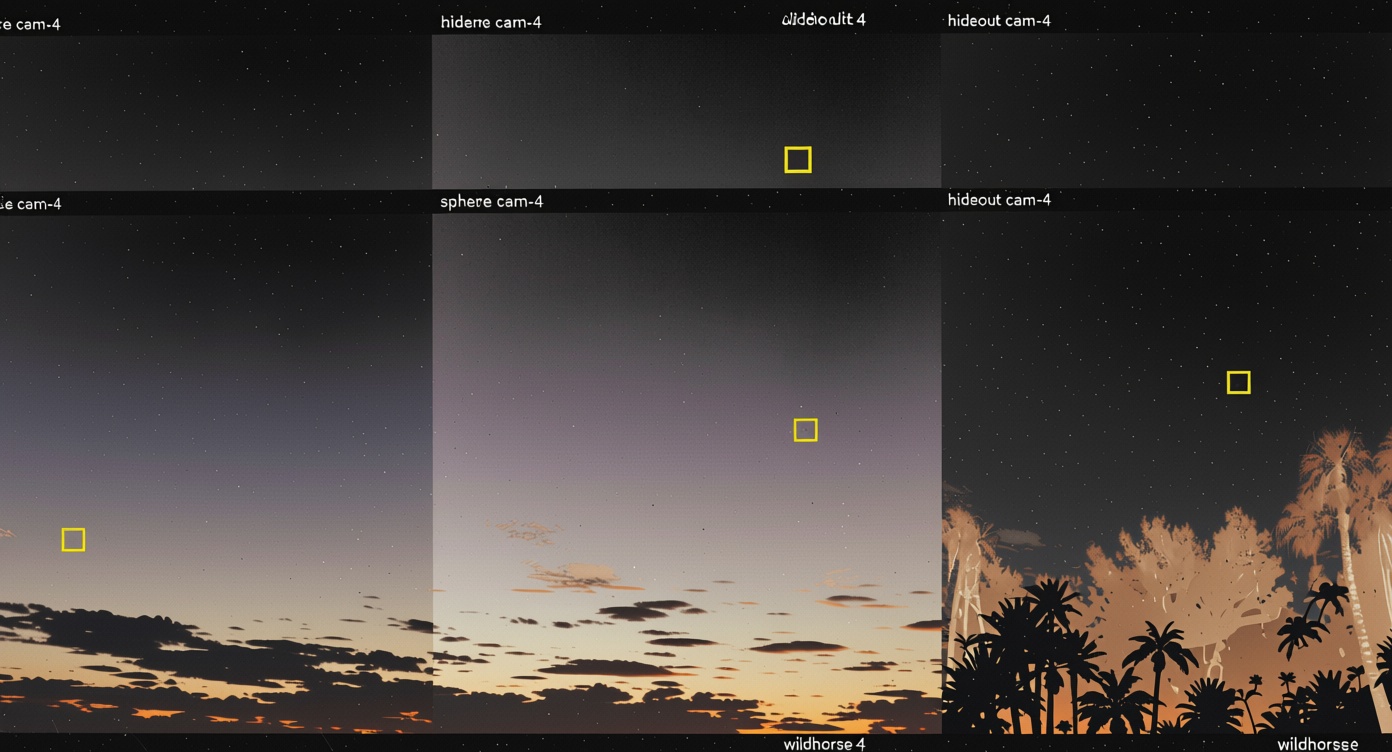
To address that problem, Loeb highlighted the Galileo Project, his initiative aimed at systematically monitoring the sky with a network of sensors. The latest observatory in Las Vegas uses three units arranged in a broad triangle spanning 10.2, 10.1 and 2.0 kilometers, allowing the team to observe the same object from multiple angles and triangulate its distance, velocity, and acceleration. According to Loeb, this multi-sensor setup is designed to do what ordinary cameras cannot: convert a visually ambiguous object into a measurable target.
A Ground-Truth Test in Las Vegas
Loeb illustrated the approach with a recent case analyzed by Galileo postdoctoral researcher Dr. Regina Sarmiento. On May 30, 2026, the observatory detected an object at a triangulated distance of roughly 20–30 kilometers. In this instance, the team was able to match the observation to ADS-B aircraft tracking data, confirming that the object was an airplane and giving researchers a rare “ground truth” benchmark. Loeb said Sarmiento’s analysis showed the triangulated distance was accurate to within a few hundred meters, or a fraction of a percent of the aircraft’s actual separation.
That calibration exercise, while narrow, is central to Loeb’s larger argument. He says it demonstrates that distance measurement is not just an academic detail but the foundation of credible UAP analysis. In his framework, agencies such as the Office of the Director of National Intelligence, the Pentagon’s All-Domain Anomaly Resolution Office, the White House, the FBI and the intelligence community would all benefit from better sensor coverage and more rigorous triangulation methods.
For Loeb and the Galileo team, the message is clear: if scientists and investigators want to understand UAPs, they must first know how far away they are. Without that, the sky can remain a place where perspective creates mystery — and mystery can easily be mistaken for evidence.