Overview
A new Big Data Poll survey is examining a question once reserved for science fiction: how Americans say they would respond if alien disclosure were officially confirmed. The study comes as public interest in UFOs, now commonly referred to by the U.S. government as Unidentified Anomalous Phenomena (UAP), continues to rise amid renewed declassification efforts and ongoing congressional attention. According to the polling firm, the project is the first public study designed specifically to gauge the potential social impact of an official announcement that intelligent life exists and has visited Earth.
The survey builds on Big Data Poll’s annual questions about UFOs and UAP, which it has been asking adults and registered voters since The New York Times first reported on the Pentagon’s Advanced Aerospace Threat Identification Program (AATIP) in 2017. This latest effort was framed around what the poll called the “official act of the U.S. government to end the secrecy surrounding the UFO/UAP subject,” with disclosure defined as confirmation that intelligent life exists and has been visiting the planet.
What the Poll Found
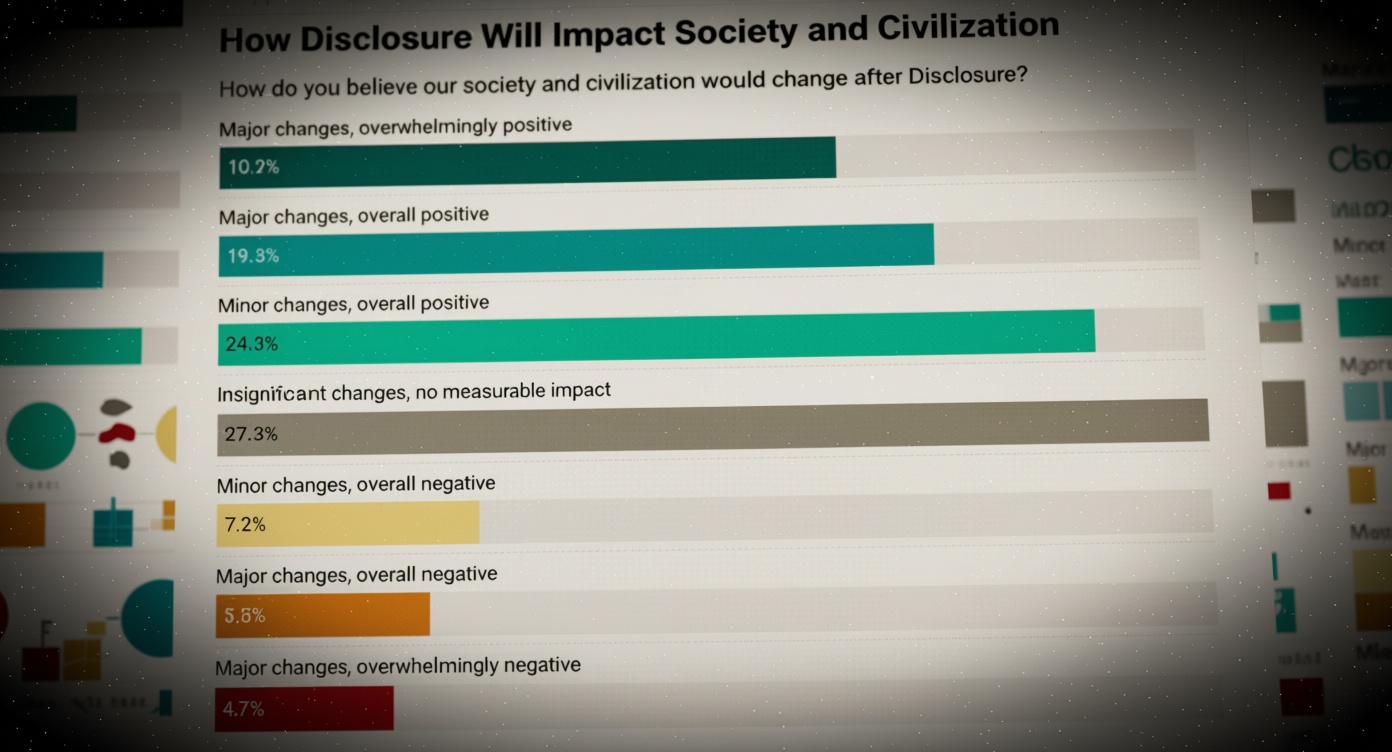
The headline result suggests the public may be more prepared than popular culture assumes. More than 8 in 10 respondents — 82.1% — said alien disclosure would have either a positive impact on society and civilization or no measurable impact at all. Within that group, 54.8% described the outcome as positively beneficial to varying degrees. Big Data Poll Director Rich Baris said the findings challenge “stereotypical assumptions” and undermine prior “doomsday predictions” tied to a hypothetical disclosure scenario.
Baris added that the data painted “a clear enough picture” to suggest those older predictions may be outdated, or perhaps were never well grounded in the first place. The poll’s framing reflects a broader shift in the public conversation, where UFOs and UAP are increasingly discussed not just as a matter of curiosity, but as a potential national-security and transparency issue. That shift has been amplified by recent government efforts to release historical records and by growing media attention to whistleblower claims.
How Americans Say They Would Believe It
The survey also explored a more personal question: what would it take for Americans to believe disclosure was real? Here, the responses suggest skepticism remains, but not necessarily disbelief. Big Data Poll found that party affiliation and sex were more predictive than other demographic factors in determining whether people would accept a presidential confirmation as sufficient evidence. Only about 2 in 10 respondents said they would never believe disclosure as described in the hypothetical scenario.
That figure is notable because it closely mirrors the share of respondents who said they do not believe intelligent life exists elsewhere in the universe, along with another roughly equivalent group that remains uncertain. Baris summarized the dynamic with a succinct observation: “Seeing is definitely believing.” In other words, while many Americans may be open to the idea of disclosure, the public still appears to want evidence that goes beyond official statements alone.
Military Witness Accounts and Broader Implications
The survey also touches on one of the more persistent claims in the UAP debate: that active-duty service members and veterans report seeing anomalous objects at higher rates than civilians. Big Data Poll says its findings are consistent with past years of its research, showing that military personnel and veterans report witnessing UFOs or UAP more often than the general public. Baris said that lends credibility to testimony by former military and intelligence officials who have appeared before Congress in recent years.
Among the most striking data points: only about 1 in 10 members of the U.S. military — 10.8% — said they had never witnessed a UFO/UAP and neither had anyone they knew, suggesting firsthand or secondhand familiarity with the subject may be more common in military circles than in the broader population. While the poll does not prove what those sightings were, it adds another layer to the growing body of public opinion research surrounding UAP. For policymakers, the takeaway may be less about alien life itself and more about how prepared Americans say they are for the possibility of a confirmation that would reshape science, security, and public trust at once.