Overview
A blog post published October 5, 2026, presents a science-fiction scenario in which a coalition of technologically advanced extraterrestrial explorers is mistaken for divine beings after a catastrophic arrival on Earth. Titled “Driven Completely Mad by the Neurobiological and Psychosocial Costs of Entry, the Gods Were a Diverse Coalition of Highly Advanced Explorers,” the piece combines space-opera imagery with a psychological interpretation of ancient religious traditions. It was shared in the broader online conversation around #aliens and #scifi, according to the source material.
The post is written as speculative fiction rather than a report of a documented event. Its central premise is that the beings later remembered as gods were not supernatural entities, but members of a multi-species coalition of explorers, geneticists and stellar architects. Their civilizations, the narrative says, had adapted their bodies and minds to shielded interstellar environments, low-gravity worlds and technologically controlled habitats. Earth, intended as a research site, instead becomes an extreme and destabilizing environment.
The Cost of Arrival
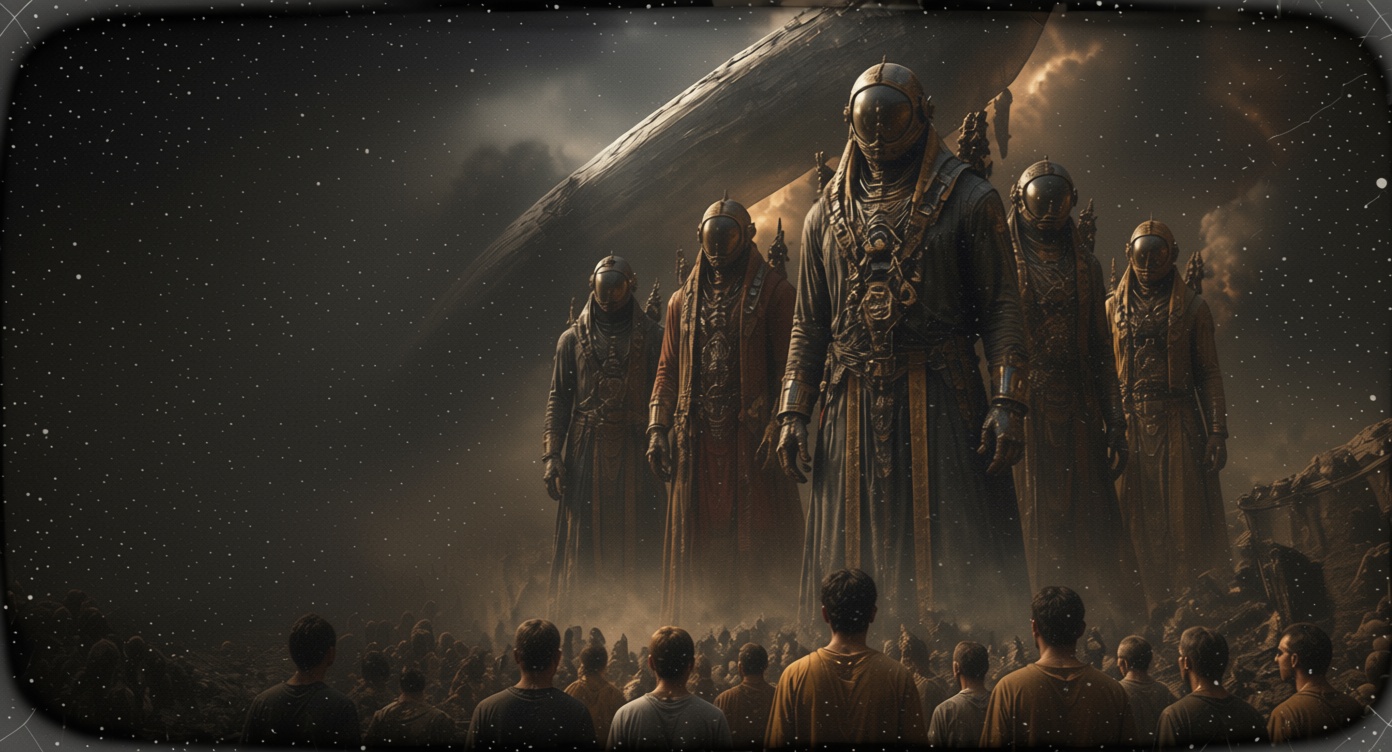
The story describes atmospheric entry as a form of neurological trauma. The coalition’s vessels, portrayed as enormous silver-hulled craft, encounter Earth’s gravity, atmosphere and magnetosphere as forces their biology and implants were not designed to withstand. The post uses deliberately dramatic language, calling the descent “a violent neurological execution” and depicting oxygen toxicity, pressure changes and electromagnetic interference as causes of widespread cognitive failure.
That fictional mechanism culminates in what the narrative calls “Entry-Induced Dissociative Psychosis.” The explorers’ memories, identities and operational protocols supposedly collapse as their neural systems malfunction. Emerging from crashed vessels, they encounter early humans while retaining fragments of advanced technology but losing any clear understanding of their origins. The resulting confusion allows the survivors to interpret—or misinterpret—their own capabilities as evidence of omnipotence.
The concept reflects familiar science-fiction themes involving first contact, technological misunderstanding and the psychological consequences of radical environmental change. It also borrows terminology from psychiatry and neuroscience, though the post does not cite clinical research or present evidence that such a condition exists. In real-world medicine, psychosis and dissociation are complex conditions with multiple possible causes; the story’s explanation should therefore be understood as a literary device rather than a scientific hypothesis.
Gods Recast as Survivors
According to the post, the aftermath becomes “thousands of years of a planetary asylum masquerading as divine history.” The amnesiac visitors establish early pantheons while their behavior is shaped by unresolved neurological damage and trauma. Their advanced equipment remains incomprehensible to the humans who encounter it, reinforcing the appearance of supernatural power.
One figure, identified as Enlil, is described as the expedition’s commander. The excerpt portrays him as suffering severe psychological fragmentation and developing manic, tyrannical paranoia. He demands absolute obedience from the local population, illustrating the article’s broader argument that apparent divine authority could be interpreted as the product of trauma, fear and distorted cognition. The source excerpt ends while introducing Enlil’s view of humanity, leaving the larger development of the character and coalition unclear.
Context and Interpretation
The blog post’s appeal lies in its fusion of ancient-gods imagery with speculative neurobiology. Rather than treating contact with advanced beings as an uncomplicated technological breakthrough, it imagines contact as mutually destabilizing: humans misunderstand the visitors, while the visitors are physically and psychologically overwhelmed by Earth. The premise reverses the conventional “advanced beings arrive to guide humanity” narrative, suggesting that superior technology does not guarantee emotional stability, cultural understanding or resilience.
No independent evidence accompanies the post, and nothing in the source establishes that extraterrestrial visitors, ancient astronauts or divine beings existed in the historical record. Its claims function within a fictional and philosophical framework, inviting readers to consider how societies might mythologize unfamiliar technology—and how contact with an advanced phenomenon could produce psychological, social and political consequences far beyond the initial encounter.