Overview
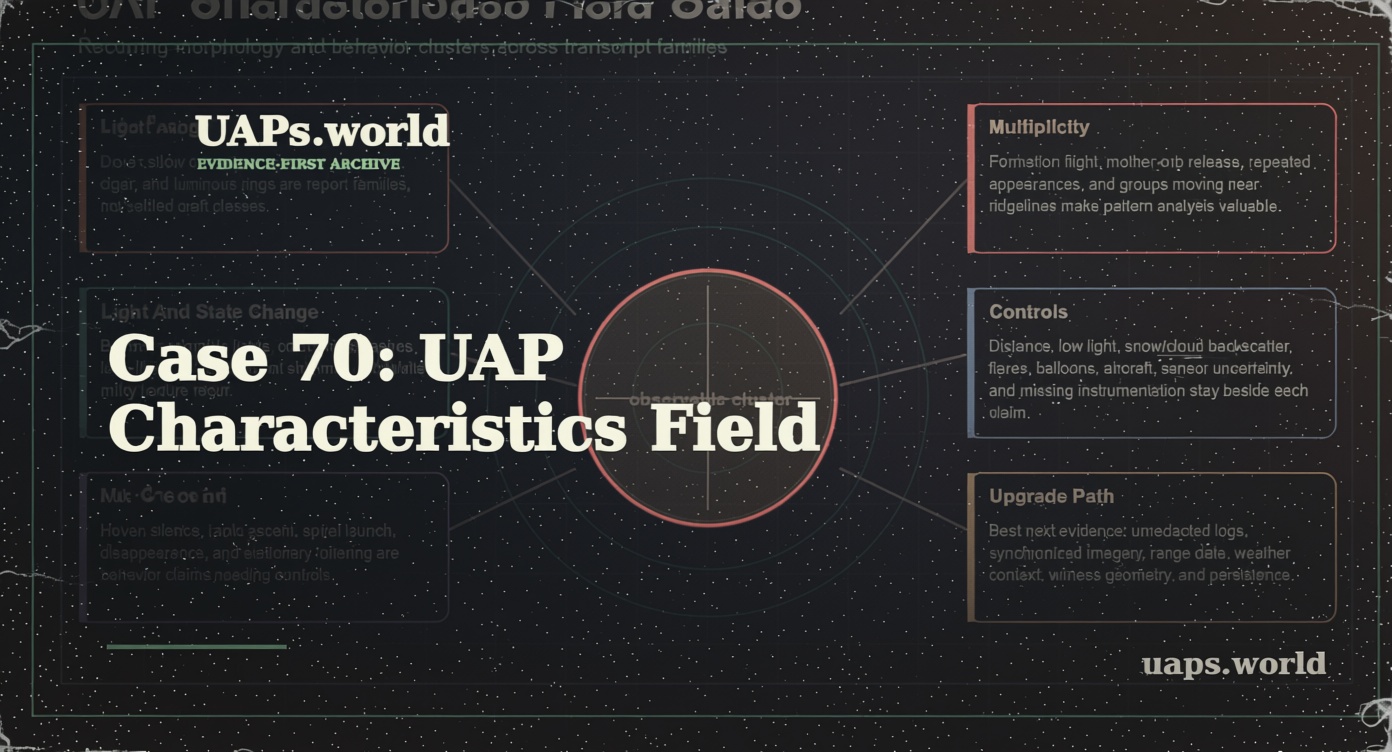
A new public-facing resource labeled “Case 70: UAP Characteristics Field Guide” is positioning itself as a reference hub for people tracking unidentified aerial phenomena through records, media, and open-source analysis. Hosted on UAPs.world, the page presents itself less as a conventional article and more as an investigative workbench, combining archived material, categorized evidence, and analysis tools into a single interface for public review. The emphasis is on documentation and classification, not speculation, with the site inviting users to move through videos, audio, photos, documents, maps, time-based data, and AI-assisted analysis.
What the Field Guide Offers
The source page shows that the field guide is built around a broad investigative archive rather than a single case file. Navigation links direct users to an UAP archive, Public UAP Field Desk, Declassified UAP videos, UAP documents, AI analysis, and Official UAP records. That structure suggests a project aimed at helping researchers, journalists, and citizen investigators compare raw material across multiple channels. The page also displays a range of labels and collection categories — including “X-Files,” “Classified,” “Legacy Program,” “Matrix,” “Dark Skies,” “Sky Watch,” “Field File,” and “S4 Sport Model” — indicating a thematic system for sorting content, though the page itself does not spell out the meaning of each category. In practical terms, the site appears designed to make UAP material easier to retrieve, review, and cross-reference.
Tools for Public Investigation
The interface includes a number of workflow tools that underline its investigative intent. Users can access classify controls, open the original source, and use functions such as share exact spot, deep link, and briefing. The page also references Local public mode, suggesting a version of the workbench intended for open access rather than restricted review. This kind of layout is increasingly common in digital research environments, where evidence can be tagged, shared, and assessed in real time. While the page does not present specific incident details in the text shown, the architecture itself reflects a growing push in UAP research toward transparency, reproducibility, and public verification.
Why It Matters
The release of a field-guide style resource matters because UAP reporting has long been hampered by fragmented records, inconsistent terminology, and limited access to source material. By centralizing evidence types and linking directly to official records and declassified content, UAPs.world is attempting to reduce that friction. The inclusion of AI analysis alongside archives and documents also reflects a broader trend in investigative media: using machine-assisted tools to sort large volumes of material while keeping the underlying sources visible to the public. For a subject that often attracts rumor and exaggeration, a resource built around evidence handling and documentation could help anchor discussion in verifiable material.
Broader Context
The Case 70 field guide does not claim to solve the UAP mystery, and the page offers no dramatic conclusions of its own. Instead, it functions as a public investigation platform — a place where users can study evidence, compare records, and evaluate claims with the help of organized archives and analysis tools. That restraint may be its most notable feature. In a field often dominated by sensational headlines, the emphasis on records, original sources, and methodical classification suggests a more disciplined approach to one of the most persistent questions in modern aerospace and intelligence reporting.