Overview
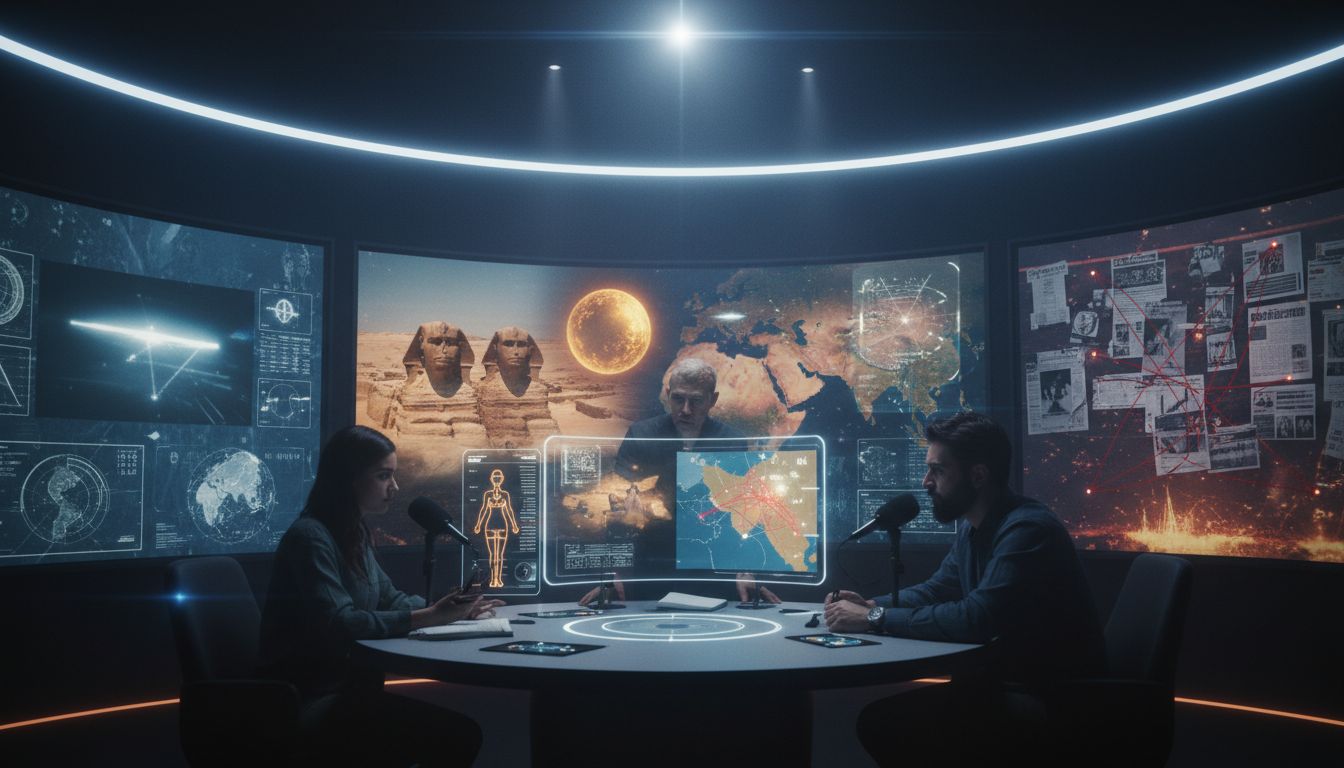
The “Total Disclosure” podcast, hosted by investigative journalist Ty Roberts, aired a segment titled “The Lady” that examines the convergence of several high‑profile events in 2026 with the long‑standing prophecies of UFO experiencer Chris Bledsoe. The episode links a recent escalation between Iran and Israel, an unprecedented spike in fireball sightings, and a controversial archaeological claim about a “second Sphinx” to Bledsoe’s predictions of a transformative moment for humanity. While the program presents these coincidences as suggestive, it stops short of asserting causality, instead inviting listeners to consider whether the timing reflects a broader shift toward greater transparency about unidentified aerial phenomena (UAP).
The Bledsoe Prophecy
Chris Bledsoe, a North Carolina contractor who first reported a close encounter near the Cape Fear River in 2007, claims to have received messages from an entity he calls “The Lady.” According to Bledsoe, this figure foretold a “pivotal shift” tied to a specific celestial event: the star Regulus turning red as it aligns with the Sphinx, projected to occur around Easter 2026. The prophecy also warned of a “missile war” involving Iran and Israel and an increase in UAP activity preceding the alignment. Bledsoe’s narrative has been documented in his book UFO of God and has attracted a niche following among UFO researchers and spiritual seekers.
Recent Developments in 2026
Roberts highlights three developments that appear to match Bledsoe’s timeline.
Military escalation: In late February and early March, U.S. and Israeli forces conducted coordinated strikes on Iranian nuclear sites. Iran responded with a large‑scale ballistic missile and drone campaign that struck Israeli cities, including Haifa and Tel Aviv. The confrontation, described by analysts as the most intense “missile exchange” in the region in decades, aligns with the prophecy’s reference to a “missile war.”
Astronomical anomalies: The American Meteor Society recorded more than 2,300 fireball events across the United States in March 2026—an unprecedented surge. Some eyewitness reports noted atypical behavior such as sudden deceleration and apparent directional control, fueling renewed public interest in UAP phenomena.
Archaeological claim: Italian radar engineer Filippo Biondi, working with the Cafre Research Project, announced an 80 % confidence level in detecting a subsurface anomaly near the Khafre pyramid at Giza. The team suggests the anomaly could represent a buried “second Sphinx,” a claim that resonates with Bledsoe’s emphasis on the Sphinx’s role in the foretold shift. The scientific community remains skeptical, citing the need for further excavation and peer‑reviewed analysis.
Government Disclosure Efforts
The episode also surveys recent U.S. policy actions that could signal a move toward greater openness about UAPs. Former President Donald Trump issued an executive directive to former Defense Secretary Pete Hegseth to accelerate declassification of extraterrestrial‑related files. In Congress, Representative Anna Paulina Luna (R‑FL) is reported to be leading a “Secret Task Force” aimed at compelling disclosure, and the White House recently registered the domains alien.gov and aliens.gov. Additionally, the disappearance of retired Air Force Major General William Neil McCasland—who had extensive experience with advanced aerospace programs—has been cited as a “mysterious” event that underscores the heightened attention on classified research.
Context and Assessment
While the alignment of these events with Bledsoe’s 2026 prophecy is striking, experts caution against drawing definitive conclusions. Dr. Emily Harris, a professor of aerospace policy at the University of Colorado, notes that “military escalations in the Middle East and spikes in fireball reports are both statistically plausible within a single year; their coincidence with an esoteric prediction does not, on its own, prove a causal link.” Likewise, archaeologists emphasize that “subsurface radar anomalies require rigorous verification before any claims of a hidden monument can be accepted.”
Nevertheless, the combination of heightened geopolitical tension, increased public scrutiny of UAP sightings, and a series of legislative and executive initiatives does suggest a growing willingness among governments to address previously classified subjects. As Roberts concludes, whether driven by “divine prophecy” or “scripted geopolitical unfolding,” 2026 may indeed become a pivotal


