Overview
Newly recovered and colorized photographs tied to the alleged early-1980s encounters of Japanese contactee Takeo Kobayashi have been added to an online UFO archive, bringing fresh attention to one of the lesser-known cases in postwar Japanese UFO lore. The material, compiled by archivist and author Albert S. Rosales and expanded with additional recovered images, documents claims that Kobayashi documented unusual aerial activity and a purported close encounter near Yakumo Town, Hokkaido, over a span of years in the late 1970s and early 1980s.
According to the archive entry, Kobayashi was an architectural designer whose interest in UFOs reportedly began after he witnessed a craft maneuvering above his home. He later referred to an elevated observation point near Yakumo as “UFO Ginza,” a place he said offered repeated views of anomalous activity. Over time, he allegedly amassed tens of thousands of photographs of the skies above the area, making his case notable not only for the incident narratives but also for the volume of imagery associated with them.
The August 1981 encounter
The most striking episode highlighted in the archive centers on the evening of August 14, 1981, when Kobayashi reportedly saw a large luminous object at around 8:00 p.m. while observing from a pasture in the Yakumo area. He claimed that the object illuminated the white wall of a farmhouse below it, though no ordinary source of light was identified. Soon afterward, he noticed something moving on the ground roughly 200 to 300 meters away.
Kobayashi described the figure in unusual terms, initially likening it to “a cow wearing a hat” before concluding it looked more like a robot. Using a 750 mm telephoto lens, he said he could distinguish a small head, two eye-like features, and an inverted triangular detail on the chest. He also reported that the upper portion of the figure moved independently from the lower section, while rod-like structures extended toward the ground and two rounded shapes appeared at the base. He said he observed and photographed the figure for approximately 20 minutes, after which both the figure and the luminous object in the sky vanished at nearly the same time.
Newly added images and archive expansion
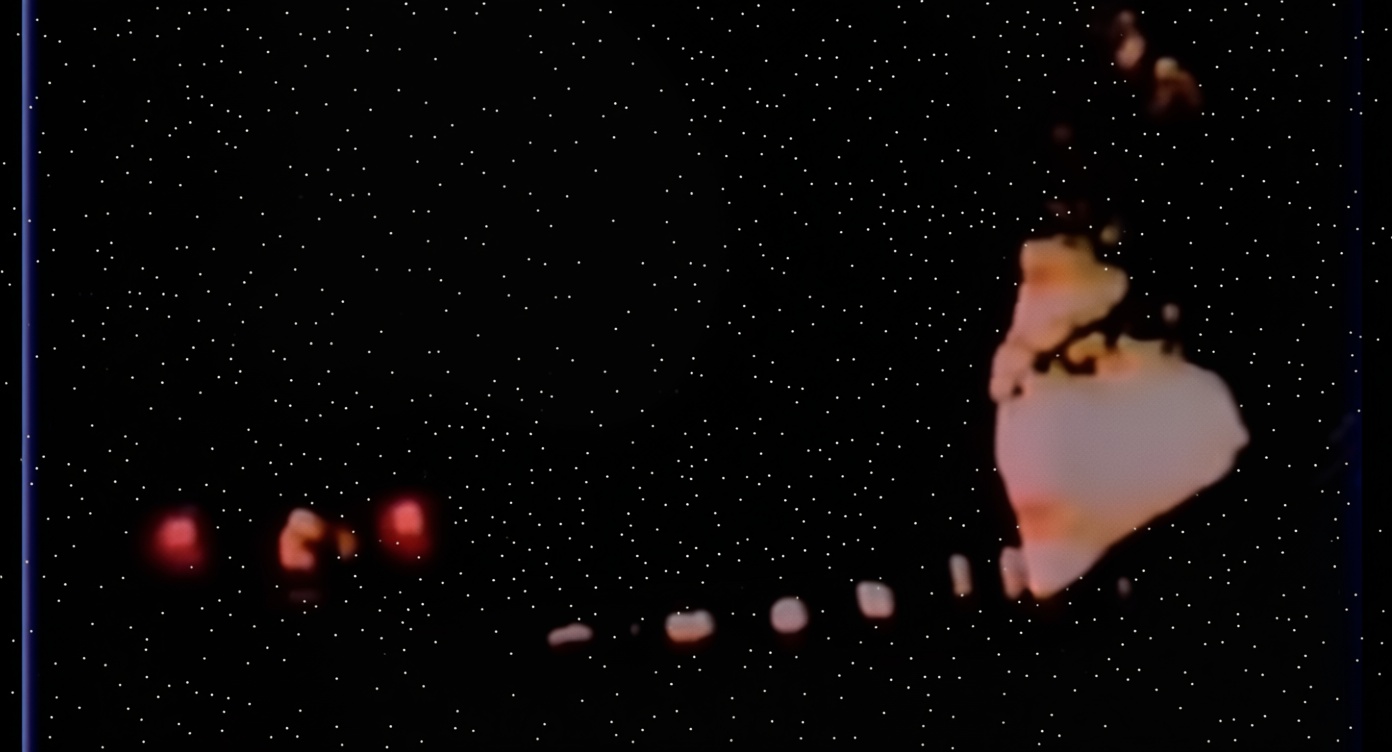
The online archive now includes newly recovered imagery and colorized versions of earlier photographs, giving viewers a clearer presentation of the material as it is currently being preserved. One image has also been presented in a brightness-adjusted version, suggesting the archivist’s effort to make the original frames more legible for analysis. While the photographs are being circulated within UFO research circles as part of a historical case file, they remain tied to Kobayashi’s own account and have not been independently verified by mainstream scientific institutions.
Rosales, who specializes in cataloging lesser-known UFO and “UFOnaut” cases, is credited in the archive for helping surface the material. The new additions are framed less as proof than as documentation—preserving an unusual body of evidence connected to a contactee narrative that has long circulated on the margins of Japanese ufology.
Why the case matters
Cases like Kobayashi’s occupy a complicated space in UFO history. They combine eyewitness claims, photography, and local geography with questions about interpretation, authenticity, and memory. For researchers, that makes them valuable archival records even when the underlying claims remain disputed. The Yakumo photographs, especially with the newly recovered and colorized images now online, add a visual dimension to a story that has been largely confined to specialist circles.
At minimum, the archive underscores how much of UFO history still depends on the preservation of private collections, obscure publications, and the work of dedicated archivists. Whether Kobayashi’s photographs depict something extraordinary or simply reflect a personal interpretation of ambiguous events, the case continues to attract interest because it blends a persistent eyewitness narrative with a rare, extensive photographic trail.