Overview
A California aerospace startup is testing a concept that could bring artificial daylight to parts of Earth after sunset—while raising concerns about light pollution, astronomy and the possibility of future observations being mistaken for UFO or UAP activity. Reflect Orbital recently demonstrated its proposed “sunlight-as-a-service” system by using powerful ground-based spotlights to imitate the illumination that would eventually be produced by satellites carrying large mirrors.
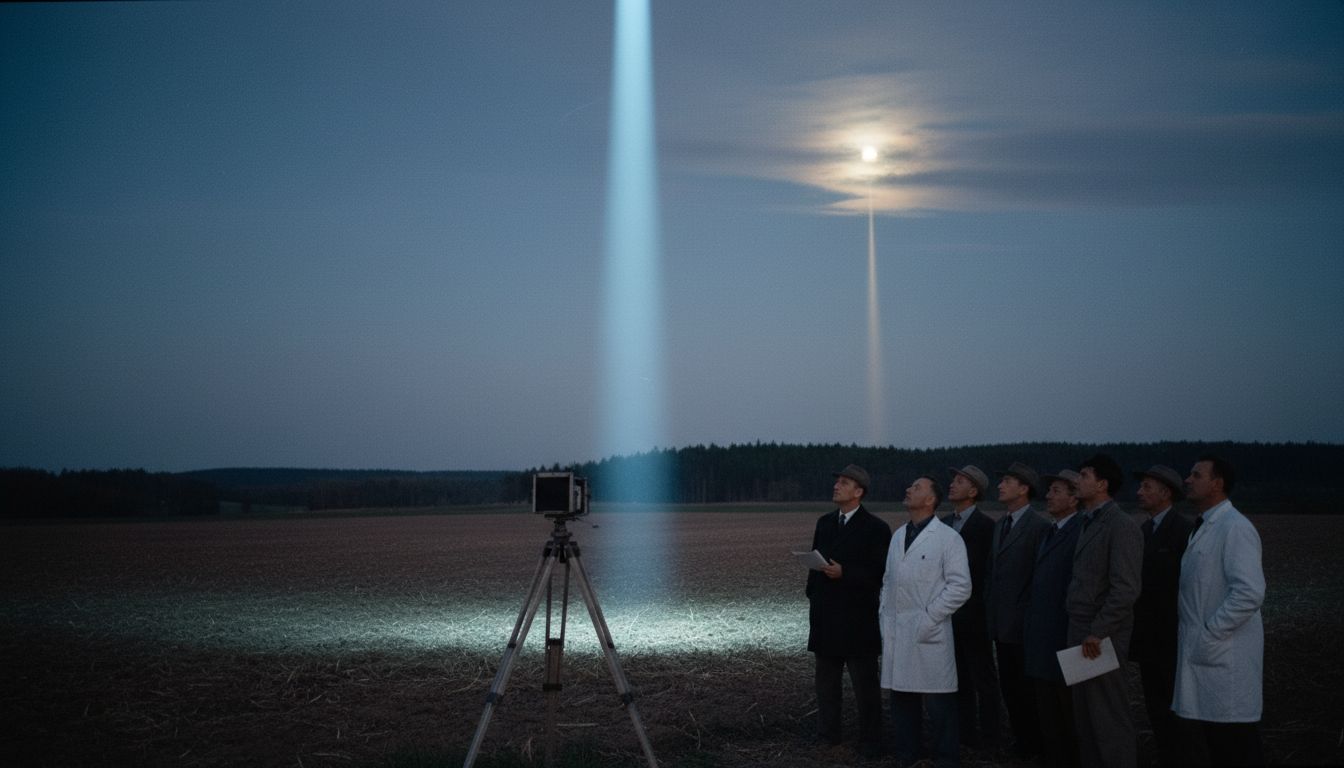
The demonstration took place on October 10 near Lone Pine, California. Residents of nearby Independence, a town of roughly 700 people, reported seeing a mountainside unexpectedly lit after dark. Hayley Carter, an Inyo County office technician, told Sky & Telescope that she and her husband initially assumed the light came from a film production. They later learned that Reflect Orbital had been testing its ability to illuminate an area more than 20 miles away.
How the Proposed System Would Work
Reflect Orbital envisions a network of approximately 50,000 satellites orbiting about 625 kilometers, or 388 miles, above Earth. Each spacecraft would carry a large deployable mirror designed to reflect sunlight toward the ground, producing a beam roughly five kilometers wide.
According to the company’s proposal, an individual satellite would be able to illuminate a location for about four minutes before moving beyond the horizon. Another satellite could then take over, potentially creating a continuous sequence of illumination. Reflect Orbital says customers could adjust the brightness from what it describes as “noon light to moon light,” and that the system could be programmed to avoid designated locations such as observatories.
The company has identified several possible applications, including extending the operating hours of solar-power installations, supporting search-and-rescue missions and assisting disaster-response teams working at night. It has also suggested using the reflected light at industrial sites or to influence crop growth.
Astronomers Raise Environmental and Safety Concerns
Astronomers and environmental advocates question whether the proposed benefits justify the consequences of placing thousands of artificial light sources in orbit. Even if a beam were aimed away from an observatory, researchers warn that scattered and diffuse light could brighten large areas of the night sky. That could interfere with ground-based optical and infrared telescopes, making it more difficult to observe faint objects and rapidly changing phenomena.
Amateur astronomers may face additional risks. The source report notes that an unexpectedly bright beam passing through a sufficiently large telescope could cause permanent eye damage, particularly if an observer were looking through an instrument with an aperture greater than 12 inches. Critics also warn that nighttime illumination could disrupt nocturnal animals and expand light pollution into remote areas that have remained relatively dark.
“There’s no nice way of doing this,” astrophysicist Gaspar Bakos of Princeton University said, describing automatic sunlight as “essentially ignoring all the progress we have made for the past many decades in bringing awareness to and decreasing light pollution.”
Potential Implications for UAP Reports
The proposal could also complicate the interpretation of unusual lights in the sky. Reflected sunlight from orbiting satellites may appear suddenly, move across the landscape or illuminate terrain without an obvious source on the ground. If such events occur without advance public notice, observers could interpret them as unexplained aerial phenomena.
That does not mean satellite reflections would represent extraterrestrial activity. Rather, the expansion of commercial space-based lighting could create a new, identifiable source of reports that initially appear mysterious. Clear notifications, tracking data and coordination with astronomers and local communities would likely be essential if the technology advances beyond testing. Reflect Orbital’s demonstration shows that even a ground-based simulation can surprise residents; a global satellite network could make such events considerably more common.