Overview
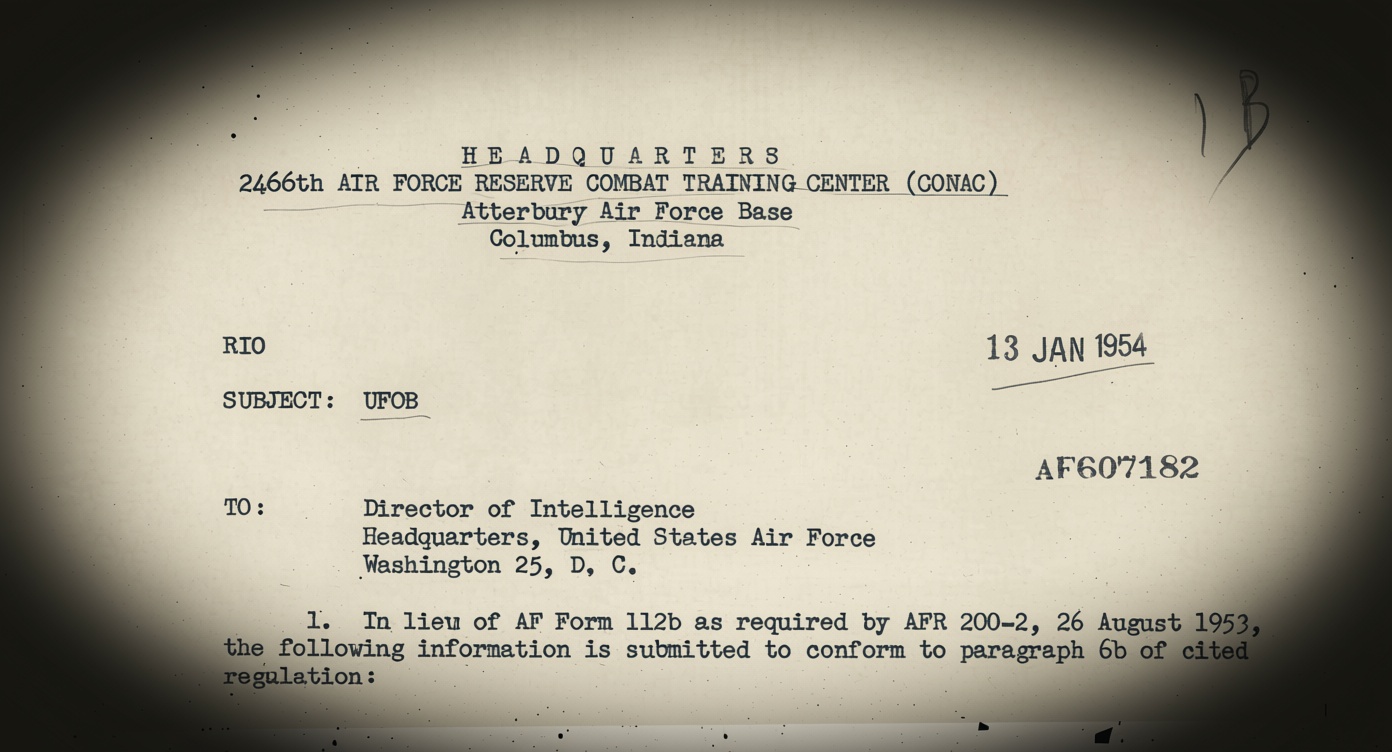
A newly circulated document from Tranche 7 of PURSUE reportedly records a 1953 unidentified flying object encounter involving an Indiana chemist and his wife. According to the available summary, the account was transmitted through U.S. Air Force intelligence channels and ultimately reached senior government officials. The document’s emergence adds another case to the growing body of mid-20th-century UFO reports preserved in military and intelligence records.
The reported incident took place during a period of heightened official interest in unexplained aerial sightings. In the early 1950s, the Air Force was collecting and assessing reports from military personnel and civilians amid Cold War concerns about possible foreign aircraft, new aviation technology and other unidentified phenomena. Civilian witnesses with technical or scientific backgrounds were sometimes considered particularly useful because investigators believed they might provide detailed, disciplined observations.
What the Document reportedly Shows
The summary identifies the witnesses as an Indiana-based chemist and his wife, but it does not provide their names, the precise location of the sighting or the date and time of the observation. It also does not describe the object’s appearance, movement, duration, lighting or distance. Those omissions make it impossible to independently evaluate the account or compare it with other 1953 reports.
What is clear from the available information is the path the report allegedly followed. The witnesses’ account was forwarded through Air Force intelligence channels before reaching senior officials, suggesting that it was considered sufficiently notable—or sufficiently relevant to national-security concerns—to be circulated beyond an initial local or regional review. However, the document’s transmission through official channels does not establish that the reported object was extraterrestrial or even that it represented an advanced aircraft.
Investigation and Unanswered Questions
The available source material provides no conclusion from Air Force investigators. It is unknown whether officials interviewed the couple, sought corroborating witnesses, examined weather or aviation records, or compared the report with radar observations. There is likewise no indication of whether the case was classified, closed as an identified conventional object, or left unresolved.
Those missing details are significant. A reliable assessment of historical UFO cases depends on the original testimony, contemporaneous records, chain of custody and investigative findings—not simply on the fact that a report was passed to senior personnel. Without the full document and supporting files, the 1953 encounter should be treated as a reported historical case rather than verified evidence of unusual technology.
Broader Context
The case comes amid renewed public interest in declassified U.S. government records concerning unidentified aerial phenomena. Researchers have increasingly examined archival reports to understand how military organizations handled unusual sightings and how information moved through bureaucratic systems. Such records can illuminate official procedures even when they do not resolve what witnesses observed.
The source page identified for the report was not accessible for independent review at the time of writing and displayed a robot-verification screen. As a result, the account’s details cannot be independently confirmed from the underlying material provided here. Further reporting would require the complete PURSUE Tranche 7 document, including any witness statements, forwarding memoranda and investigative conclusions. Until those records are available, the Indiana chemist’s encounter remains an intriguing but incompletely documented entry in the history of U.S. UFO reporting.