Overview
A recent documentary-style video from Beyond the Official Story revisits one of the Andes’ best-known archaeological landmarks, Machu Picchu, and argues that the site may contain clues to a more complicated construction history than the standard narrative allows. Built at roughly 2,400 meters above sea level in southern Peru, Machu Picchu is widely attributed to the Inca ruler Pachacuti in the 15th century and is generally understood by archaeologists as a royal estate, ceremonial center, or religious sanctuary. The video does not dispute that Machu Picchu is an Inca site, but it pushes viewers to reconsider whether the Incas were the sole originators of its most advanced stonework.
Contrasting Masonry Styles
The central argument presented in the video focuses on what it describes as a striking “historical anomaly”: two visibly different standards of masonry coexisting within the same city. On one hand, some walls are built from smaller, irregular stones that appear consistent with practical construction. On the other, there are sections made from massive blocks fitted with extraordinary precision, reportedly without mortar, and designed to withstand centuries of earthquakes and heavy rainfall. The documentary frames this contrast as more than an architectural choice, suggesting it may indicate a layered building history rather than a single, unified construction campaign.
The “Technical Regression” Claim
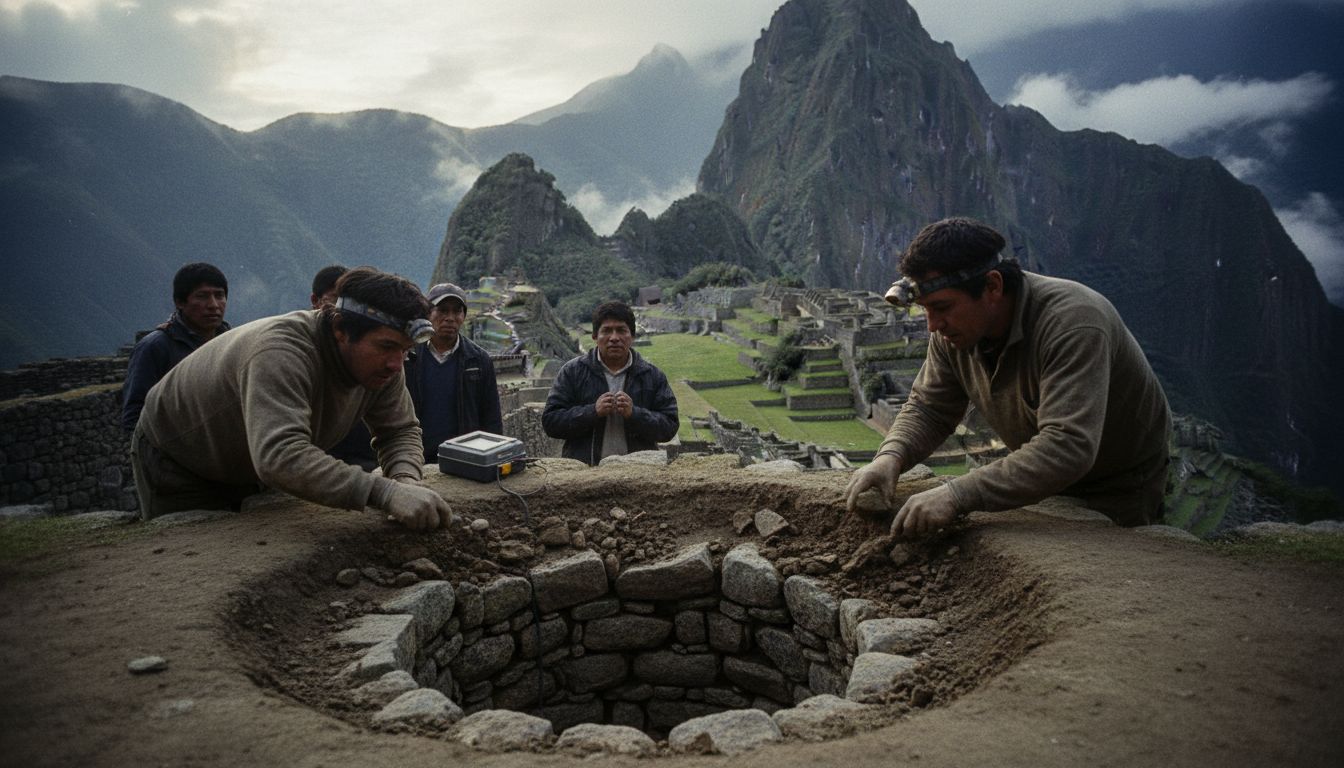
A more controversial part of the video is its discussion of “technical regression”—the idea that some of Machu Picchu’s oldest or deepest stone layers may actually show a higher degree of sophistication than later additions placed above them. The program cites 3D scanning work as evidence that some underground or foundational structures display unusually refined fitting and alignment. In the video’s telling, this challenges the conventional assumption that technology steadily improves over time. Instead, it raises the possibility that later builders may have inherited, adapted, or simplified techniques from an earlier tradition whose full extent has not yet been reconstructed.
Hidden Engineering and Broader Context
The documentary also emphasizes that Machu Picchu’s most impressive features are not always visible at ground level. Beneath the terraces, it points to a sophisticated network of drainage systems, including layers of stone and gravel designed to manage intense Andean rainfall. It further notes that the site appears to have been built in close relationship with the region’s geology, including natural fault lines that may have helped with both stone extraction and water management. Beyond the engineering, the video cites recent genetic research suggesting that the people who lived at Machu Picchu came from diverse parts of the Inca world, including the Amazon basin and coastal regions. It also highlights the Intihuatana Stone, long associated with solar observation and seasonal tracking, as evidence of advanced astronomical knowledge.
What the Video Leaves Open
While the documentary frames these findings as evidence that Machu Picchu may rest on an older architectural legacy, its claims remain interpretive rather than conclusive. Mainstream archaeology continues to identify the site as an Inca achievement, shaped by a highly capable civilization with substantial engineering skill. Still, the video taps into a genuine area of scholarly interest: how ancient societies built with such precision, how knowledge was transmitted or lost, and whether some monumental sites preserve traces of earlier traditions. For now, the strongest conclusion is not that Machu Picchu’s story has been overturned, but that it continues to provoke serious questions about the sophistication of ancient Andean engineering.