Overview
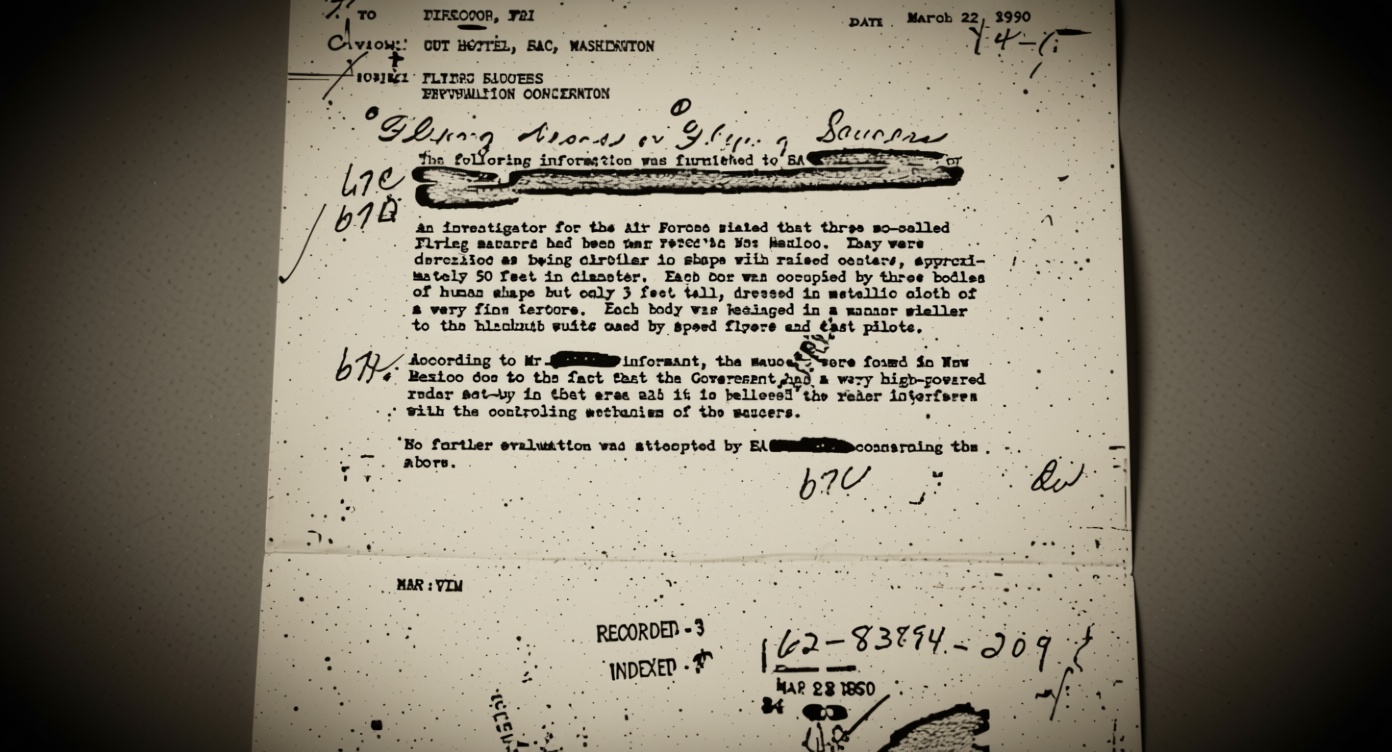
A recent reassessment of three alleged Franklin D. Roosevelt–George C. Marshall memoranda challenges claims that the U.S. government operated a formal extraterrestrial-recovery program as early as 1942—five years before the Roswell incident. The documents have been cited by UFO researchers as evidence of a wartime effort to retrieve and study an unidentified craft. However, the review argues that the papers, considered as documentary evidence, do not establish that such a unit existed.
The analysis focuses less on the extraordinary claims associated with the alleged crash and more on the records themselves: where they came from, how they were preserved, whether their contents were altered, and what can be independently verified. The central conclusion is that the memos’ evidentiary value remains unproven, particularly because their custody histories contain significant gaps.
The Three Documents
The documents are generally presented as part of a pre-Roswell timeline involving Roosevelt and Marshall, who served as Army chief of staff during World War II. Their purported contents have been interpreted as references to a recovery operation, military handling of unusual technology, and communications between senior officials.
The reassessment, however, notes that the papers do not come with a complete, independently documented chain of custody. It is therefore difficult to determine when and where they were created, who retained them, or whether the versions now circulating are complete originals. The review also points to unexplained alterations and inconsistencies in the documents’ presentation, issues that require resolution before they can be treated as authenticated government records.
In historical research, provenance is especially important when a document appears to support a major claim absent from established archival records. A memo attributed to senior wartime officials would ordinarily be evaluated alongside filing practices, related correspondence, registry entries, and corroborating material from government archives. The review says that this broader documentary context has not been adequately demonstrated.
The Marshall File Number
One argument advanced in support of the memos concerns a file number associated with the alleged Marshall document. The number has been treated by some researchers as evidence that the memo originated within a classified or restricted military system. The reassessment raises a significant complication: the number was reportedly publicly available before the memo became prominent.
That fact does not, by itself, prove fabrication. Publicly available information can sometimes be incorporated into genuine documents, and a file number may have more than one interpretation. But it weakens the claim that the number independently authenticates the memo. Without contemporaneous records showing how the number was assigned and used, it cannot reliably establish the document’s origin.
Later Army Responses
The review also considers subsequent replies from the Army. Those responses have been interpreted differently by supporters and skeptics: some see them as evasive or suggestive of a concealed program, while others view them as consistent with routine archival limitations and the absence of responsive records.
The article’s analysis cautions against treating an inconclusive government response as confirmation. A failure to locate records is not proof that the underlying event occurred, just as an ambiguous bureaucratic reply is not necessarily evidence of a cover-up. The meaning of the Army’s correspondence depends on the scope of the searches, the records examined, and the precise questions posed—details that must be established independently.
Broader UFO Claims
The documents appear in a wider narrative promoted by UFO commentators, including claims that crash retrieval and reverse-engineering efforts began with an alleged 1933 incident in Italy and continued through Roswell. The source article connects that narrative to later testimony and public allegations involving intelligence officials, military programs, and classified technology.
Those broader claims remain contested. The three Roosevelt–Marshall memos may be relevant to the debate, but they do not currently provide conclusive proof of a 1942 recovery unit. Until their provenance, alterations, and archival context are resolved through independent document examination and corroborating records, they are best treated as disputed artifacts rather than established evidence of a secret government program.