Overview
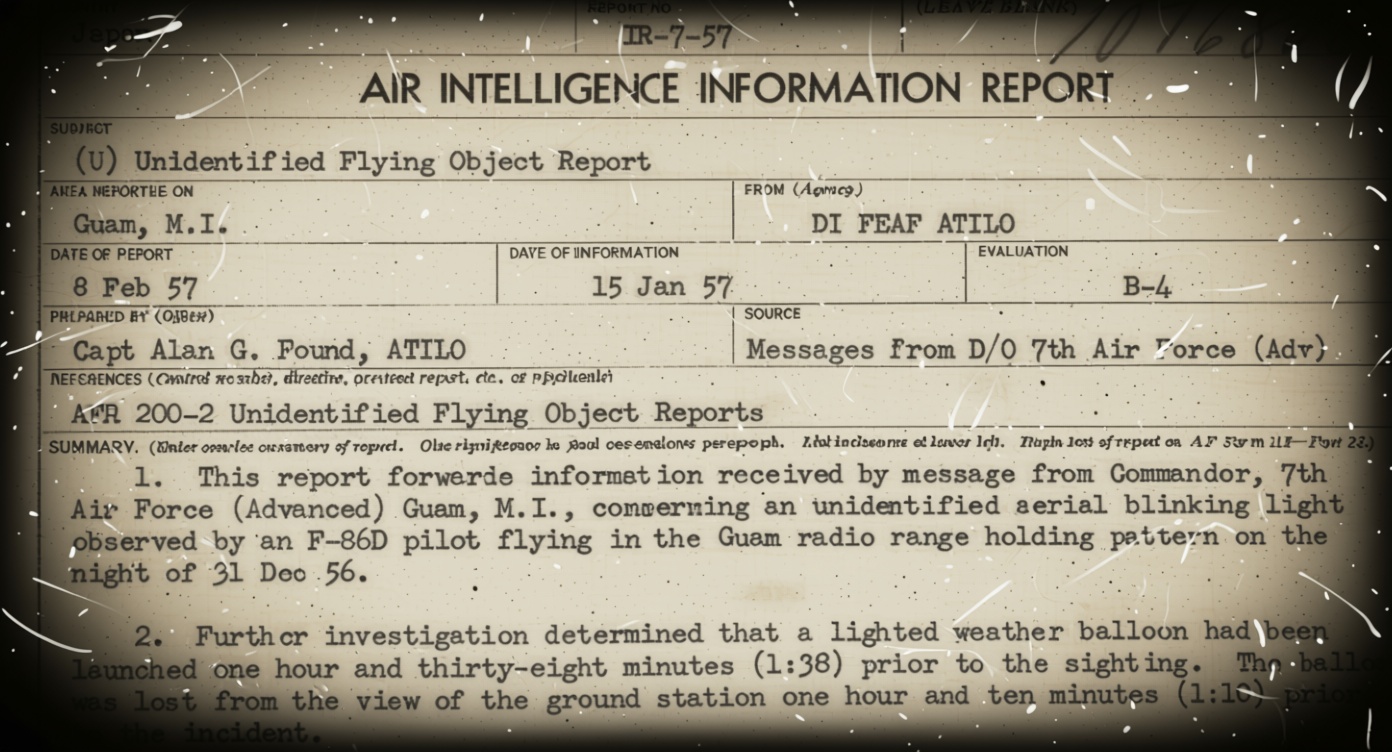
The U.S. Department of Defense has released a 1956 report concerning a reported UFO encounter over Guam, according to an article published by the Pacific Daily News on Oct. 22, 2026. The document’s release brings renewed attention to an incident recorded during the early Cold War, when reports of unidentified objects were routinely reviewed by U.S. military and intelligence agencies.
However, the available source material provides no details about the reported sighting, the individuals involved, the circumstances of the encounter or the report’s conclusions. It is therefore not possible, based on the information provided, to determine what was observed over Guam or how military officials assessed the event at the time.
Historical Context
In 1956, the U.S. government was actively investigating reports of unidentified flying objects through military programs commonly associated with the Air Force’s Project Blue Book. Such reports could involve visual observations by military personnel, civilians or pilots, as well as radar detections and other technical data. Investigators typically sought explanations ranging from aircraft and weather phenomena to astronomical objects, equipment errors or misidentification.
The terminology used in the newly released document may differ from modern language. “UFO” was the standard term in public and official discussions during much of the 20th century, while “unidentified anomalous phenomena,” or UAP, is more commonly used by government agencies today. The presence of an unidentified object in a historical report does not, by itself, establish that it was extraterrestrial or beyond the capabilities of known technology.
Guam’s Strategic Significance
Guam’s location in the western Pacific gave it considerable military importance during the period. The island served as a major U.S. base and logistics hub, placing it within a region of heightened strategic activity during the Cold War. Aircraft operations, naval movements and long-distance communications were all part of the island’s military environment.
That setting could make unusual aerial reports particularly significant to officials, especially if they involved restricted airspace or were observed near military facilities. At the same time, the strategic importance of Guam also means that ordinary military activity, unfamiliar aircraft and surveillance operations may have complicated efforts to identify objects reported in the area.
What Remains Unknown
The provided information does not state whether the report was newly declassified, obtained through a records request or published as part of a broader Department of Defense release. It also does not identify the report’s author, classification history, original military unit or any follow-up investigation.
Those details will be important in evaluating the document. Researchers will likely examine whether it contains witness statements, diagrams, radar records, photographs, correspondence or an official assessment. They may also compare the report with contemporaneous records from Project Blue Book and other military archives to determine whether the Guam incident was investigated elsewhere.
Assessment
For now, the release confirms only that the Defense Department has made a 1956 report about a reported UFO encounter over Guam available. It does not, on the information currently provided, confirm the nature of the object or support a conclusion that the event involved nonhuman technology. Further analysis of the original document will be necessary before the incident’s significance can be assessed.
The Pacific Daily News article, published Oct. 22, 2026, is the cited source for the release. The report itself remains the central piece of evidence, and its contents—not the fact of its publication alone—will determine what can responsibly be concluded about the historical encounter.