Overview
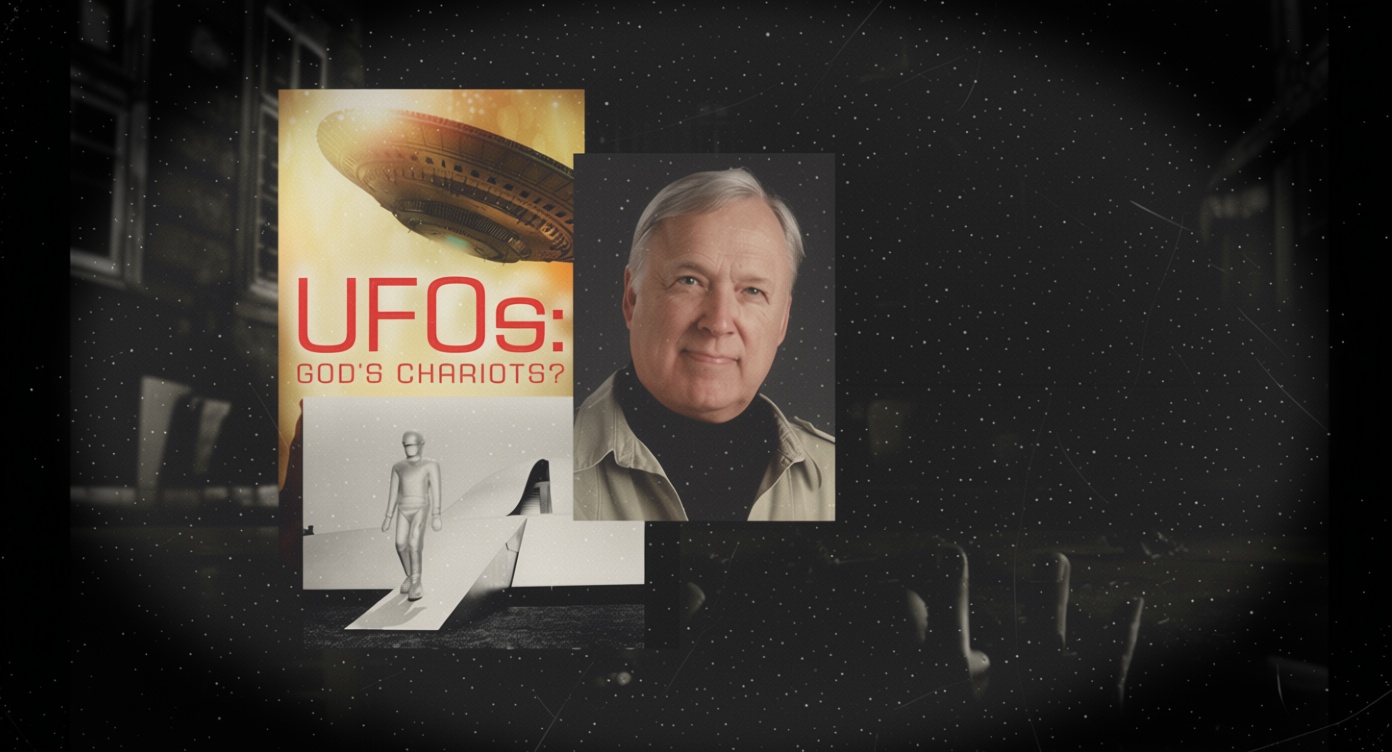
An interview on the Harp’s Light program examines what the possible discovery of extraterrestrial intelligence—and the continuing debate over unidentified aerial phenomena (UAP)—could mean for religion, science and human self-understanding. Host Hunter speaks with Dr. Ted Peters, a theologian and author known for his work in astrotheology, in a discussion titled “Astrotheology and the UFO Phenomenon.” The conversation considers whether contact with nonhuman intelligence would create a crisis for religious belief, how UAP reports should be interpreted, and why technological explanations do not necessarily answer questions about meaning.
Astrotheology and the Religious-Crisis Debate
Peters describes astrotheology as a field that brings space sciences into dialogue with traditional theological doctrines, including creation and Christology. He explains that the discipline developed from earlier discussions of “exotheology” and has increasingly aligned with scientific fields such as astrobiology. Its broader purpose, he says, is to consider the human condition within a vast universe that may contain other forms of life or intelligence.
A central point of the interview is Peters’ research into what he calls “The Peters ETI Religious Crisis Survey.” According to Peters, the results challenge the popular idea that confirmation of extraterrestrial life would cause organized religion to collapse. He says that more than 90% of respondents across religious communities—including Roman Catholics, Eastern Orthodox Christians, Protestants and Buddhists—believed their faith would remain intact. Peters argues that expectations of a religious crisis are often projected by secular observers rather than supported by the views of religious believers themselves.
Science, Materialism and Meaning
Peters distinguishes between scientific naturalism, which he characterizes as a method for gathering and testing evidence, and materialism, which he describes as a broader philosophical position asserting that reality is ultimately reducible to physical matter. He expresses support for empirical UAP investigations, including work associated with the Scientific Coalition for UAP Studies and researcher Robert Powell, while maintaining that scientific analysis alone cannot address every dimension of the phenomenon.
To illustrate that distinction, Peters invokes the figures of Apollo and Hermes. Apollo represents measurement, rationality and data; Hermes symbolizes interpretation, communication and meaning. In his view, some UAP encounters are reported with what he calls a “religious valence,” or a sense of transcendence that cannot be resolved solely through physics. Such experiences, he suggests, require a hermeneutic approach that considers how witnesses interpret events and why those events may take on spiritual significance.
Ancient Astronauts and Popular Culture
The discussion also challenges ancient-astronaut theories associated with Erich von Däniken’s Chariots of the Gods? Peters recounts debating von Däniken and criticizes what he calls the theory’s “technological imperative”—the assumption that ancient religious experiences were misunderstandings of advanced technology. The interview also addresses interpretations of the biblical Nephilim and Genesis 6, including the work of Michael Heiser. While Peters acknowledges the popularity of extraterrestrial readings of the “sons of God,” he considers literal hybridization theories speculative and lacking a sufficiently developed theological foundation.
Peters further examines how popular films express modern spiritual concerns. He praises The Day the Earth Stood Still (1951) and Close Encounters of the Third Kind (1977) for presenting encounters with the unknown in ways that engage religious themes. By contrast, he questions science fiction centered on “redemptive violence,” in which conflict with alien beings is treated as the solution to humanity’s problems.
A Warning Against “Ufolatry”
The interview concludes with Peters’ warning against “ufolatry,” or the tendency to treat UFOs and advanced technology as potential saviors. He argues that neither extraterrestrial visitors nor technological progress can resolve humanity’s fundamental moral failures. For Peters, placing ultimate hope in “UFO saviors” risks becoming a modern form of idolatry.
His overall position is that religious communities are more capable of incorporating extraterrestrial life into their worldviews than popular narratives often suggest. At the same time, he calls for an approach that remains open to scientific evidence while resisting premature conclusions. The UAP debate, he proposes, should leave room for both empirical investigation and serious reflection on the enduring human questions of purpose, morality and transcendence.