Overview
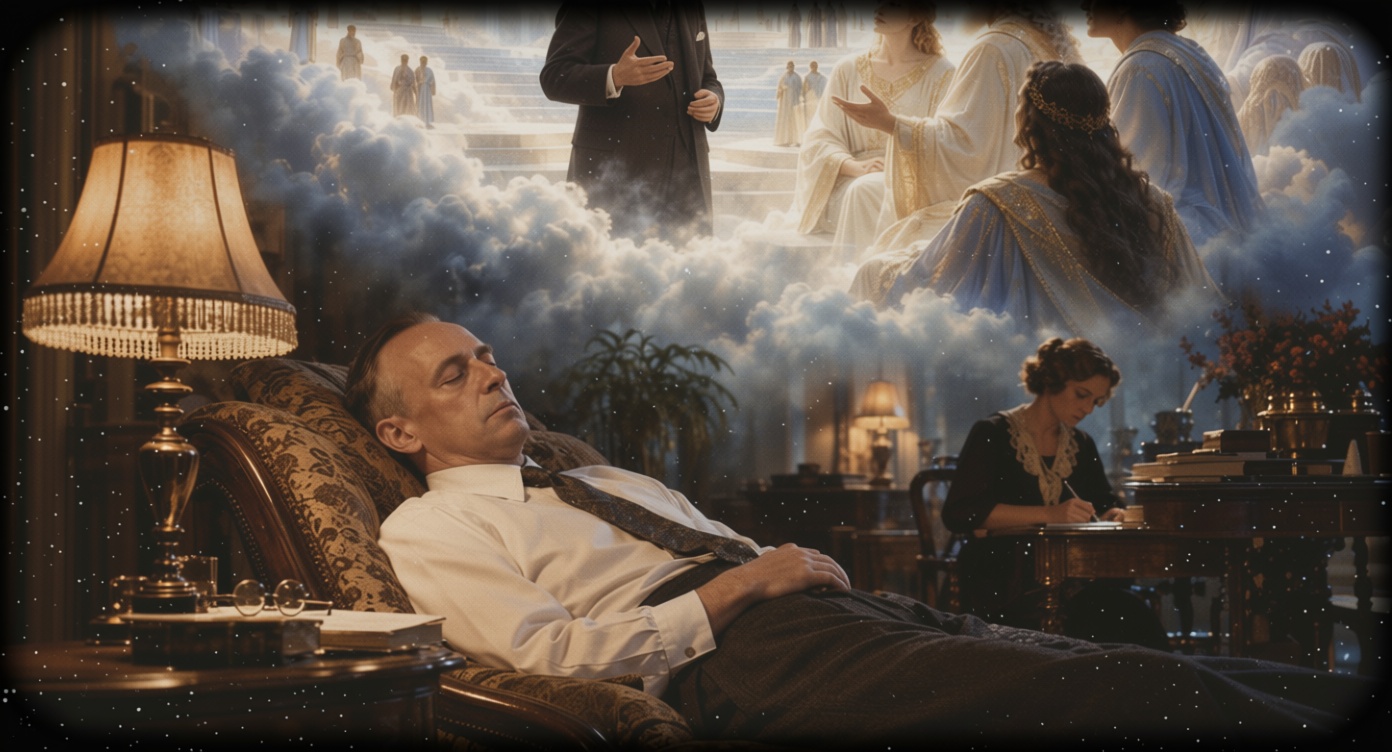
Edgar Cayce (1877–1945), widely known as the “Sleeping Prophet,” remains one of the most prominent figures in American psychic and spiritual history. Supporters said Cayce could enter a sleep-like or trance state and provide “readings” about illnesses, treatments, dreams, past lives and other personal matters. However, the available accounts and transcripts do not establish that he obtained information through paranormal means under controlled, repeatable scientific conditions.
Born in Kentucky, Cayce reportedly became interested in healing after experiencing health difficulties of his own. According to biographical accounts, he later developed a method in which he would lie down, close his eyes and enter a trance-like state while questions were presented to him. Many of the people discussed in the readings were not physically present. Over time, Cayce is said to have conducted thousands of sessions, records of which were preserved by the Association for Research and Enlightenment, or A.R.E., an organization established around his work.
Medical Readings and Claims
The medical readings form the central basis of Cayce’s reputation. Followers credited him with identifying symptoms and physical conditions and with recommending dietary changes, exercise, massage, hydrotherapy, herbal preparations and other treatments. Some later accounts describe particular recommendations as unusually accurate or ahead of their time, presenting them as evidence that Cayce possessed an exceptional ability.
Individual successes, however, are not sufficient to establish a medical or paranormal claim. A person who makes a large number of predictions or recommendations may produce some apparently correct results by chance. Medical conditions can also improve naturally, symptoms may fluctuate, and patients may remember successful statements more readily than incorrect or unsuccessful ones. These factors can create an impression of accuracy even when no unusual information-gathering ability is involved.
The Scientific Standard
Modern scientific testing would require investigators to prevent ordinary sources of information from reaching the subject. That could include conversation, observation, written records, prior knowledge and subtle cues from participants. Researchers would also need to define in advance what counted as a correct answer, compare results with appropriate controls and ensure that independent investigators could repeat the findings.
Historical readings generally were not conducted under those conditions. As a result, the surviving records cannot readily determine whether Cayce’s statements originated from a paranormal source, ordinary inference, information supplied by others or other explanations. The absence of controlled testing does not by itself prove that every reading was mistaken, but it means the claims cannot be evaluated as established scientific findings.
Verification and Interpretation
A further difficulty is determining Cayce’s overall accuracy. Thousands of readings provide a substantial body of material from which especially impressive examples can be selected. A rigorous assessment would need to consider all relevant statements, including vague, incorrect and unsuccessful predictions, rather than focusing only on cases remembered as successful.
Interpretation also becomes more complicated after an event has occurred. Statements that seemed uncertain beforehand may later appear precise when people connect them to a specific outcome. This tendency, along with selective memory and retrospective interpretation, makes it important to evaluate claims using records preserved before the result was known.
Cayce’s legacy therefore remains significant as a subject of religious history, popular culture and the study of claims about extrasensory perception. Yet based on the available accounts, science has not confirmed that his readings demonstrated a genuine paranormal ability. The question remains one that would require carefully controlled, transparent and independently replicated evidence—standards the historical record does not provide.