Overview
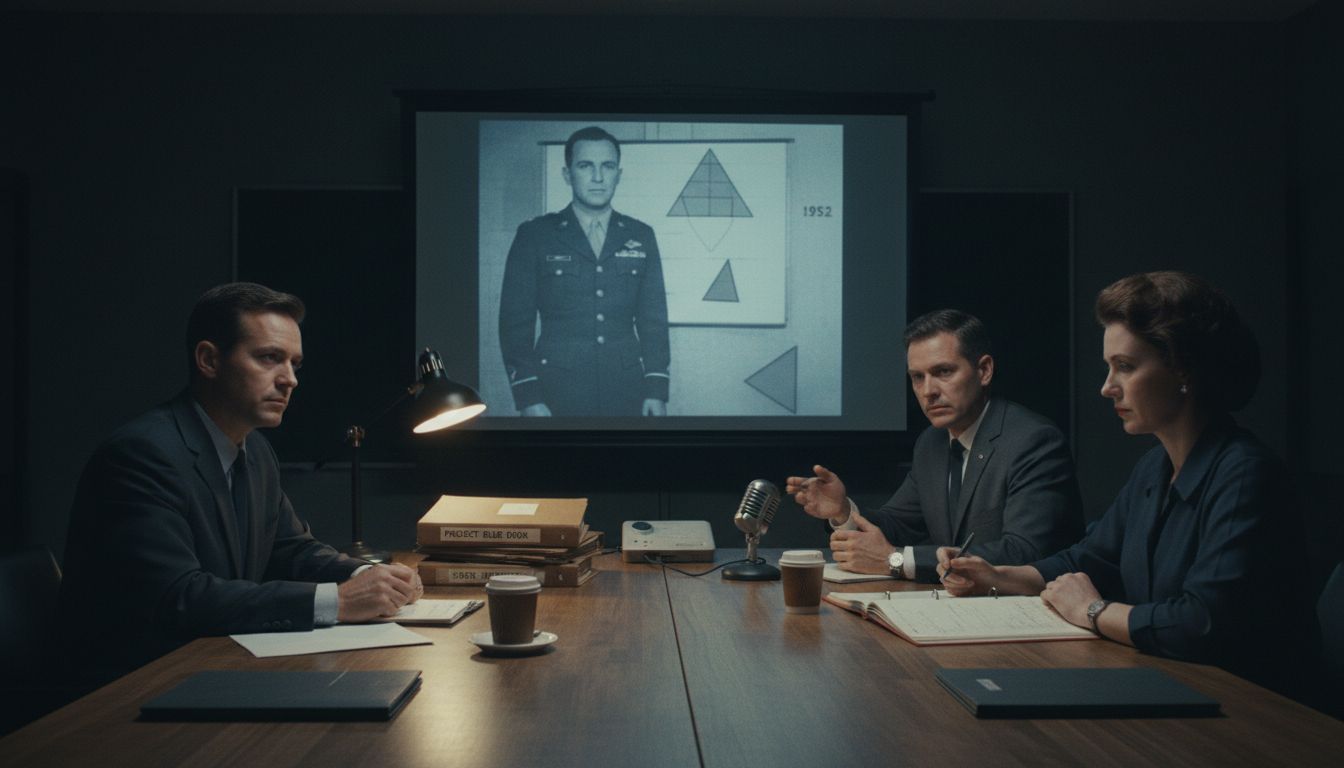
The fifth season of UFO Talker opens with an examination of a little-known 1952 presentation by Edward J. Ruppelt, the first director of the U.S. Air Force’s Project Blue Book. In the episode, hosts Michael Ryan and Christine Scott discuss a recording of a confidential meeting in which Ruppelt addressed a predominantly military audience while the Air Force’s investigation of unidentified flying objects was still active. The episode, released September 30, 2026, is titled “The Secret Ruppelt Tape: Battelle’s Hidden UFO Connection/ What was Project Stork?”
Unlike Ruppelt’s later public writings or media appearances, the recording is presented as an opportunity to hear him discuss the UFO issue in an operational setting. The program considers what the presentation may reveal about how military officials understood UFO reports during a period of heightened public and institutional concern.
Project Blue Book and the Battelle Connection
A central focus of the episode is Project Stork, a name associated with the Air Force’s effort to analyze UFO reports with assistance from Battelle Memorial Institute. Battelle, a research organization based in Columbus, Ohio, conducted statistical and scientific work for the Air Force, including analysis of reported UFO characteristics and the reliability of observations.
The discussion places that work in the context of the early 1950s, when reports of unusual objects were being collected from military personnel, civilian observers and law-enforcement agencies. Ruppelt oversaw Project Blue Book during a period that included the well-known wave of sightings reported around Washington, D.C., in July 1952. The episode explores whether the recording offers additional insight into the relationship between Ruppelt’s office, Battelle and broader Air Force efforts to determine whether the reports represented misidentifications, conventional technology or something less readily explained.
The program does not establish that Battelle uncovered evidence of extraterrestrial craft. Rather, it revisits the historical record and asks how statistical methods and classified research shaped the government’s response. That distinction is important: an investigation into unexplained reports is not, by itself, proof of an extraordinary explanation.
From Historical Files to Modern Claims
Beyond the Ruppelt recording, the episode broadens its discussion to claims involving secret space programs, as well as recent releases of NASA and military data. Such subjects have attracted renewed attention as government agencies have acknowledged that some aerial observations remain unresolved. However, unresolved cases can reflect incomplete data, sensor limitations or insufficiently detailed eyewitness accounts, rather than evidence of nonhuman technology.
The hosts also critique reporting about a Utah film that has circulated in UFO and UAP discussions. The segment appears to focus on the importance of carefully evaluating the provenance, imagery and interpretation of purported evidence before drawing conclusions. The episode’s historical emphasis provides a counterweight to sensational claims, encouraging listeners to separate documented records from speculation.
Drone Incursions and Geopolitical Explanations
Another segment considers an argument advanced by Franc Milburn concerning drone incursions reported in the United Kingdom and Europe. Milburn’s position, as described in the episode, is that some of these incidents may have involved Russian operations or intermediary actors rather than unidentified aerial phenomena. That interpretation places the reports within the context of espionage, influence operations and military probing—areas that can be difficult to distinguish from ordinary security incidents when information is limited.
Taken together, the episode presents UFO investigations as a mixture of history, intelligence analysis and contested interpretation. Its examination of Ruppelt and Project Stork underscores the value of primary sources, while its treatment of modern sightings emphasizes the need for corroborated data. The 1-hour, 56-minute program is available through UFO Talker, which publishes weekly discussions, interviews and accounts of reported sightings.