A Wave of “Airship” Reports
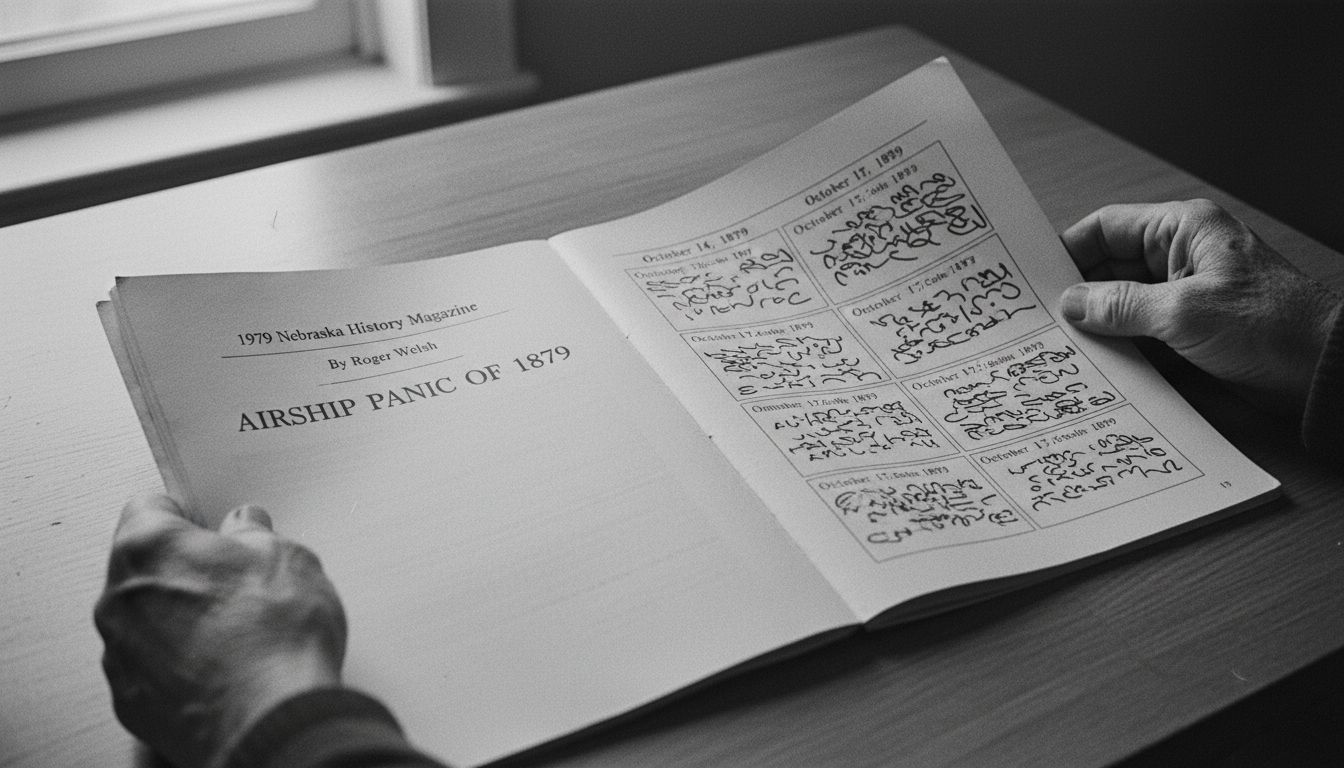
In 1897, residents across Nebraska reported seeing a strange aerial object that newspapers variously described as an “airship,” a “mysterious light” or a craft unlike anything known at the time. The accounts were later examined by historian Roger L. Welsch in a 1979 article for Nebraska History titled “‘This Mysterious Light Called an Airship’: Nebraska ‘Saucer’ Sightings, 1897.” According to the article’s summary, Welsch located nearly 200 reports of unusual aerial sightings published in Nebraska newspapers.
The reports began in February and emerged during a broader wave of airship stories across the United States. Newspapers in communities including Omaha, Lincoln, Wymore and Hastings chronicled observations by local residents. The witnesses included farmers, townspeople and other individuals whose accounts varied in detail but frequently involved a luminous object traveling through the night sky.
Descriptions of the Mysterious Craft
Welsch’s account presents a composite picture of what witnesses believed they had seen. The craft was described as large and canoe-shaped, with a bright headlight, a red light at the rear and several lights along its sides. Some observers reported seeing a dim green light or the outline of wings. Others claimed the object moved in ways they considered impossible for known aircraft, stopping suddenly, shifting sideways or reversing direction before accelerating toward the horizon.
The article also records more unusual details. Some witnesses said they heard a mechanical hum, while others believed they could hear voices or laughter coming from the craft. Such descriptions contributed to the impression that the object was not merely a distant light but a vehicle occupied by people. As Welsch wrote, observers were left “bewildered, mystified, thrilled—even terrified” by what they had witnessed.
A Story Shaped by Its Time
The reports appeared at a moment when powered aviation was not yet a familiar part of everyday life. Lighter-than-air vehicles, including balloons and experimental dirigibles, did exist, but reliable powered flight had not entered public experience. That technological uncertainty gave the sightings a ready-made explanation: perhaps an inventor had secretly developed a revolutionary flying machine.
At the same time, the newspapers and their readers recognized that ordinary explanations were possible. Witnesses might have mistaken stars, clouds or other familiar objects for a craft, while hoaxes and exaggerated stories could also spread rapidly through competing newspapers. Welsch’s article reflects that tension, noting that some observers feared being dismissed as “drunks, fools, or charlatans,” even as they insisted they had seen something extraordinary.
Historical Evidence, Not Identification
The Nebraska reports are significant because they document how Americans interpreted unfamiliar lights and objects before modern aviation and the contemporary UFO era. They also show how local testimony, newspaper repetition and national interest could transform isolated observations into a regional mystery.
However, the historical record does not establish what the witnesses actually saw. The 1979 article compiles and analyzes newspaper accounts; it does not provide physical evidence confirming an unknown aircraft or extraterrestrial vehicle. The sightings may have involved astronomical objects, atmospheric effects, conventional lights, experimental technology, misidentifications or deliberate fabrications. Their enduring value lies in what they reveal about public perceptions of technology, the press and unexplained phenomena in late-19th-century Nebraska.