Overview
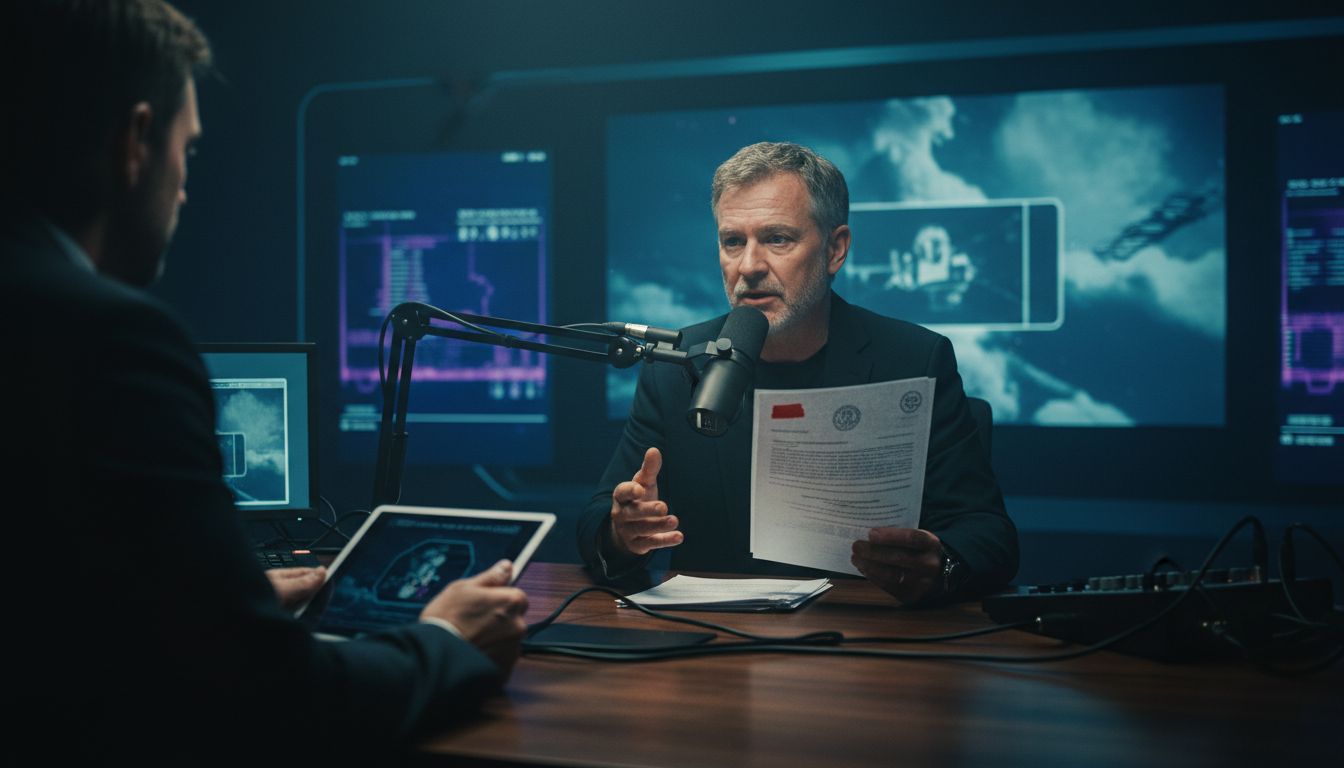
Investigative journalist Ross Coulthart says the long-running UAP disclosure debate has entered a new phase, arguing that Washington’s secrecy is increasingly colliding with public testimony, declassified records and international developments. In an interview with Los Angeles Magazine ahead of NewsNation’s Reality Check: Road to Disclosure, Coulthart said the conversation around unidentified anomalous phenomena has “fundamentally changed,” not only because more officials are speaking publicly, but because the issue is now being framed more explicitly as a national security concern.
Coulthart, who became one of the most recognizable figures in the modern disclosure movement after his 2023 interview with former intelligence officer David Grusch, said the latest congressional and media attention reflects a broader shift. Grusch previously alleged that the U.S. government has maintained a secretive crash-retrieval and reverse-engineering effort involving non-human technology — claims the government has not publicly confirmed. Coulthart’s latest comments suggest that, whatever the ultimate truth may be, the issue is no longer confined to fringe speculation.
What Coulthart Says Was Missed
At the center of Coulthart’s remarks was what he described as an underreported detail from a recent Capitol Hill UAP press conference. “The very important thing that he said yesterday that a lot of people missed was a very explicit and clear on-the-record statement that he has seen human intelligence and signals intelligence relating to how our foreign adversaries, i.e. China and Russia, are monitoring our crash retrieval and reverse engineering program,” Coulthart said.
That assertion, if borne out, would imply that rival nations may be actively trying to collect intelligence on U.S. UAP-related programs even as American officials continue to deny that such programs exist. Coulthart said the contradiction itself is troubling. “At the same time as the U.S. government denies that there’s this program going on, we’ve got this crazy situation where… the Chinese particularly are spying incredibly aggressively to try and find out what the U.S. is doing in its secret UAP research,” he said.
He added that the imbalance in information may be even more striking than it appears. “The Chinese and the Russians probably know a lot more about it than we do. And that’s the absurdity,” Coulthart said, underscoring his view that secrecy has created a distorted and potentially dangerous information environment.
International Pressure Is Growing
Coulthart also pointed to developments overseas that he believes could intensify pressure on Washington. He said he recently learned that journalist Jesse Michaels had obtained what he called a major scoop involving former Brazilian Defense Minister Aldo Rebelo, who reportedly went on the record alleging that the Varginha incident and the Colares case involved the recovery of non-human craft in Brazil. Those claims, like many in the UFO field, remain disputed and unverified in the public record.
Still, Coulthart argued that if more international figures begin making similar statements, the U.S. government could face mounting credibility challenges. “We’re now in a position where world leaders are now contradicting the U.S. denials,” he said. “Unless President Trump gets out ahead of this, we’re going to see other countries coming out and contradicting the U.S. for being so evasive.”
Why the Disclosure Process Matters
For Coulthart, the significance of recent UAP file releases lies not simply in what they contain, but in what they reveal about the government’s posture. He said the documents demonstrate that the disclosure process is no longer theoretical: it is happening in public, through hearings, records requests and interviews that are increasingly difficult to ignore. NewsNation’s upcoming special is expected to trace that arc from Roswell and Cold War secrecy to modern whistleblowers and congressional scrutiny.
The broader question, Coulthart suggested, is whether U.S. institutions can adapt to a topic that now sits at the intersection of science, defense, intelligence and public trust. For supporters of disclosure, the challenge is no longer proving that the conversation exists. It is determining how much of it the government has been withholding — and whether that secrecy can survive a scrutiny that is now arriving from both inside and outside the United States.