Overview
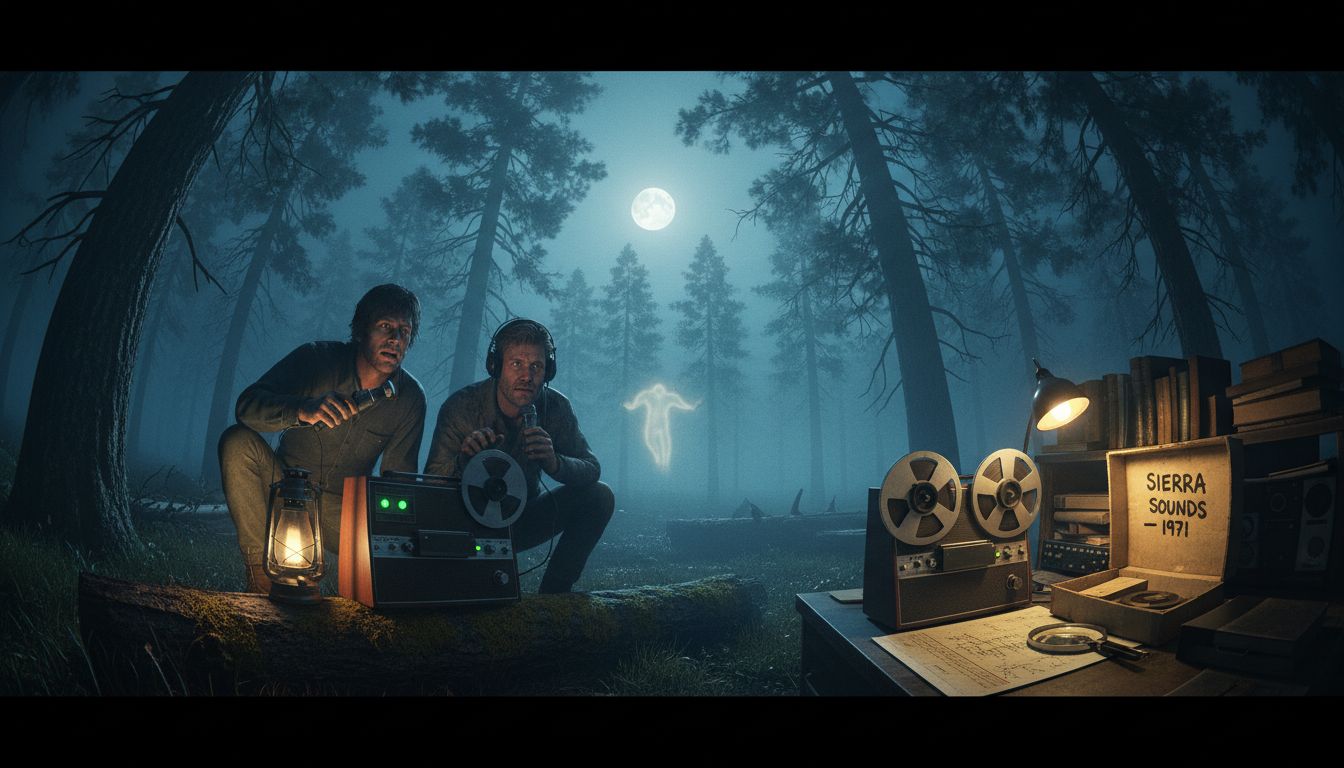
A decades-old audio recording made in the Sierra Nevada mountains in 1971 continues to draw attention from Bigfoot enthusiasts and skeptics alike. The tape, known as the Sierra Sounds, was recorded by campers Ron Morehead and Al Berry, who reportedly set out to capture evidence of Bigfoot during a trip in the wilderness. Morehead was already a believer in the creature’s existence, while Berry approached the effort as a skeptic looking to expose a hoax. What they captured instead has become one of the most debated recordings in the cryptozoology world.
According to accounts of the tape, the recording begins with the men whispering to one another before distant howls break the silence. The sounds escalate into a series of grunts, knocks, and fast vocalizations that Bigfoot proponents have long described as unusually complex. Some listeners have dubbed one of the sequences “samurai chatter,” because it resembles rapid dialogue from old Japanese samurai films. The audio has circulated widely among Bigfoot researchers for years, helping to keep the Sierra Sounds in the public conversation around unexplained wilderness recordings.
The Linguist’s Analysis
The recordings took on added significance after retired U.S. Navy cryptographic linguist Scott Nelson studied the audio and offered a striking interpretation. Nelson concluded that the vocalizations were “definitely a language,” adding that they were “definitely not human in origin” and, in his view, “could not have been faked.” His assessment has been widely cited by believers as evidence that the audio may contain more than random animal calls or prank sounds.
At the same time, the Sierra Sounds have not undergone a formal scientific study, leaving the broader claims unresolved. That gap matters, especially because the tapes occupy a gray area between folklore, eyewitness testimony, and audio analysis. Nelson’s conclusion may be compelling to some listeners, but without peer-reviewed research or independent verification, the recordings remain an intriguing artifact rather than conclusive proof of anything nonhuman.
Enduring Debate
The story is further shaped by the perspectives of the two men who made the recording. Al Berry died in 2012, and according to a post referenced by Morehead, Berry maintained that he would have found it even more interesting if he could have figured out how someone might have staged the event. That comment suggests he remained unconvinced of a supernatural explanation while also acknowledging that the sounds resisted easy dismissal.
Morehead, meanwhile, has continued to describe himself as an “adventurist” and remains active in the Bigfoot community. For believers, that long-running commitment helps preserve the Sierra Sounds as a central piece of the Bigfoot canon, alongside other famous cases such as the Patterson–Gimlin film. For skeptics, the lack of independent scientific confirmation keeps the tape in the realm of unresolved curiosity. Either way, the recording has proved durable: more than 50 years later, it still invites listeners to decide for themselves what they are hearing.