Overview
Long before Disney’s blue, wisecracking genie appeared in Aladdin (1992), jinn occupied a far more complex place in Middle Eastern religious thought, folklore and art. In Islamic tradition, jinn are generally understood as intelligent, free-willed beings created from smokeless fire. They may be benevolent, hostile or indifferent to humans, and—like people—can be associated with belief, morality and individual choice. They are not, in the traditional account, spirits automatically bound to lamps or obligated to grant wishes.
The Arabic word jinn derives from the root j-n-n, associated with concealment or being hidden from view. Related terms include janna, meaning a screened or enclosed garden; junūn, a state in which the mind is veiled; and janīn, a fetus hidden within the body. The linguistic connection suggests that the defining feature of jinn is not fire or magic, but invisibility and hiddenness.
Jinn in Historical Art
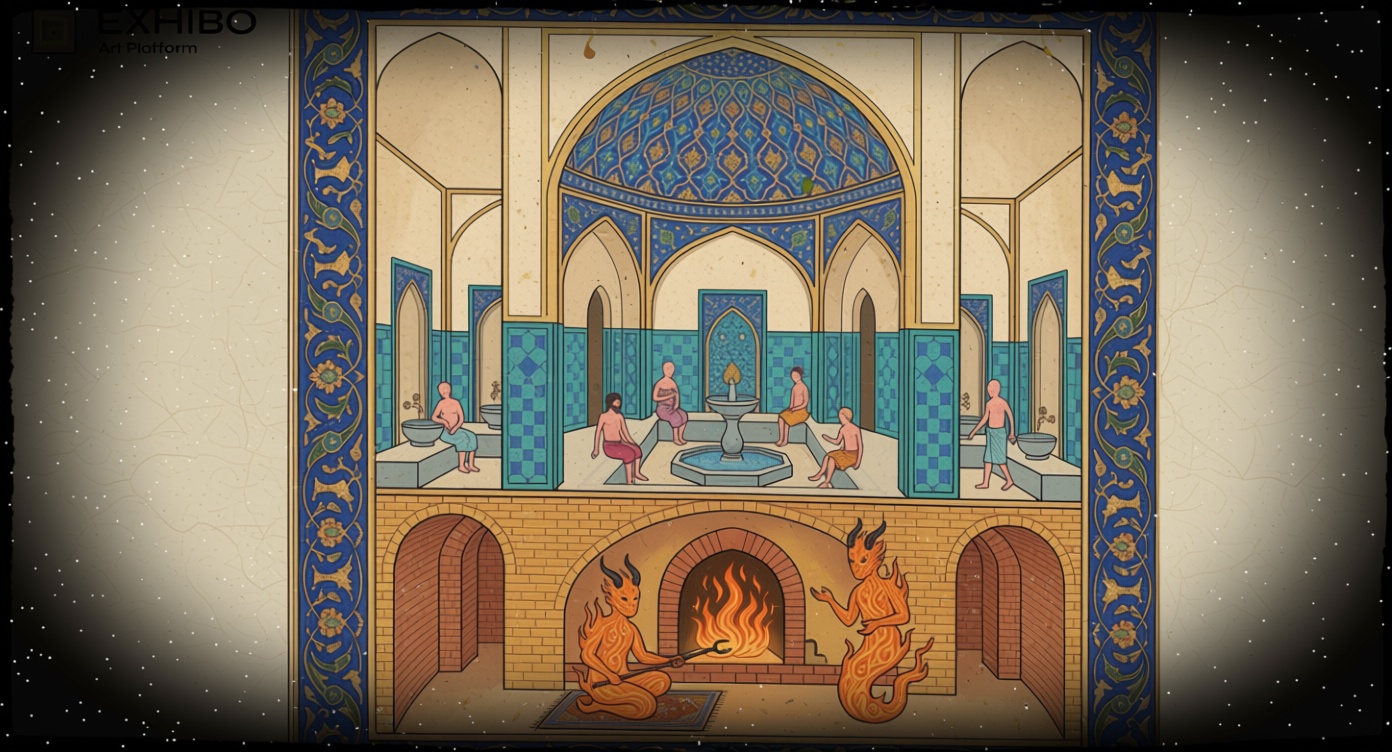
A striking example appears in the fourteenth-century Kitāb al-Bulhān, or Book of Surprises, a manuscript compiled in Jalayirid Baghdad and now held by Oxford’s Bodleian Library as MS. Bodl. Or. 133. One illustration depicts the public baths at Tiberias, on the western shore of the Sea of Galilee. The image is drawn as a cutaway: bathers and attendants occupy the upper level, while the furnace and two jinn appear below, tending the fire.
The scene is notable for its lack of spectacle. The jinn are not depicted as monsters, captors or wish-granters. Instead, they appear to be performing ordinary labor—keeping the baths warm and conversing while they work. The image offers a glimpse of a worldview in which unseen beings could be integrated into explanations of places, infrastructure and everyday events rather than confined to tales of supernatural punishment.
Beyond the Lamp
The familiar Western image of a genie emerged through later literary and popular adaptations, particularly stories associated with The Thousand and One Nights. Disney’s version drew on that tradition while reshaping it for family entertainment. The character’s humor, blue appearance, imprisonment in a lamp and promise of three wishes are imaginative inventions or substantial adaptations, rather than straightforward representations of Islamic theology.
This distinction is important because the older concept of jinn encompassed far more than wish fulfillment. Folkloric traditions connected unseen beings with locations, illness, sleep, luck and the boundaries of human knowledge. In many communities, beliefs surrounding jinn could influence everyday behavior—for example, caution around particular trees or practices intended to avoid disturbing unseen inhabitants.
Regional Folklore and Modern Culture
The source also emphasizes that jinn traditions remain active rather than merely historical. In Syrian folklore, jinn are more commonly associated with horror stories than comic adventure. Across the region, contemporary films and horror franchises continue to draw on the idea of hidden beings, often presenting them as dangerous or morally ambiguous figures. The enduring popularity of such stories demonstrates that jinn have not disappeared beneath the cultural influence of Disney; instead, different traditions continue to coexist.
The historical record therefore presents jinn as a broad and adaptable category—concealed beings with agency, character and uncertain intentions. Disney’s genie remains a beloved fictional creation, but it represents only one modern interpretation of a much older and more varied tradition.