Overview
The Kera Incident remains one of Japan’s most enduring UFO-related mysteries, centered on a small object allegedly discovered by middle-school boys in Kochi City in 1972. According to the accounts later documented by amateur astronomers, the group claimed to have found, handled, and ultimately lost a hat-shaped metallic object that appeared to behave in unusual ways. The case has gained lasting attention not because of strong physical evidence, but because of the unusual consistency of the boys’ descriptions and the object’s repeated disappearances from places where it had been stored.
The 1972 Encounter
The story reportedly began on August 25, 1972, when 13-year-old Michio Seo saw a strange metallic object flying over a rice field in the Kera area of Kochi City. He described its motion as erratic, like a bat hunting insects, and said it emitted pulsing multi-colored light and a loud “popping” sound that kept the boys from approaching it at first. In the days that followed, the group continued watching the object at night, and on September 4, one of the boys, Toshiaki Kozoka, attempted to photograph it. The boys later said the flash caused the object to react violently, shooting upward before returning to the ground.
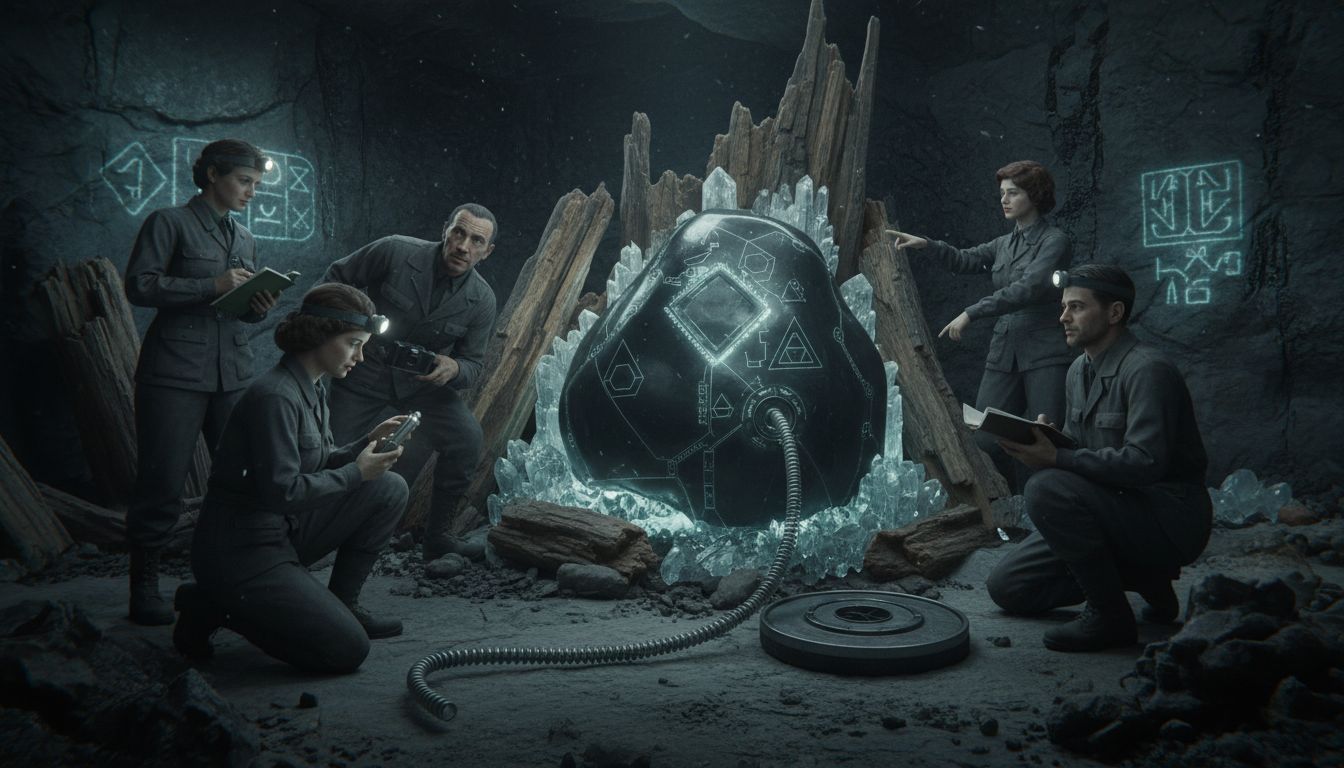
Believing the object avoided rainy weather, the boys reportedly used water and a cloth to subdue it. They then took it to the home of Yasuo Fujimoto, where they examined what they described as a silver, hat-shaped craft about 8 inches wide and 4 inches high, weighing roughly 1.3 kilograms. The underside allegedly featured grooves, small holes, and engravings resembling waves, a bird, and a plant-like form. Attempts to open it with hammers and screwdrivers reportedly failed, with the boys claiming the metal would not dent and that they heard “clattering” and “buzzer-like” sounds from inside.
Evidence and Skepticism
The evidence supporting the incident is limited mainly to the boys’ sketches and a single low-quality photograph. That scarcity has made the case difficult to assess independently, and skeptical explanations have long centered on the possibility that the object was a modified cast-iron ashtray, a design that some investigators said closely matched commercially available items in Japan at the time. Mutsuo Fujimoto, director of the Center for Science Education in Kochi and father of one of the boys, examined the object and remained unconvinced it was anything extraordinary. He later said he regretted not studying it more carefully, but his initial assessment leaned toward an ordinary manufactured object rather than an anomalous craft.
Why the Story Endures
Despite the skeptical interpretation, the Kera Incident continues to draw interest because of the reported details surrounding the object’s behavior. The boys said it repeatedly vanished from locked bags and rooms, only to reappear later in the original field or nearby ditches. Its final disappearance came on September 22, 1972, while the boys were transporting it to show a science teacher; it was never recovered. Advocates of the story point to the consistency of the witnesses’ accounts over time and a separate report from a girl in the nearby village of Agawa, who said she saw a similar glowing yellow object in the same period.
Cultural Context
The case also reflects Japan’s broader 1970s UFO boom, when interest in unexplained aerial phenomena grew alongside popular fascination with science fiction and folklore. In that context, the Kera Incident has been interpreted in several ways: as a childhood hoax, a misidentified object, or, in more speculative modern retellings, something far stranger. References to Onibi, or “demon fire,” show how the story sits at the intersection of traditional belief and contemporary UFO culture. More than five decades later, the Kera Object remains a notable example of how a local mystery can evolve into a lasting part of UFO history.