Overview
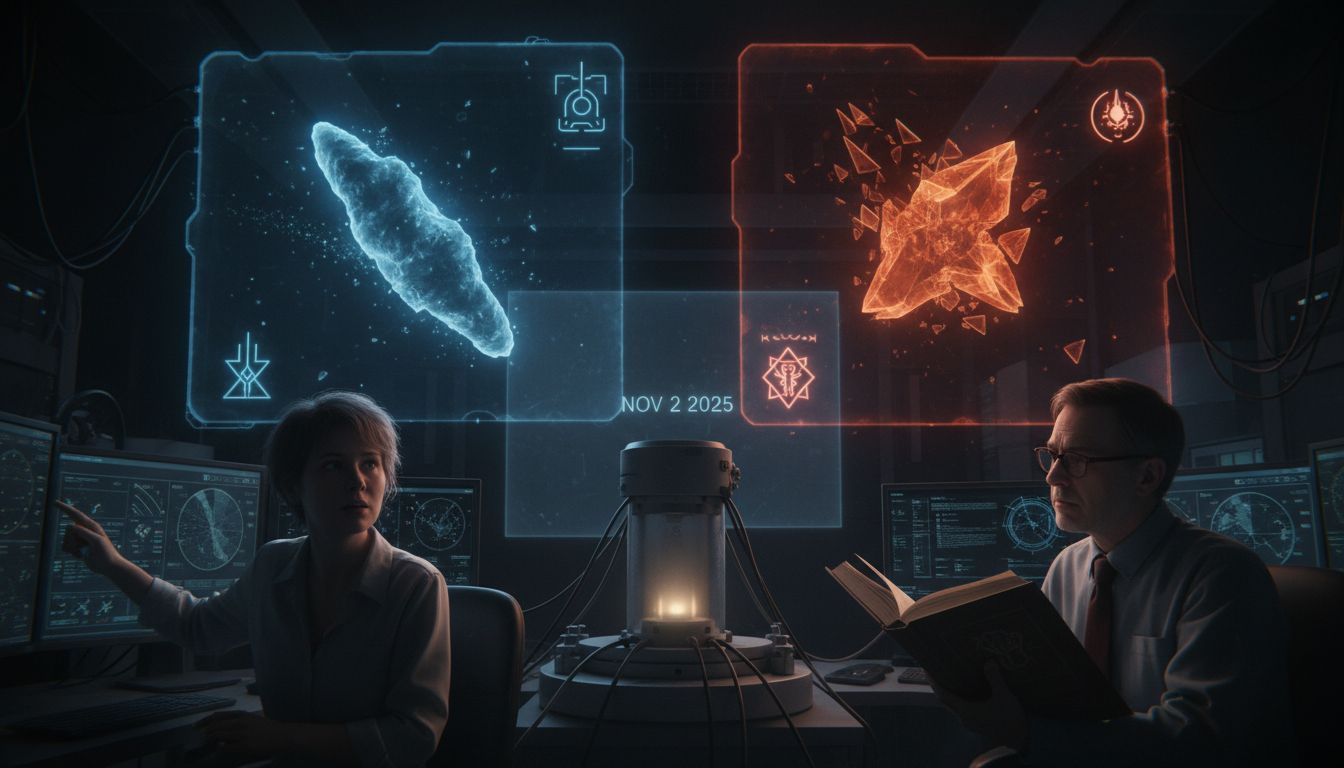
On 2 November 2025, four days after the interstellar object 3I/ATLAS passed perihelion, two previously unseen images were posted on a dedicated forum. The black‑and‑white surveillance frame showed a bright core with structured emissions and geometric patterns, while the full‑color image displayed a massive green coma, a white‑pink core and directed plasma streams—behaviour not typical of a natural comet.
Both images were stamped with the cryptic labels C/2025 N1 UMBRA‑3/C, CASSANDRA / ORACLE VI, and ARGUS‑VIS. Over the next eleven days a small research team investigated the meaning of these designations.
1. The “Cassandra” Paper (2005)
At the 57th International Astronautical Congress in Valencia, Spain, a paper titled “Cassandra: A strategy to protect our planet from Near‑Earth Objects” was published (Document ID: IAC‑06‑A3.5.07). The abstract listed keywords such as Asteroids, Moon, Kuiper Belt, RADAR, Commercial off‑the‑Shelf, Nuclear Explosives.
The paper outlined a four‑step planetary‑defense architecture:
- Detect threatening objects at extreme distances.
- Track them continuously through cislunar space.
- Maintain “persistent custody” from beyond geosynchronous orbit.
- Coordinate defensive response via a distributed sensor network.
In 2005 the system was purely theoretical. By 2025, according to the leaked images and internal documents, the Cassandra architecture appears to have been fully operational, though never publicly disclosed.
2. Funding and Procurement Pathway
In November 2022 the Air Force Research Laboratory (AFRL) awarded a $72 million contract to Advanced Space LLC for the “Oracle Family of Systems.” The award was processed through the National Security Technology Accelerator (NSTXL) and the Space Enterprise Consortium (SpEC) using an Other Transaction Agreement (OTA), a mechanism that bypasses standard DOD classification and disclosure rules.
This procurement route allowed the development of advanced surveillance hardware with minimal public documentation, matching the secrecy surrounding the Cassandra program.
3. Oracle – The Eye at Lagrange Point 1
Public AFRL statements confirm the Oracle mission’s purpose: cislunar Space Domain Awareness (SSA) from Earth‑Moon Lagrange Point 1 (EML‑1), about 326 000 km from Earth. The program includes three elements:
- Oracle‑M (Mobility Pathfinder) – a low‑cost demonstrator delivered mid‑2024 to validate deep‑space propulsion and navigation.
- Oracle‑P (Prime SSA Experiment) – slated for launch in 2026, carrying a Leidos‑built imaging payload for persistent object tracking in extended geosynchronous orbit and beyond.
- Oracle‑VI – referenced in the leaked images, likely an upgraded version of the Oracle sensor suite.
The imaging system features a wide‑field electro‑optical camera, a narrow‑field tracking camera, and autonomous processing algorithms capable of “seeing” objects without being blinded by the Sun.
4. ARGUS‑VIS – From Ground Surveillance to Space Custody
The designation ARGUS‑VIS appears alongside the Oracle labels. “ARGUS” is a legacy DARPA program (ARGUS‑IS) known for wide‑area, real‑time ground surveillance using dozens of parallel video streams. An infrared variant (ARGUS‑IR) also exists.
Technical documents leaked with the November 2 images suggest an ARGUS‑VIS sensor adapted for space, providing massive parallel imaging capability to monitor and “maintain custody” of objects in cislunar space. A 2009 photograph of the original ARGUS‑IS system is included for comparison, implying the 2025 version is a direct descendant.
5. Implications for 3I/ATLAS
The timing of the image release—four days after 3I/ATLAS’s perihelion—combined with the labels points to the object being the target of the Cassandra‑Oracle‑ARGUS network. The structured emissions and directed plasma streams captured in the images are consistent with an active surveillance or even a controlled interaction, rather than a natural cometary breakup.
If the Cassandra plan has indeed been operational for two decades, the public has been unaware of a fully functional planetary‑defense infrastructure capable of detecting, tracking, and potentially intervening with interstellar objects.
6. Conclusion
The leaked visuals and accompanying documentation reveal a covert, twenty‑year‑old planetary‑defense architecture that moved from academic theory to an operational system in 2025. Central to this system are the Cassandra detection network, the Oracle cislunar SSA satellites, and the ARGUS‑VIS sensor suite. The interstellar visitor 3I/ATLAS appears to have been the first publicly observable target of this hidden infrastructure, raising profound questions about transparency, oversight, and the future of space security.