Overview
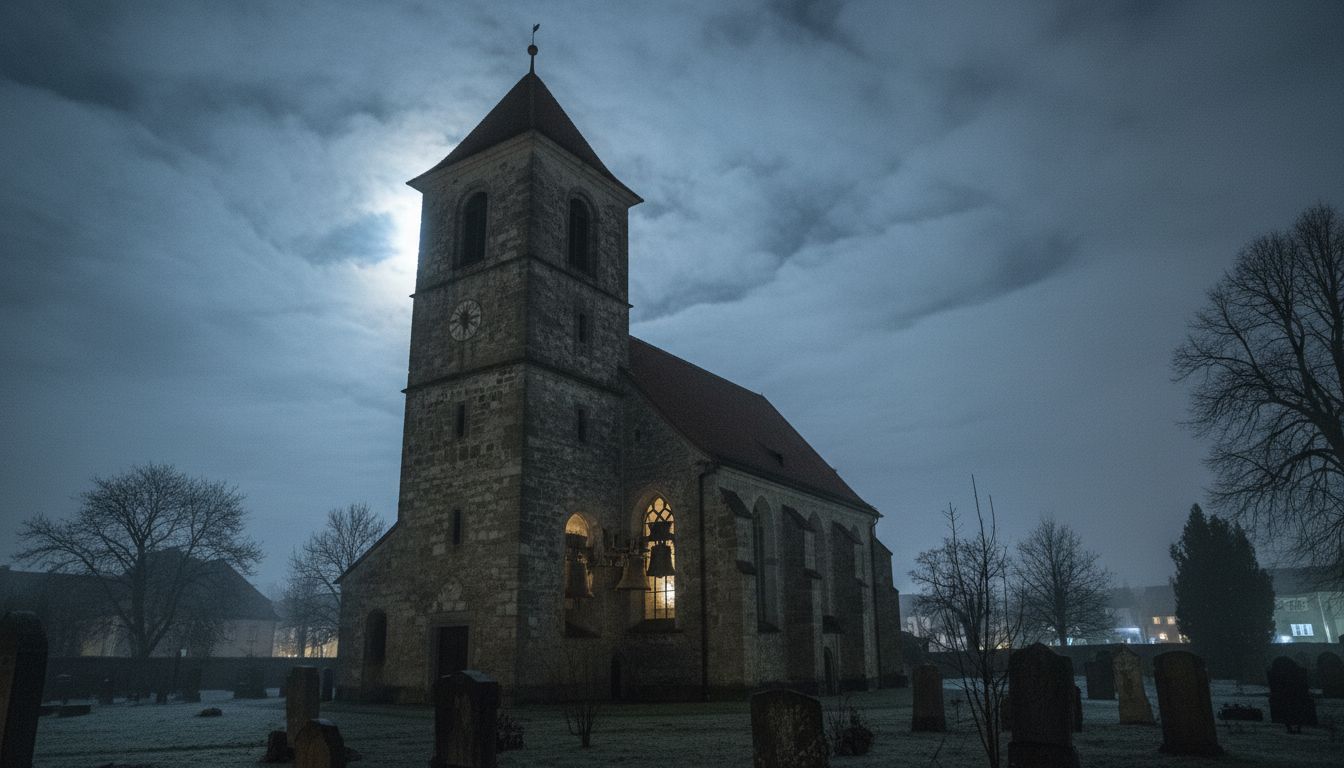
A long-standing local legend associates St. Mary Ramersdorf Church (Sankt Maria Ramersdorf) in Munich with ghostly appearances, midnight bells and supernatural judgment. According to a recent account published by Moon Mausoleum on Nov. 11, the church bells were once believed to summon the dead during the “witching hour,” when spirits allegedly gathered on the heath surrounding the church.
The story is presented as folklore rather than a documented historical event. No evidence is provided that ghosts appeared, that people were beheaded, or that paranormal activity occurred at the site. The account reflects the way religious landmarks, cemeteries and nighttime bell sounds have often become connected with local supernatural traditions.
A Historic Pilgrimage Site
Located in Munich’s Ramersdorf-Perlach district near the A8 motorway, the church is described by the source as a parish and pilgrimage church with a tower approximately 58 meters high. Its history stretches back centuries: the settlement was mentioned in a document from 1315, while a chapel may have existed there as early as the 11th century, when the area was known as Rumoltesdorf.
The church’s importance grew around a crucifix said to have been presented to Emperor Louis IV by Antipope Nicholas V and later donated to the church by one of the emperor’s sons, probably Duke Otto V. The building was remodeled and enlarged in the late Gothic style shortly before 1400. Its distinctive onion dome was added in 1791 after lightning struck the tower.
Ramersdorf’s pilgrimage tradition expanded significantly in 1683. The source recounts that seven Munich cloth merchants vowed to establish a 30-day Marian devotion if Vienna were freed from the Ottoman siege. That observance, known as the “Women’s Thirty Days” pilgrimage, continues to form part of the church’s religious and cultural legacy. Artists including Erasmus Grasser and Jan Pollack also contributed to the church’s decoration.
The Legend of the Damned
Against this historical setting, the legend describes a far darker scene. On certain nights, the bells were said to toll at midnight, prompting ghostly figures to rise from nearby burial grounds and assemble on the heath. The spirits supposedly held court, judged the damned and beheaded those condemned before the bell rang again.
The tale may draw on the church’s former rural surroundings. Moon Mausoleum describes the area as a largely barren heath where little grew, creating an isolated landscape after dark. Before modern roads and urban development transformed Ramersdorf, the combination of open ground, a churchyard and resonant bells could have provided fertile conditions for stories about the dead returning to conduct their own supernatural proceedings.
Legend Versus Evidence
The account states that the heath has since disappeared, replaced by the developed Munich district surrounding the church. It also suggests that the ominous bell tolling still echoes nightly at midnight, although it provides no independent documentation or historical record confirming that claim. The source does not identify eyewitnesses, archival reports or church records supporting the alleged hauntings.
As a result, the story is best understood as a cultural legend attached to one of Bavaria’s historic pilgrimage sites—not as a verified paranormal incident. The enduring appeal of the Ramersdorf tale lies in its contrast between the church’s documented religious history and the unsettling image of the dead gathering beneath its tower.


