Overview
Meredith Spearman’s latest essay, “The Last Lesson of Jacques Vallée,” argues that UFO and UAP research is at risk of losing one of its founding insights: the human experience of an encounter is not secondary to the data, but central to it. Using Jacques Vallée’s career as a guide, Spearman contends that the field increasingly privileges instruments, sensors, and official records while treating witnesses as unreliable bystanders. In her view, that is a profound shift from the mindset that animated the early days of serious UFO study, when researchers understood that the phenomenon had to be examined as both a physical and a human event.
A Photograph That Captures an Early Ethic
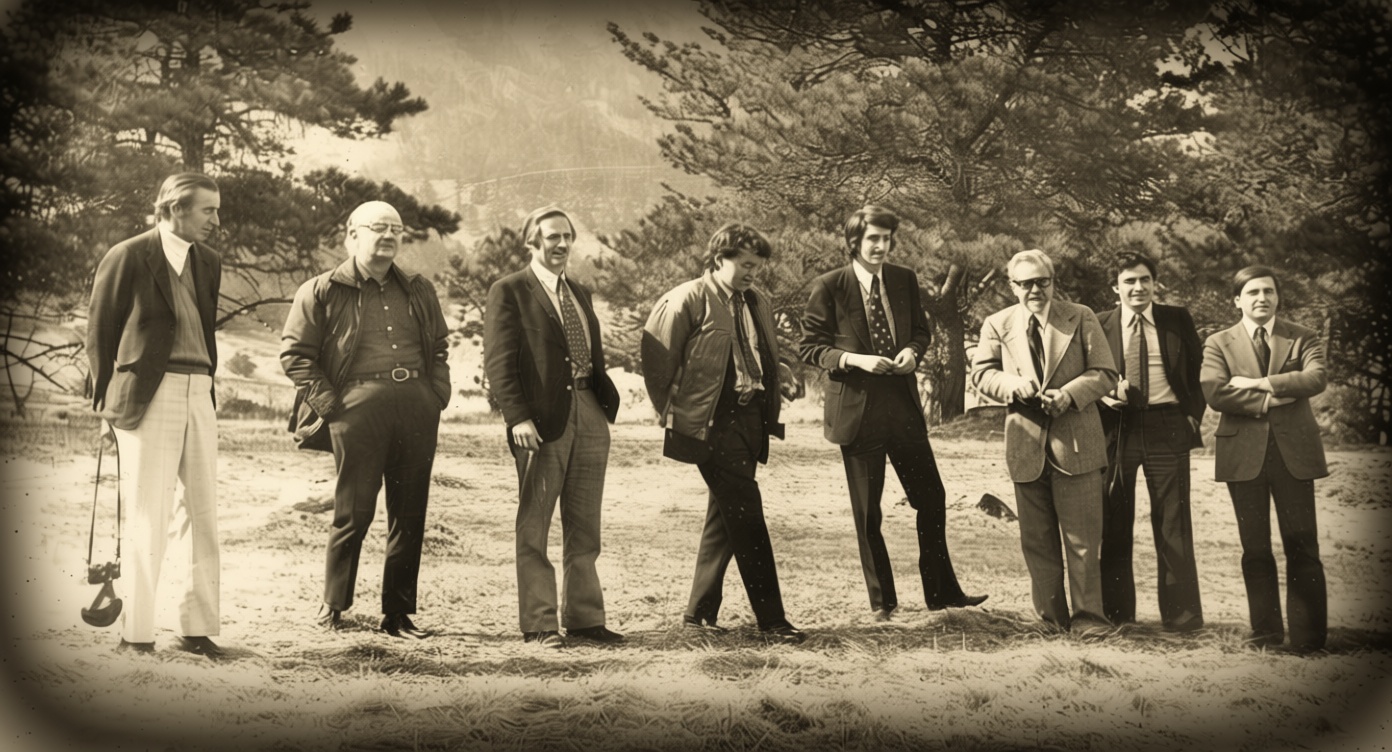
Spearman anchors her argument in a striking photograph from 1966, taken by Ted Phillips outside Boulder, Colorado, showing eight men assembled in a field with the Flatirons in the background. The group included J. Allen Hynek, Jacques Vallée, psychiatrist and anthropologist Douglass Price-Williams, psychologist Leo Sprinkle, statistician Dave Saunders, NASA’s Dick Henry, Claude Poher, and Fred Beckman of the University of Chicago Hospital. What makes the image notable, Spearman writes, is not only the mix of disciplines, but the fact that nobody appears to regard it as unusual. Psychiatry, psychology, anthropology, statistics, medicine, physics, and astronomy were all present at the same table.
For Spearman, that photograph captures the spirit of the Invisible College, the informal network Vallée and Hynek helped build when institutional support for UFO research was weak. The lesson of that era, she argues, was that the phenomenon could not be understood through skyward measurements alone. It was also unfolding in memory, belief, culture, and personal experience. In other words, the witness was not a problem to be eliminated from the analysis; the witness was part of the event itself.
Witness Experience as Core Evidence
That point becomes the essay’s central warning. Spearman says contemporary UAP discourse often elevates sensor data, metallurgical claims, and questions about classified programs while sidelining the people who report encounters. The result, she suggests, is a research culture that treats the witness as “interference,” rather than as a source of meaning and evidence. She argues this is a departure from the field’s origins, where investigators recognized that any encounter had consequences before, during, and after the sighting — including effects on perception, identity, and life trajectory.
In Spearman’s telling, Vallée resisted any effort to isolate one piece of the puzzle and call it the whole. His subject was never just the object in the sky; it was the larger system connecting the object, the report, the institution, the culture, and the person who experienced it. That perspective, she suggests, remains one of his most important contributions and one of the most easily forgotten.
Vallée Beyond the “Mystic” Label
Spearman also pushes back against the popular image of Vallée as merely the “mystic” of ufology or the theorist of Magonia and the “control system.” While acknowledging those ideas, she says that portrait leaves out another side of Vallée: the informaticist. He built computerized UFO catalogues at a time when computers were still primitive tools, and in the 1960s he also developed an artificial-intelligence system for astronomical research. That technical work, Spearman implies, reflects a mind committed to organizing complex data without flattening its human context.
Why It Matters Now
The essay’s broader argument is that modern UAP research may be becoming more sophisticated in tools while less mature in perspective. As hearings and debates focus on airspace, surveillance, declassification, and sensor arrays, Spearman warns that the field risks forgetting what Vallée’s generation knew instinctively: the phenomenon is inseparable from the people it affects. Her conclusion is not that instrument data should be dismissed, but that it should be interpreted alongside witness testimony rather than above it. If the field loses that balance, she suggests, it may gain more information and understand less.