Overview
A Munich folklore tradition tied to St. Peter’s Church says a black-hooded figure seen in the cemetery served as an omen of death during the medieval plague years. The story, preserved in local retellings and recently highlighted by Moon Mausoleum, reflects how communities across Europe used supernatural imagery to explain the terror of the Black Death. Rather than presenting a historical record of events, the legend captures the fear and uncertainty that surrounded one of Europe’s deadliest pandemics.
The Legend of the Cemetery Figure
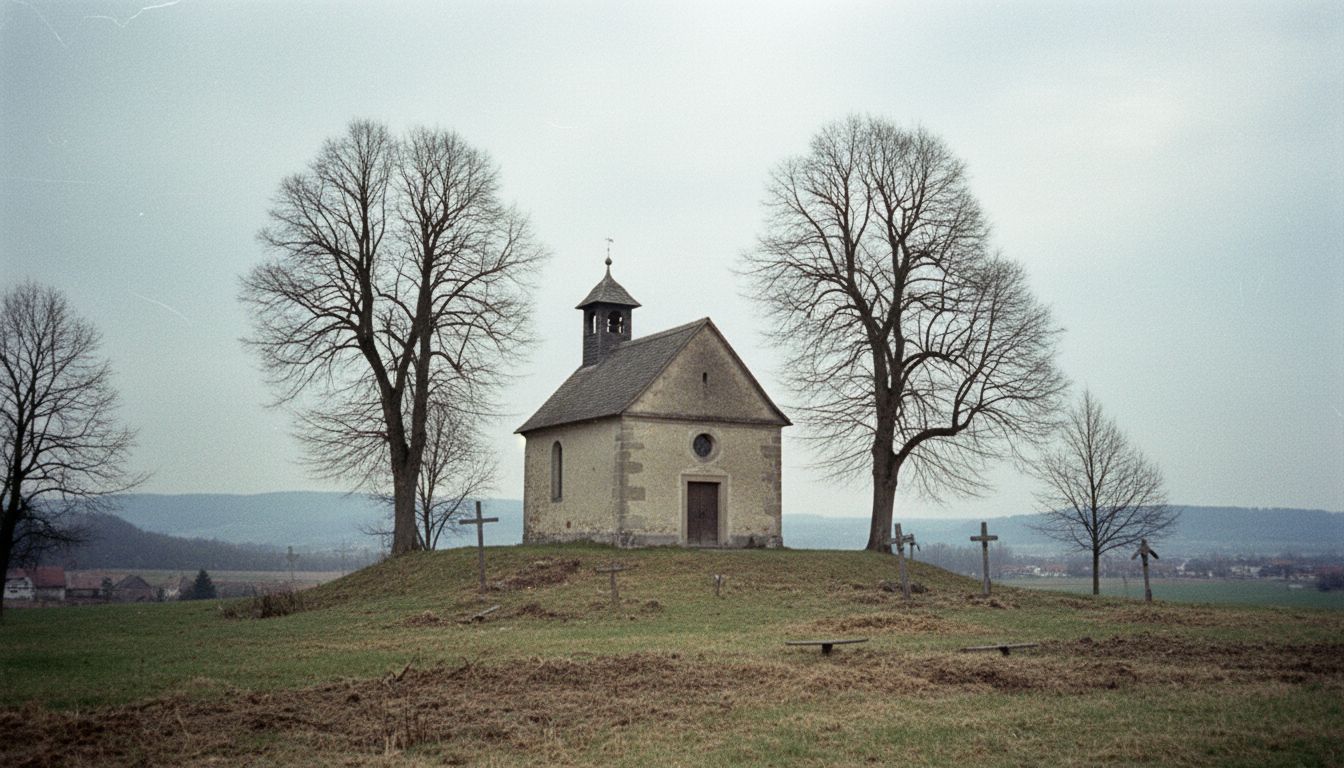
According to the tale, the story begins in 1349, when a maid walking home along Kaufinger Street—now one of Munich’s best-known shopping districts—took a shortcut through the cemetery at Old Peter’s Church, as St. Peter’s is often called. In the dim light, she reportedly saw a black, ragged figure sitting on a grave. Terrified, she ran on, only to see the figure apparently following her, with “bony fingers tapping in rhythm” as she fled. When she finally reached her destination and locked the door behind her, the figure was said to be waiting on the step. In the legend’s final twist, the apparition grinned and declared, “I am the Black Death.”
The imagery is typical of plague-era folklore: darkness, skeletal features, and a sudden human encounter with death itself. Stories like this were not unusual in medieval Europe, where unexplained disease often inspired warnings, omens, and moral lessons wrapped in supernatural language.
Munich During the Plague Years
The legend is set against a grim historical backdrop. When the Black Plague struck Munich in 1349, nearly half the city’s population is said to have died. Some historians cited in the source also suggest that plague outbreaks may have returned to Munich as many as 25 times between the mid-14th and late-17th centuries, a period spanning roughly 350 years. In such an environment, folklore would have offered a way to make sense of repeated catastrophe, even if it could not prevent it.
The Church and Its Place in the City
St. Peter’s Church itself gives the legend an added sense of place. As Munich’s oldest parish church, its origins likely reach back to the 12th century, with the Gothic structure consecrated in 1294. Its 91-meter tower, nicknamed “Old Peter,” remains one of the city’s landmarks. The church also had its own cemetery in the 15th century, lending historical plausibility to the story’s setting. Much of the building was later damaged in World War II, leaving only the tower stump and parts of the choir before restoration.
Folklore as a Record of Fear
While there is no evidence that the black-hooded figure was anything more than legend, the story remains important as a window into how medieval people understood death, disease, and warning signs. European plague folklore often blurred the line between history and myth, turning epidemics into stories that could be remembered, retold, and localized to familiar landmarks. In Munich, that role falls to St. Peter’s Church—not as a source of verified prophecy, but as a cultural symbol of how a city once imagined death walking among its graves.