Overview
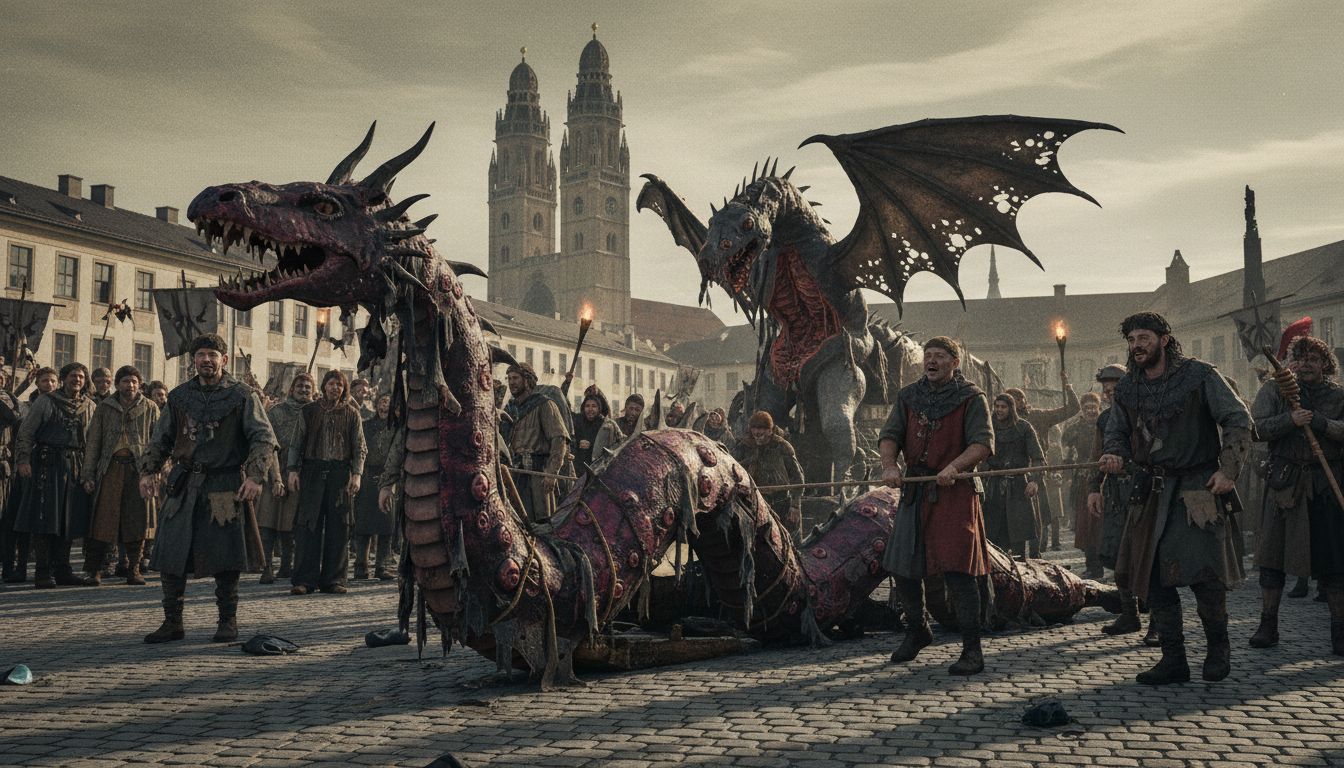
Munich’s centuries-old plague dance traces its origins to a grim blend of history and folklore, according to local legend tied to the city’s medieval struggle with disease. During the Black Plague of 1349, nearly half of Munich’s population is said to have died, and some historians have suggested the city may have suffered repeated outbreaks over a period of roughly 350 years. In the shadow of those losses, stories spread about what had caused the suffering — among them, the tale of a plague-ridden lindworm that crawled out from the darkness, terrorized the city, and brought disease with it.
The legend still has a visible place in Munich’s urban landscape. At the northern edge of Marienplatz, the city’s central square, the New Town Hall displays dragon imagery connected to the story. The building’s western corner, where the Wurmeck Tower rises, features a large dragon and three stone reliefs that recount the myth. According to the tale, the lindworm emerged from the earth in the city center — possibly at the very site of the old marketplace — and spread deadly plague through its poisonous breath.
A Dragon in Stone
The New Town Hall, or Neues Rathaus, now forms the northern side of Marienplatz and houses Munich’s city government, including the city council and the offices of the mayors. Although the municipality moved there from the Old Town Hall in 1874, the dragon symbolism on the building reflects a much older tradition. The Wurmeck Tower itself was first completed in 1906, and the carved scenes above the dragon depict the creature attacking citizens while others flee in fear.
One panel shows the lindworm ascending as a man collapses from its poisonous breath, while women and children run for safety. Another depicts mercenaries and townspeople preparing to fight back, including the loading of a cannon. The imagery underscores how the plague was once understood not only as a medical catastrophe, but as a near-mythic assault on the city — something to be confronted through both civic resolve and symbolic action.
Folklore, Faith, and Civic Memory
The lindworm legend belongs to a broader tradition in German folklore. The creature is described as a snake- or dragon-like being, often bipedal, though sometimes shown with four or more legs, and usually lacking wings or bearing only small ones. In the Munich story, it functions as both monster and explanation: a supernatural embodiment of disease itself. That theme also appears elsewhere in the city, including on the Marian column in Marienplatz, where one of the four putti commemorates the struggle against plague through the image of a basilisk, another mythic creature associated with deadly poison.
Such symbols reflect how deeply the plague shaped Munich’s identity. The city endured repeated outbreaks, and over time those experiences became woven into legend, architecture, and public ritual. The dragon and basilisk are not simply decorative; they are reminders of a period when disease was overwhelming, explanations were uncertain, and communities looked to myth to make sense of suffering.
A Dance That Endured
Out of that history emerged a ceremonial dance that, according to the tradition, has continued through Munich for more than 500 years. The custom is presented as a symbolic response to the end of the plague and the defeat of the dragon — a public act of remembrance and renewal after catastrophe. Whether viewed as folklore, cultural heritage, or collective memory, the story reveals how Munich transformed fear into ritual.
Today, the legend remains part of the city’s identity, preserved in stone reliefs, public monuments, and long-running civic traditions. It is a reminder that even in the aftermath of epidemic, cities often carry forward not just the memory of loss, but also the stories they create to endure it.