Overview
A theoretical physics paper released on October 1, 2026, proposes that empty space may be better understood as a physical medium: a “superfluid aether” through which matter, light and forces move. Titled “An Argument for Superfluid Aether Theory: A Hydrodynamic Interpretation of Relativity, Gravity, and Quantum Unification,” the paper presents a mechanical alternative to aspects of Einstein’s general relativity and attempts to connect gravity with quantum mechanics.
The concept described in the accompanying video is not part of the established scientific consensus. The available summary does not identify peer-reviewed validation, experimental confirmation or specific independent assessments of the proposal. Its claims should therefore be regarded as speculative until they are supported by mathematical analysis, reproducible predictions and testing against existing observations.
Relativity and the Proposed Aether
At the center of the theory is the assertion that the vacuum is not a true void but a fluid-like substrate. In this model, particles and observers would be wave excitations within that medium. Relativistic effects are consequently explained through mechanical interactions rather than spacetime geometry alone.
The paper reportedly interprets time dilation as the result of increased resistance within the medium, causing internal signals in a moving clock to follow longer paths. Length contraction, meanwhile, is attributed to physical compression produced by pressure and motion through the proposed fluid. These interpretations differ from the standard formulation of special and general relativity, which has been repeatedly confirmed through observations and experiments.
Gravity, Black Holes and Cosmic Structure
The theory reimagines gravity as an inward flow of superfluid toward “matter sinks.” Earth’s gravitational acceleration is described as the apparent result of objects being carried upward while aether flows downward at approximately 9.81 meters per second squared.
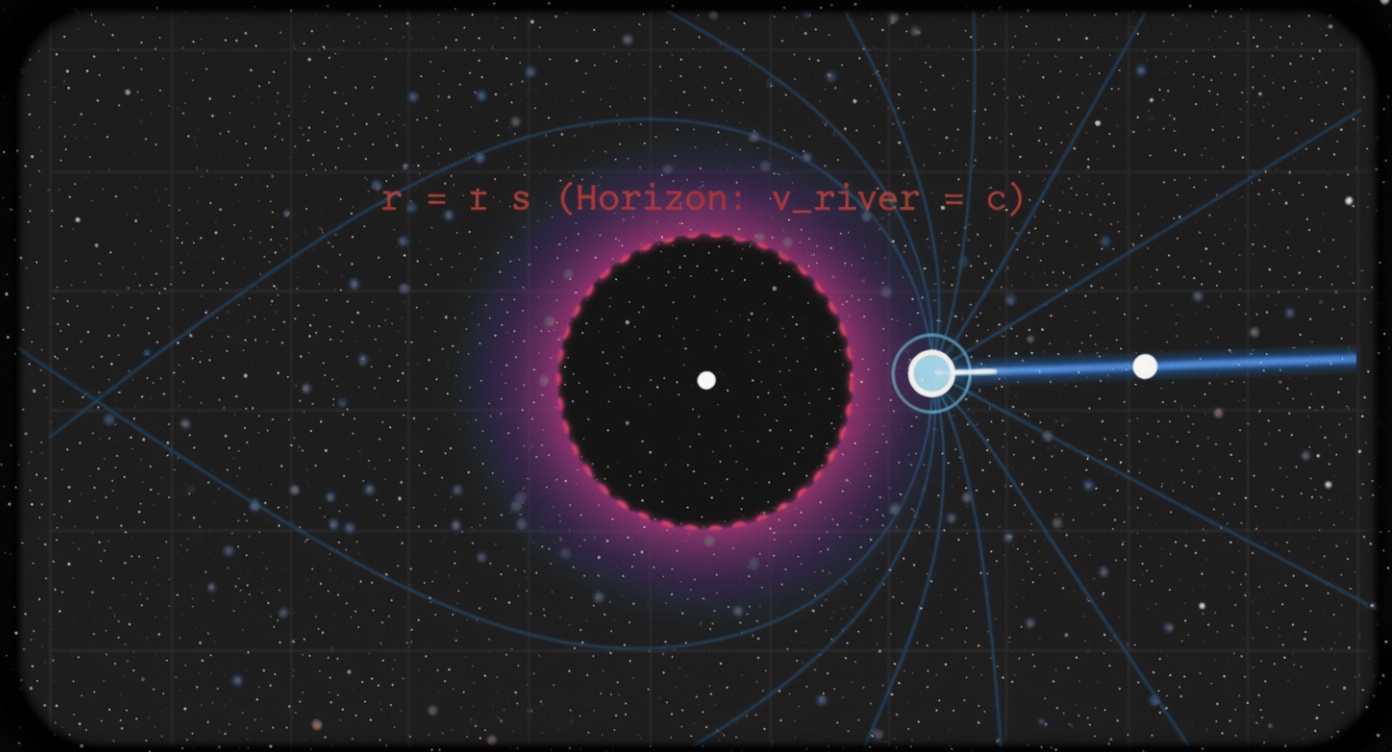
Black holes are compared to “supersonic waterfalls.” According to the proposal, the medium reaches light speed at the event horizon and becomes supersonic inside it, preventing light from escaping because it is swept inward by the flow. The framework also seeks to avoid mathematical singularities by suggesting that the fluid has a finite density limit at extremely small, potentially Planck-scale distances.
On a cosmic scale, galaxies are characterized as quantum vortices. Their rotation, the paper argues, could account for the unexpectedly high speeds of stars near galactic edges without requiring dark matter particles. Similarly, cosmic expansion is attributed to tension in an increasingly stretched fluid, offering an alternative interpretation of dark energy.
Implications for UAP Propulsion
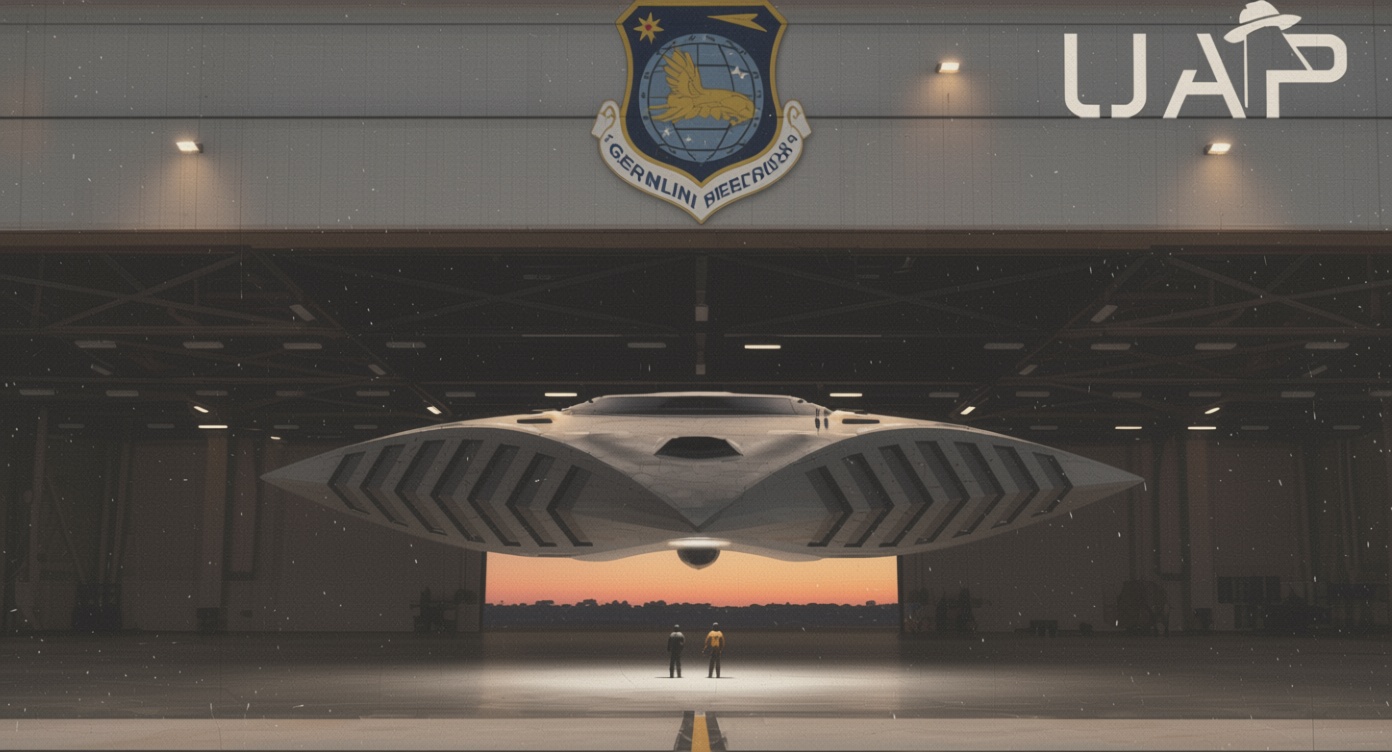
A substantial portion of the proposal reportedly concerns unidentified aerial phenomena. It suggests that if space behaves as a polarizable dielectric lattice, a vehicle might interact directly with that medium by creating an electrical imbalance. Concentrating electrons on one side of a craft, the theory claims, could generate an asymmetric force and produce thrust without conventional engines or propellant.
The proposed mechanism is also said to enable rapid acceleration, sharp maneuvers and reduced inertial forces for occupants. However, the summary does not provide engineering demonstrations, measured UAP data or experimental evidence showing that such “aetheric coupling” is physically achievable. Reports of unusual aerial objects remain separate from proof of any particular propulsion theory.
Scientific Context
The paper’s broader ambition is to provide a unified, mechanical description of relativity, gravity and quantum phenomena. Its proponents portray the idea as a possible foundation for new physics, but the available material contains no documented consensus from physicists or evidence that it resolves known experimental problems.
For the proposal to gain scientific acceptance, it would need to produce precise predictions that differ from existing theories and survive rigorous testing. Until then, the superfluid aether remains an unverified theoretical framework, notable for its attempt to connect cosmology, fundamental physics and UAP propulsion, but not an established explanation of the universe.