Overview
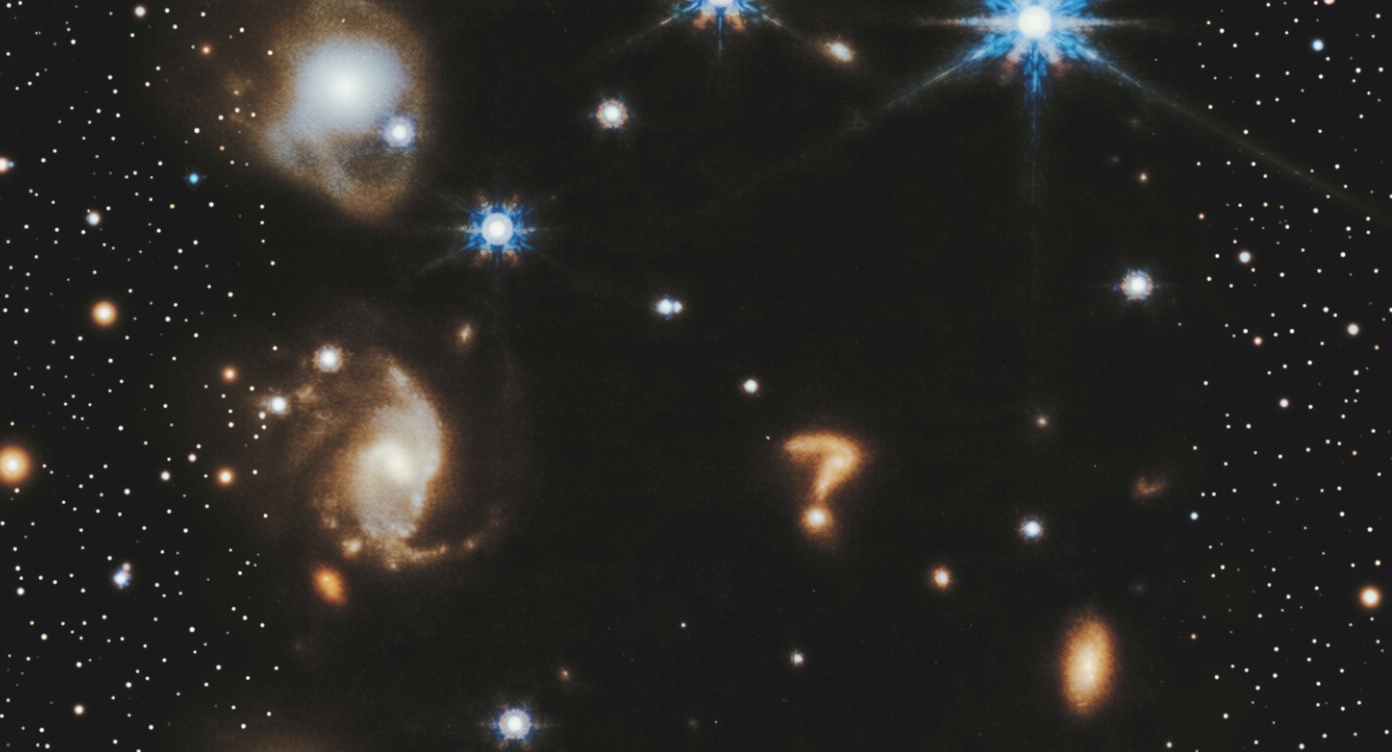
NASA and other scientists continue to confront a growing list of deep-space mysteries that resist easy explanation, underscoring how much of the universe remains observationally and theoretically unresolved. A recent piece surveying five bizarre cosmic phenomena highlights how even the most advanced instruments, including the James Webb Space Telescope (JWST), are producing findings that do not fit neatly into established models of physics and galaxy formation.
Early-Universe Objects Defy Expectations
The article places particular emphasis on one of the most striking findings from JWST observations: a population of compact, unusually bright objects known as “Little Red Dots.” Rather than revealing only the small, infant galaxies astronomers expected near the edge of the observable universe, the telescope has detected sources that appear far more energetic and structurally complex than anticipated. One especially puzzling object, seen hundreds of millions of years after the Big Bang, is described as being roughly solar-system sized while emitting 100 billion times more energy than an ordinary star.
Researchers cited in the piece suggest that this may point to a previously unknown class of object, informally referred to as a “black hole star.” In this scenario, a supermassive black hole would sit inside a dense cloud of hydrogen, with the surrounding material glowing intensely as it is heated from within. That idea remains speculative, but it reflects a broader scientific challenge: the early universe may have formed large structures much faster, and in stranger ways, than current models predicted.
Other Cosmic Puzzles Remain Unsettled
The article also points to other deep-space oddities that have long intrigued astronomers, including the Boötes Void, sometimes called “the Great Nothing.” Vast regions like this, where comparatively few galaxies appear to exist, continue to raise questions about how matter was distributed across the cosmos after the Big Bang and whether current surveys fully capture the scale and structure of the universe.
While the source material does not fully detail all five mysteries in this excerpt, the framing suggests a consistent theme: modern astronomy is increasingly encountering phenomena that look less like isolated anomalies and more like clues that existing theories may be incomplete. From unusually bright early-universe objects to immense cosmic voids, the frontier of space science is still yielding surprises.
What It Means for Astronomy
For NASA and the broader scientific community, these discoveries are not just curiosities; they are pressure tests for fundamental physics. Theories of star formation, black hole growth, and galaxy evolution were built on decades of observation, but new data from JWST and other deep-space tools are exposing gaps in those frameworks. In practice, that means scientists must consider whether the answer is improved measurement, revised theory, or both.
As researchers continue to analyze these signals, the most important takeaway may be humility. The universe is proving to be more diverse and more difficult to categorize than expected, and the emerging picture is one in which many of the cosmos’ oldest questions remain open.