Overview
A study highlighted by NBC News is examining whether unexplained flashes recorded in the night sky during the early 1950s may have been connected to UFO reports and human nuclear testing. The research focuses on photographic plates taken before the launch of Sputnik 1 in 1957, when no human-made satellites were known to be orbiting Earth. While the findings have attracted attention because they could suggest surveillance by an unknown technology, the evidence remains under investigation and does not establish an extraterrestrial explanation.
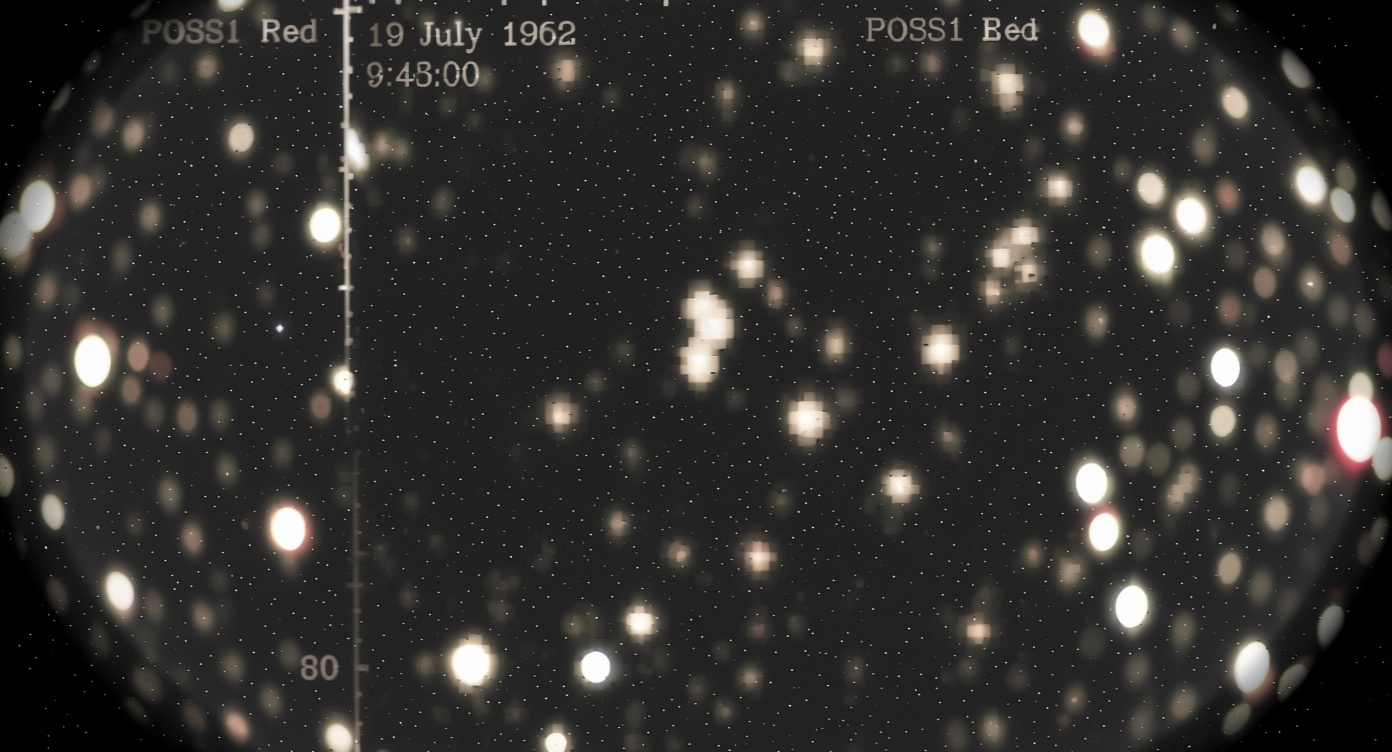
Astronomer Beatriz Villarroel and researcher Dr. Stephen Bruehl analyzed archival observations from California’s Palomar Observatory. The plates contain numerous brief points of light, known as “transients,” dating as far back as 1952. In modern astronomy, similar flashes can occur when sunlight reflects from the surfaces of satellites or pieces of space debris. The apparent presence of such events before the beginning of the satellite era has prompted researchers to ask whether the flashes had another explanation.
Evidence and Patterns
According to the report, the researchers identified patterns they say are consistent with objects located above Earth rather than with ordinary photographic defects or atmospheric phenomena. The number of flashes reportedly declined in portions of the sky affected by Earth’s shadow, a pattern that would be expected if the objects were reflecting sunlight and could no longer be illuminated. The team also said it had considered and sought to rule out potential alternatives, including cosmic rays, atmospheric effects and radiation associated with nuclear detonations.
One of the study’s most notable claims involves a reported relationship between the flashes and above-ground nuclear tests. In 1954, roughly 200 transients were recorded over the Pacific Ocean one day before the United States conducted its second-largest hydrogen-bomb test, according to the summary of the research. Additional groupings were reportedly observed over Arizona and New Mexico around the time of nuclear tests carried out in Nevada. Researchers argue that the geographic and temporal patterns merit further examination, although correlation alone does not demonstrate that the flashes were monitoring the tests.
The Non-Human Technology Hypothesis
Bruehl acknowledged that attributing the observations to “non-human technology” is unconventional. He nevertheless described the idea as a “plausible theory” if the objects were genuinely in orbit and appeared to be tracking nuclear activity before humans possessed the ability to place satellites around Earth. The researchers’ interpretation has drawn interest because it would place the reported events in the context of the early atomic age, when the United States and Soviet Union were rapidly expanding their nuclear programs.
However, the available account does not provide full details of the study’s methodology, statistical analysis, or peer-review status. Nor does it identify the objects directly. The flashes could potentially reflect an overlooked natural process, an archival or photographic artifact, or another conventional explanation that has not yet been recognized. Consequently, the findings should be viewed as an unresolved scientific question rather than proof of extraterrestrial visitation or technological surveillance.
Expanding the Historical Record
The research team plans to broaden its investigation by examining additional photographic archives. Villarroel said that China’s ongoing digitization of historical plates could offer an important new source of evidence. The researchers also hope to study materials from European observatories, searching for similar flashes that might correspond with Soviet nuclear tests conducted in Kazakhstan.
If independent archives reveal comparable patterns, they could help determine whether the observations were localized recording problems or part of a broader phenomenon. For now, the pre-Sputnik transients remain unexplained. Further access to original plates, transparent analysis and confirmation by independent researchers will be essential in assessing whether the flashes represent an overlooked chapter in the history of astronomy—or evidence of something far less familiar.