Overview
A recent NewsNation compilation revisits one of the most persistent themes in UFO reporting: claims that unidentified aerial phenomena have appeared near military installations and nuclear sites. The segment gathers together a range of accounts, from alleged surveillance of sensitive facilities to broader theories about portals, hidden programs, and classified investigations. While none of these claims has been independently verified in the compilation itself, the framing reflects a familiar pattern in UAP coverage — the intersection of national security concerns, public fascination, and unresolved testimony from military personnel.
The report lands at a time when interest in unexplained aerial events remains high, driven in part by declassified government reviews and ongoing debate over what the term UAP should encompass. For many observers, sightings near nuclear infrastructure are especially provocative because they raise questions about whether unusual objects are simply misidentified aircraft or something more difficult to explain. For others, the issue is less about proving extraordinary claims than about understanding why so many witnesses, including trained observers, continue to describe anomalous behavior near sensitive sites.
Claims Near Nuclear Facilities
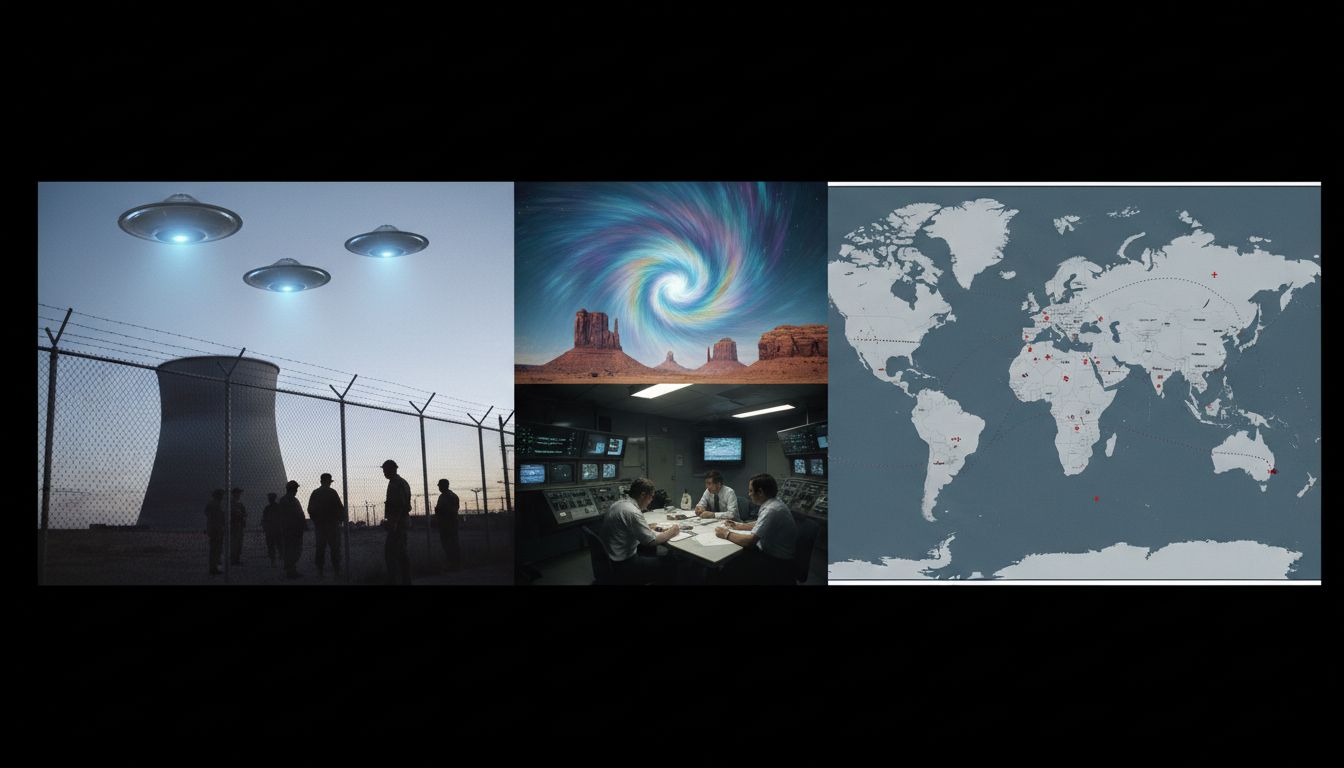
One of the central threads in the compilation is the long-running allegation that UFOs have appeared around nuclear weapons bases, missile fields, and other restricted military areas. Such claims have circulated for decades and have been referenced in books, documentaries, and congressional discussions. Advocates point to testimony from former military officers who say they observed unexplained objects operating in highly controlled airspace, sometimes in apparent disregard for security protocols.
Skeptics, however, caution that sightings around nuclear facilities can be amplified by the extraordinary stakes of the locations themselves. Military personnel may be more likely to report unusual activity, and the sensitivity of the environment can make routine events seem more significant. Even so, the compilation underscores why these stories persist: if an object is seen near a nuclear site, the public instinctively asks whether it was a drone, an aircraft, a sensor anomaly, or something that has yet to be identified.
Portals, Hidden Programs, and Speculation
The NewsNation piece also touches on more speculative ideas, including theories about portals and hidden government programs. These concepts are common in the wider UFO discourse, but they remain unproven and controversial. Claims of secret programs often stem from witness interviews, insider allegations, or references to classified research that cannot be easily checked by the public. As a result, they tend to live in the space between rumor, testimony, and legitimate concern about government transparency.
That ambiguity has helped fuel a thriving ecosystem of online discussion and documentary programming. Yet it also creates challenges for journalism. Without documentary evidence or corroboration, assertions about covert retrievals, nonhuman technology, or portals remain claims — not established facts. Responsible coverage of the subject increasingly separates what witnesses say they saw from what can actually be demonstrated.
Broader Context and Unresolved Questions
The compilation places these stories against a backdrop of global tensions, where military readiness, surveillance, and airspace security are already major concerns. In that environment, any unidentified object near a strategic site is likely to attract attention, regardless of whether it is ultimately mundane or unexplained. The broader UAP debate has therefore become as much about transparency and risk assessment as it is about the possibility of extraordinary intelligence.
What remains clear is that the public appetite for answers has not faded. The enduring appeal of these stories lies in their mix of mystery and consequence: if some sightings are genuine anomalies, they may reveal gaps in defense systems or aviation awareness; if they are misidentifications, they still expose how quickly uncertainty can spread in an age of heightened geopolitical anxiety. For now, the NewsNation compilation adds another chapter to a debate that continues to move between evidence, speculation, and unresolved testimony.