Overview
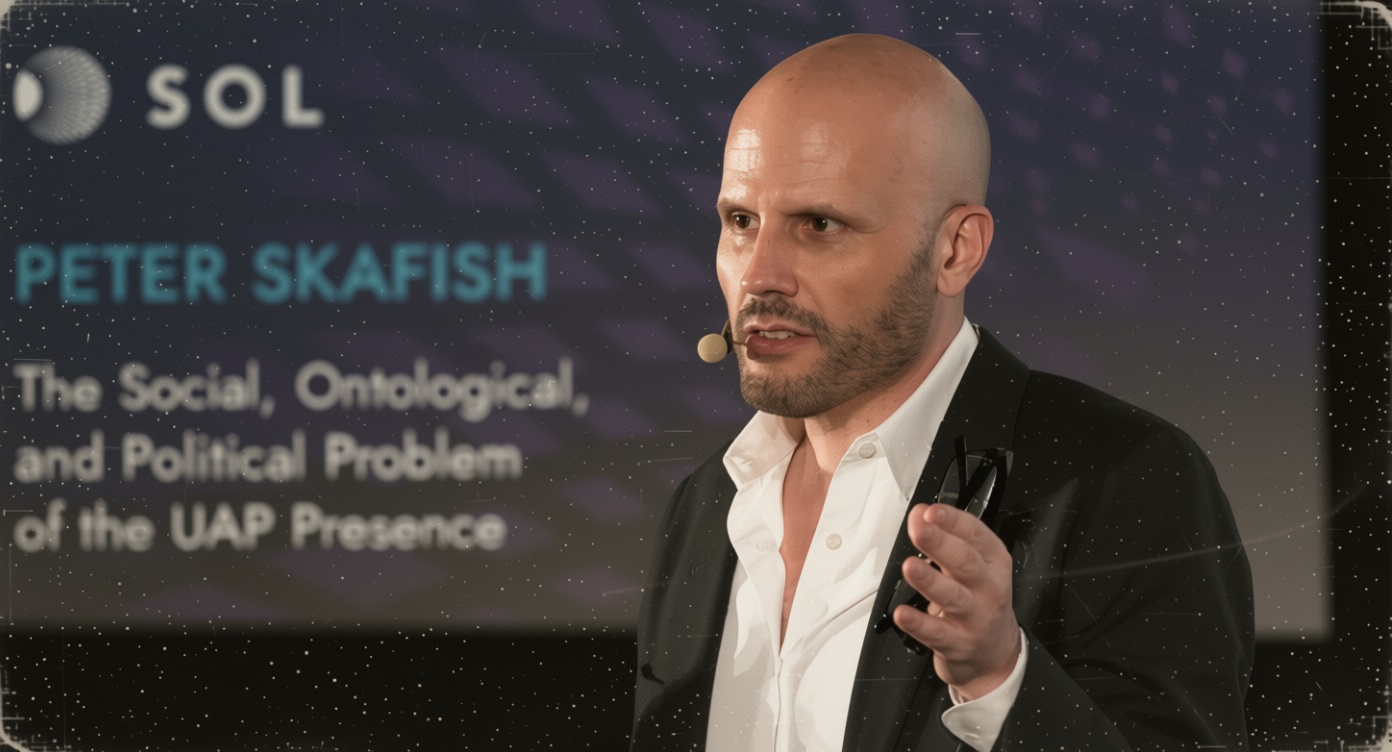
At the 2025 Sol Foundation Symposium in Baveno, Italy, Dr. Peter Skafish delivered a keynote address examining what he called “The Social, Ontological, and Political Problematic of the UAP Presence.” The event, held from October 25 to 27, brought together speakers focused on the scientific, cultural and policy implications of unidentified anomalous phenomena (UAP).
Skafish, a co-founder of the Sol Foundation, argued that UAP should not be treated solely as a technical or military question. In his presentation, he described the subject as a multidimensional challenge involving science, philosophy, public institutions and humanity’s understanding of its place in the universe. His central premise was that the 21st century could eventually be defined by a shift from widespread uncertainty to the possibility that Earth is being monitored or visited by non-human intelligence—entities he referred to as “The Others.”
The Social Dimension
The first part of Skafish’s framework focused on the role of witnesses. He argued that UAP research has often placed excessive emphasis on instrument data while undervaluing testimony from individuals who report encounters. Describing this as the “primacy of testimony,” he cited astronomer J. Allen Hynek’s work with Project Blue Book and investigations associated with the 1965 Valensole case in France.
According to Skafish, testimony should not be dismissed simply because it is subjective. Rather, he said, it should be examined alongside radar, imagery and other forms of evidence. He maintained that reports of encounters also reveal important information about human societies, memory and interpretation. Understanding alleged non-human activity, in his view, is inseparable from understanding how people collectively construct knowledge about unusual events.
Ontology and “Ontological Shock”
Skafish then addressed what he described as the ontological problem: how UAP reports challenge conventional assumptions about reality. Referring to the concept of “ontological shock,” associated with former intelligence official David Grusch and psychiatrist John Mack, he questioned the traditional division between physical objects and psychological or spiritual experiences.
Drawing on ideas linked to researcher Jacques Vallée, Skafish suggested that UAP might require a framework capable of considering physical, psychological and cultural dimensions simultaneously. He advocated a “pluralistic approach” to reality, arguing that biology, consciousness and ethics should not be treated as mutually exclusive categories. These claims remain subjects of debate, and the presentation did not establish independently verified evidence for non-human intelligence.
Political and Security Implications
The political dimension of the talk concerned government secrecy, national security and the potential consequences of responding to UAP as a military problem. Skafish warned that framing unidentified phenomena primarily as a threat could encourage an unnecessarily confrontational or bellicose response.
He referred to historical reports—including the 1976 Tehran incident, accounts from the Korean War and cases reported in Peru—in which UAP were alleged to have interfered with aircraft systems or displayed unusual maneuvers. Such accounts are disputed and vary in evidentiary quality. Skafish also identified the 2017 New York Times reporting on a secret Pentagon program as a turning point in modern public discussion of UAP.
A Call for Broader Inquiry
Skafish concluded by calling for greater academic and institutional engagement, including participation from historians, theologians, sociologists and political theorists. He argued that any future disclosure process would require “species cohesion” rather than intensified geopolitical competition.
His message was not limited to demands for additional data. He urged researchers to combine “sobriety and imagination” while assessing extraordinary claims, warning that humanity’s response could be as consequential as the phenomena themselves. Whether UAP ultimately prove to have conventional, unknown or non-human explanations, Skafish’s presentation framed the issue as a test of how societies manage uncertainty, evidence and potentially transformative ideas.