Overview
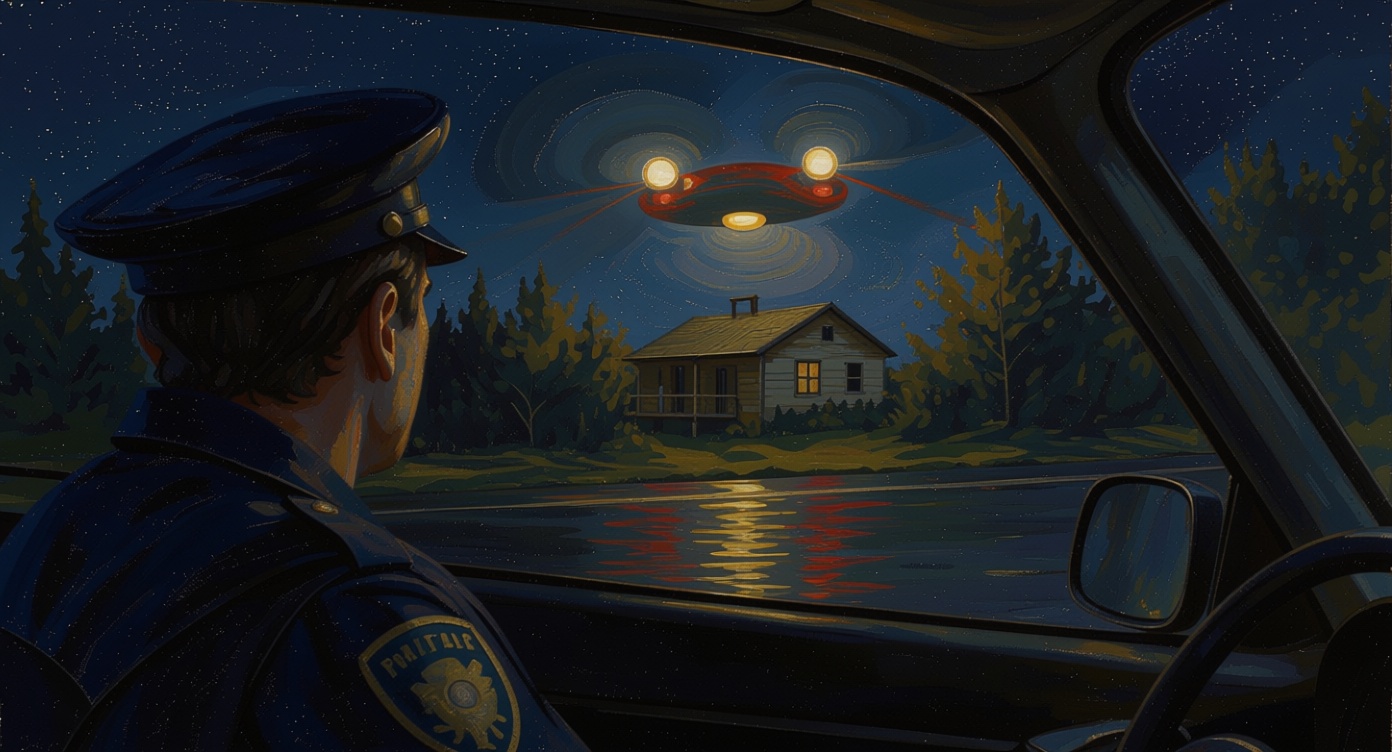
A Chesapeake, Virginia, police officer reported witnessing a large, circular object hovering silently over a residence in 1988, according to an account recorded by the National UFO Reporting Center (NUFORC) hotline. The witness, identified as police officer Robert Lunsford, estimated the object’s width at approximately 75 feet and said it remained motionless above the house during the incident.
The report is one of several unidentified aerial phenomenon accounts associated with the Chesapeake area during that period. While the incident has not been independently verified through publicly available physical evidence, Lunsford’s professional background and his description of the object’s behavior have contributed to continued interest in the case among UFO researchers.
The Reported Encounter
According to the account, Lunsford responded after receiving a report about an unusual craft positioned over a home. He described the object as circular and illuminated by bright red lights, with no apparent engine noise or other sound. Rather than moving through the sky, the craft reportedly hovered in place, creating the impression of a stationary object suspended above the property.
Lunsford’s observations were notable because he had experience both as a police officer and through military service. He reportedly said the object did not resemble any aircraft he had seen during his military career. The absence of familiar features—such as visible wings, propulsion systems, or conventional aircraft lighting—made it difficult for him to identify the object using ordinary aviation explanations.
Radar and Local Checks
The account also states that inquiries were made with nearby airports and military facilities to determine whether the object had appeared on radar. No corresponding radar return was reportedly found. That detail is central to the case, although the available account does not identify the specific radar systems consulted, the duration of the search, or whether weather, terrain, radar coverage, or technical limitations could have affected the results.
The lack of a radar contact does not, by itself, establish that the object was extraterrestrial or technologically advanced. Radar systems vary in capability, coverage, and operating conditions, and an object may fail to appear for a number of reasons. Nonetheless, the reported absence of a return added to the witness’s uncertainty and made the sighting more difficult to match to conventional aircraft activity.
Wider Chesapeake Sightings
Lunsford also reportedly noted that other similar sightings had occurred in the area around the same time. The account does not provide enough detail to determine whether those reports involved the same object, shared the same characteristics, or were independently documented by authorities. Such clusters can attract attention, but they require careful comparison of dates, locations, weather conditions, witness descriptions, and potential conventional explanations before any connection can be established.
The case was preserved through the NUFORC hotline, which has collected civilian and official witness reports for decades. Hotline testimony can provide valuable contemporaneous records, but it is generally based on personal recollection and may not include supporting photographs, video, radar data, or physical evidence.
Assessment
The 1988 Chesapeake report remains an unresolved witness account, rather than confirmed evidence of an extraordinary craft. Its significance rests primarily on the combination of an apparently experienced observer, a large object described as silent and stationary, and reported efforts to check for radar confirmation. At the same time, the absence of independently available documentation limits what can be concluded.
For researchers, the incident illustrates both the value and the limitations of historical UFO reports. A detailed account from a trained observer can warrant further investigation, but identifying the object would require corroborating records—such as dispatch logs, aviation data, radar archives, or additional witnesses—that have not been established in the material available.