Overview
A social-media post is questioning whether a purported Nikola Tesla patent for an “inertial space drive” was removed from patent databases in 1956, allegedly at the same time that advertisements for antigravity technology appeared. The material provided does not establish that such a patent was removed, nor does it document a connection between the alleged removal and contemporary advertising. The patent record cited in the post identifies a different invention: Tesla’s 1928 U.S. patent, US1655114A, titled “Apparatus for Aerial Transportation.”
The record at the U.S. Patent and Trademark Office’s Google Patents interface shows that Tesla filed the application on Oct. 4, 1927, and that it was granted on Jan. 3, 1928. The document describes a proposed aircraft combining features associated with airplanes and helicopters. It does not use the term “inertial space drive,” and the supplied text contains no reference to antigravity, reactionless propulsion or a technology capable of producing thrust without expelling mass.
What the Patent Describes
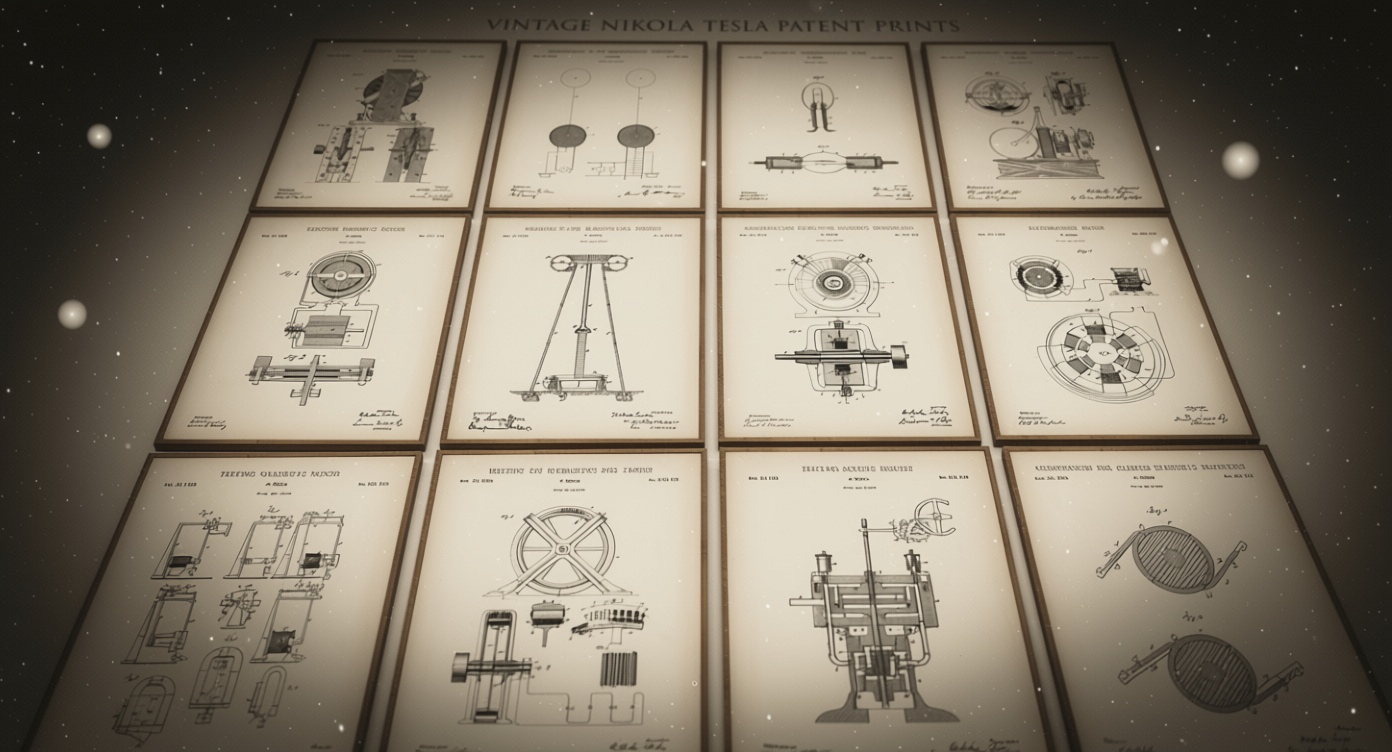
Tesla’s patent presents what he called a “helicopterplane,” designed to rise and descend vertically while also traveling horizontally. The document says the aircraft would use a prime mover and airscrew, along with mechanisms for tilting the machine, controlling it in flight and supporting it during landing.
Tesla framed the invention as a response to limitations he saw in conventional airplanes. In the patent, he wrote that airplanes were difficult to operate because they required significant forward motion to generate lift, making takeoffs and landings more hazardous and requiring specialized facilities. He also discussed helicopters and the relationship between thrust, air mass and velocity, citing principles associated with engineer W. T. M. Rankine.
The patent states that the application was “a continuation in art” of an earlier Tesla application, identified as Serial No. 499,518 and filed Sept. 9, 1921. That language indicates a procedural and technical relationship between patent applications; it is not evidence that the 1928 document involved an unconventional propulsion system. The text supplied in the source describes aerodynamic flight and propeller-based propulsion.
The 1956 Claim
The post’s central question—that the patent was removed from databases in 1956—cannot be confirmed from the cited material. No archival database record, patent-office notice, catalog entry, deletion log or contemporaneous document is provided to show that US1655114A was removed or suppressed. In addition, the patent remains accessible through the cited public record.
It is also important to distinguish between a patent’s original filing and later digital availability. The U.S. patent system’s historical records have been preserved and digitized through multiple collections, but records can be indexed differently across databases. A patent becoming difficult to find in one catalog would not, by itself, demonstrate that it was officially removed or concealed.
Advertising and Historical Context
The post also refers to advertisements for “antigravity technology” appearing around 1956. However, it supplies no advertisement, publication name, date, company, product description or independent historical source. Without those details, the alleged timing cannot be evaluated, and coincidence in dates would not establish a connection to Tesla’s 1928 aircraft patent.
Based on the available record, the document is best understood as a conventional early aviation patent describing a vertical-takeoff aircraft and related mechanical systems. Claims that it was an “inertial space drive” patent or that it was removed in 1956 remain unsupported by the evidence provided. Further verification would require authenticated patent records, archival catalogs and original examples of the alleged 1956 advertisements.