Overview
A set of photographs attributed to amateur astronomer Ralph E. Nicholson has resurfaced as a notable case in the history of 1950s UFO reporting. The images were reportedly taken from the roof of Nicholson’s home in Paterson, New Jersey, in November 1957, while he was attempting to observe and photograph one of the newly launched Sputnik satellites.
The photographs show unidentified objects whose appearance and origin remain unresolved. Although later UFO publications presented them as evidence of unusual aerial activity, the available material does not establish that the objects were extraterrestrial—or even definitively identify what they depicted. The case is documented primarily through reproductions in period UFO magazines and newsletters.
The Sputnik Connection
The reported sighting occurred during intense public interest in the Soviet Union’s early space missions. Sputnik 1, launched on October 4, 1957, had become the first artificial satellite to orbit Earth, while Sputnik 2 followed on November 3. Amateur astronomers and members of the public frequently watched the night sky for the satellites, making the period particularly fertile for both legitimate observations and misidentifications.
According to accounts later published by UFO writer Gray Barker, Nicholson had been watching for Sputniks through a telescope when he noticed an unfamiliar object and attached a camera. Nicholson reportedly said the object displayed “no flames,” appeared to have portholes, and “looked very solid.” Those descriptions were later repeated in UFO literature, but the source material does not provide detailed observational records, precise timing, exposure data, weather conditions, or independent witnesses that could help establish the object’s identity.
Publication of the Images
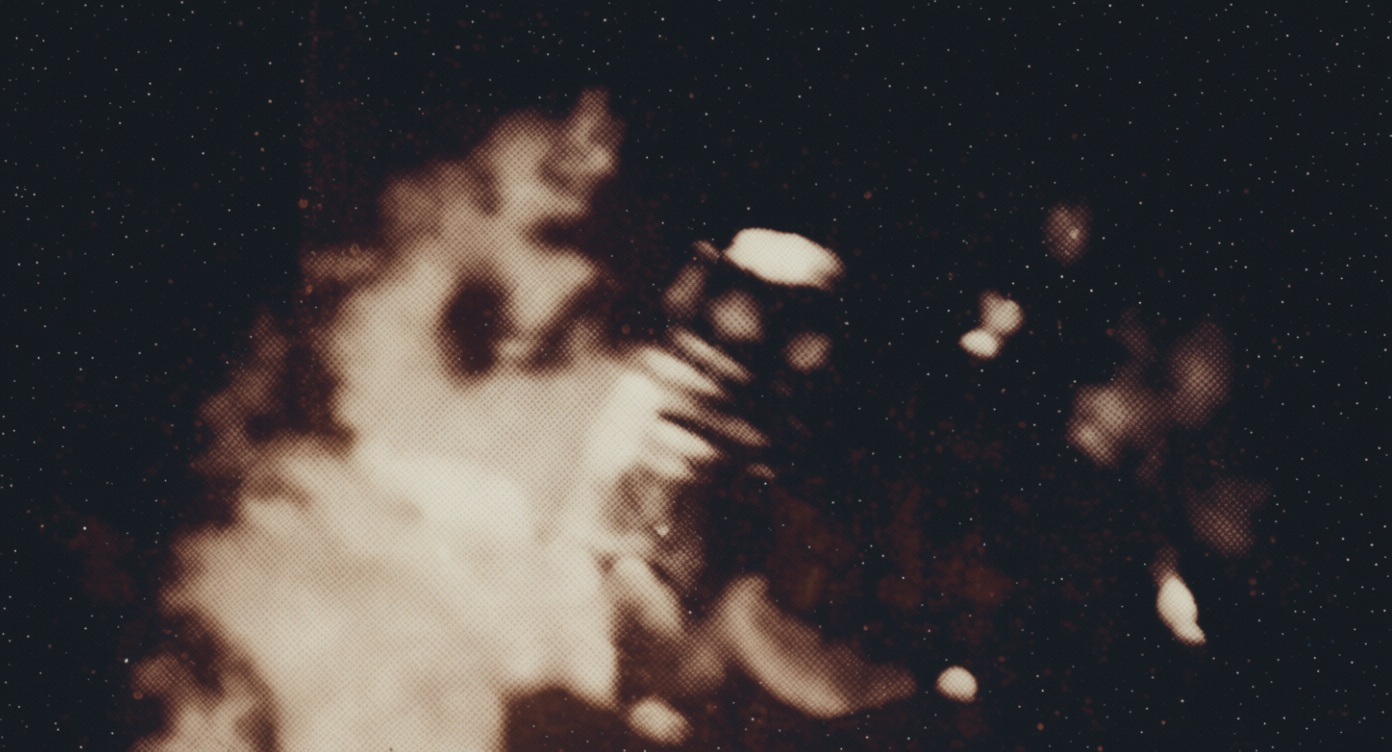
The photographs were circulated by UFO researcher and photographer August C. Roberts, who later referred to the three images collectively as “The Nicholson Photos.” One image appeared on the cover of The Saucerian Bulletin, Vol. 3, No. 3, published by Barker on June 15, 1958. Roberts was credited with supplying the photograph.
A separate publication, Saucer News No. 31, issued in June–July 1958, reproduced two additional Nicholson photographs side by side. Its caption identified the photographer as Ralph Nicholson of “Patterson, New Jersey”—a misspelling of Paterson—and stated that the image on the right had been taken through a telescope. These two images differed from the photograph used on the Saucerian Bulletin cover, accounting for the three pictures subsequently associated with the case.
Historical Significance and Limits
The Nicholson photographs are significant less because they prove a particular explanation than because they illustrate how UFO cases were documented and circulated during the early Space Age. Images often moved through specialist publications, where captions and retellings could become the principal surviving record. In this instance, Roberts’ distribution of the photographs and Barker’s publication helped preserve the case within UFO history.
However, a photograph’s appearance in a UFO publication is not independent verification. The surviving account, as presented, does not include the original negatives, a complete chain of custody, technical camera information, or a controlled analysis of the objects’ shapes and apparent motion. Possible explanations could include a conventional aircraft, a distant astronomical or atmospheric phenomenon, an artifact of photographing through a telescope, or an unidentified object that cannot now be resolved.
Continuing Interest
The Nicholson images remain an intriguing archival case tied to the excitement surrounding Sputnik and the rapid expansion of public attention toward space. They document what Nicholson and later researchers believed was an unusual observation, while also demonstrating the evidentiary challenges surrounding historical UFO reports. The photographs remain unidentified, but no confirmed evidence currently establishes an extraterrestrial origin.