Overview
A new reassessment of the so-called 1933 Magenta narrative examines the connection frequently alleged between an unidentified object reportedly recovered in Italy, wartime intelligence operations, and the development of America’s missile and space programs. The account places particular emphasis on the June 1944 launch of a German V-2 rocket and the later emergence of Huntsville, Alabama, as a center of U.S. Army missile research. However, the available historical record supports Huntsville’s documented military and aerospace role without substantiating the recovery of an exotic craft.
The narrative, discussed in an Aug. 11, 2025, Medium article, claims that a craft crashed near Magenta, outside Milan, in 1933 and was subsequently examined by Italian scientists, including figures such as Guglielmo Marconi and Enrico Fermi. It further alleges that the object was transferred to U.S. Army research personnel in June 1944. Those assertions remain part of a broader UFO-recovery story rather than established historical findings. No publicly verified archival record has demonstrated that such a vehicle existed, was transported to the United States, or was incorporated into American propulsion research.
The Huntsville Connection
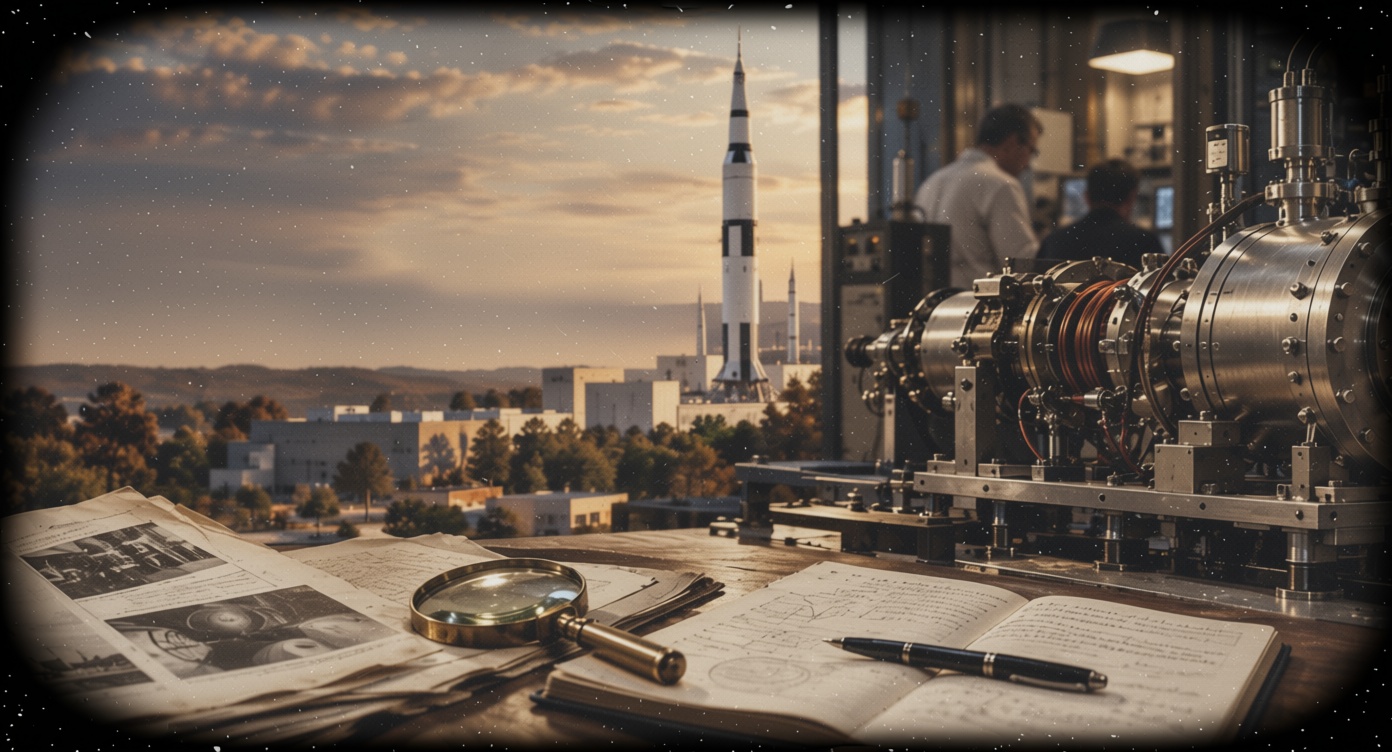
Huntsville’s actual history is considerably better documented. After World War II, the United States recruited German rocket specialists through programs associated with Operation Paperclip, including Wernher von Braun. Von Braun later became a leading figure at the Army Ballistic Missile Agency and, beginning in 1960, directed NASA’s Marshall Space Flight Center in Huntsville. His team developed the Redstone and Saturn rocket families, making the city a major center of American launch-vehicle engineering.
The V-2 itself was a landmark in conventional rocketry. A June 20, 1944, test is described in the source material as the first human-made object to reach space, although the precise designation of the earliest space-bound V-2 flights has been debated by historians. The following day, according to the Magenta account, the alleged Italian object was delivered to Army research authorities. The timing is presented as significant, but chronological proximity is not evidence of a technological relationship.
Documented Propulsion Research
The reassessment also turns to less speculative examples of advanced propulsion research. Richard Eskridge’s work on a plasma thruster illustrates how scientists have explored propulsion systems that differ substantially from chemical rockets. Plasma and electric propulsion can provide high exhaust velocities and excellent fuel efficiency, although they generally produce low thrust and are more useful for in-space maneuvering than for launching vehicles from Earth.
A preliminary study of a proposed force is also discussed, but the available material does not establish that the concept produced a working engine or demonstrated anomalous performance. This distinction is important: government and private research organizations routinely investigate ideas that remain theoretical, impractical, or unsupported after testing. The existence of a study alone does not indicate that a breakthrough propulsion technology—or recovered nonhuman technology—was involved.
Gravity Modification Claims
The account further notes that HoloChron identified gravity modification as a research goal. Gravity-control concepts appear periodically in speculative propulsion discussions, often involving attempts to alter inertia, spacetime geometry, or gravitational coupling. To date, however, no publicly verified experiment has demonstrated controllable gravity modification capable of propelling a spacecraft.
Taken together, the evidence presents two separate stories: a well-documented history of rocket development in Huntsville and a set of unverified claims about the Magenta object and exotic propulsion. The former is supported by engineering records, institutional histories, and surviving hardware. The latter remains dependent on disputed narratives and incomplete documentation. A credible reassessment therefore requires separating documented research, preliminary theoretical work, and extraordinary recovery claims rather than treating them as parts of a single proven technological lineage.