Overview
A reassessment of the documentary record surrounding the 1933 Magenta UFO narrative and the later Roswell controversy points to a more complicated picture than either a definitive extraterrestrial explanation or a single, fully documented military answer. The evidence indicates that balloon-borne equipment and radar-reflector materials available during the period could resemble several descriptions later associated with unusual debris. At the same time, identifying a specific mission—particularly Project Mogul Flight 4—remains an inference rather than a conclusion established by surviving records.
The distinction is important because many accounts of Roswell and earlier UFO cases rely on recollections recorded years or decades after the events. Those testimonies may preserve genuine memories, but they can also reflect later interpretations, media coverage, or the blending of separate incidents. The documentary record must therefore be weighed alongside witness accounts, rather than treated as automatically confirming or disproving them.
The Air Force Investigation
The principal official source is The Roswell Report, a 994-page publication prepared by Col. Richard L. Weaver and 1st Lt. James McAndrew in response to a request from Rep. Steven H. Schiff of New Mexico. According to the foreword, the report sought records explaining events in July 1947 that had become known as the “Roswell Incident,” and duplicated material supplied to the Secretary of the Air Force and the General Accounting Office, now the Government Accountability Office.
Air Force historian Richard P. Hallion wrote that the report’s significance rested partly on McAndrew’s summary of Project MOGUL, a highly classified program involving balloon-borne experiments. The foreword presents Mogul as providing “the explanation for the ‘Roswell Incident.’” However, the surviving documentary record does not necessarily establish that Flight 4 was the object recovered near Roswell. Rather, the flight has been proposed because its timing, location, and equipment appear broadly compatible with descriptions of the debris.
Debris, Balloons and Missing Records
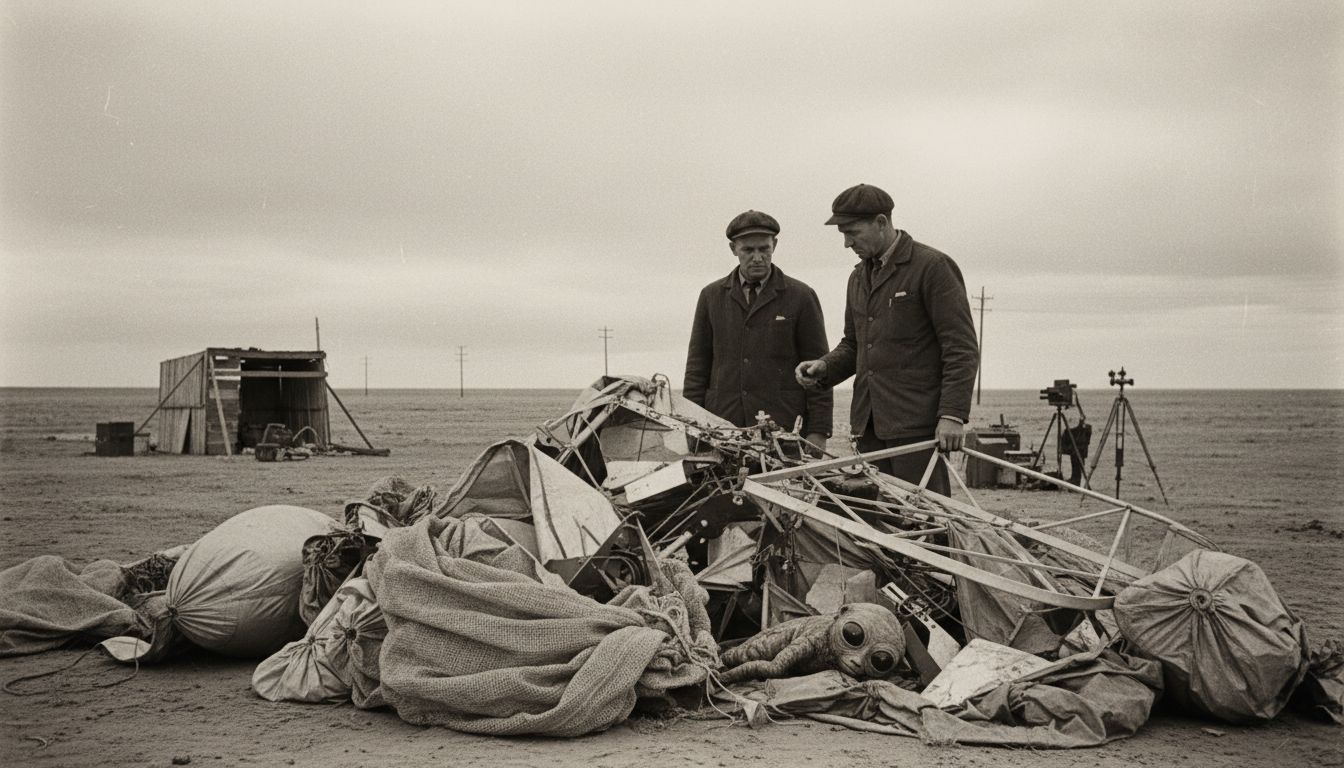
The balloon-and-reflector explanation has some material support. Project Mogul used trains of balloons carrying instruments and radar targets, equipment that could produce unfamiliar fragments of metallic, foil-like, or rubberized material after landing. Such components are consistent with portions of contemporary debris descriptions, even if they do not independently prove the material came from Mogul.
The GAO’s investigation also documented that some relevant records had been destroyed or could not be located. That finding has fueled continuing suspicion, but the destruction of records does not by itself establish what they contained or why they were destroyed. The GAO documented a records gap; it did not demonstrate that the missing documents proved an extraterrestrial crash. This limitation is central to any responsible assessment of the case.
Witnesses and Later Narratives
Later witnesses introduced claims involving unusual bodies, military secrecy, and alleged recoveries. Those accounts remain part of the historical record, but they were generally collected long after 1947 and are difficult to verify independently. Subsequent events—including classified testing, aircraft accidents, and the handling of human remains in military or medical settings—could have contributed to body-related stories without serving as definitive explanations for every witness statement.
The broader lesson from the Magenta and Roswell narratives is that possibility should not be confused with proof. Balloon technology may explain some physical descriptions, while later events may have helped shape stories about bodies. Neither conclusion resolves every testimony. The most credible account remains one that separates documented facts, reasonable inferences, unresolved records, and memories that cannot currently be corroborated.