Overview
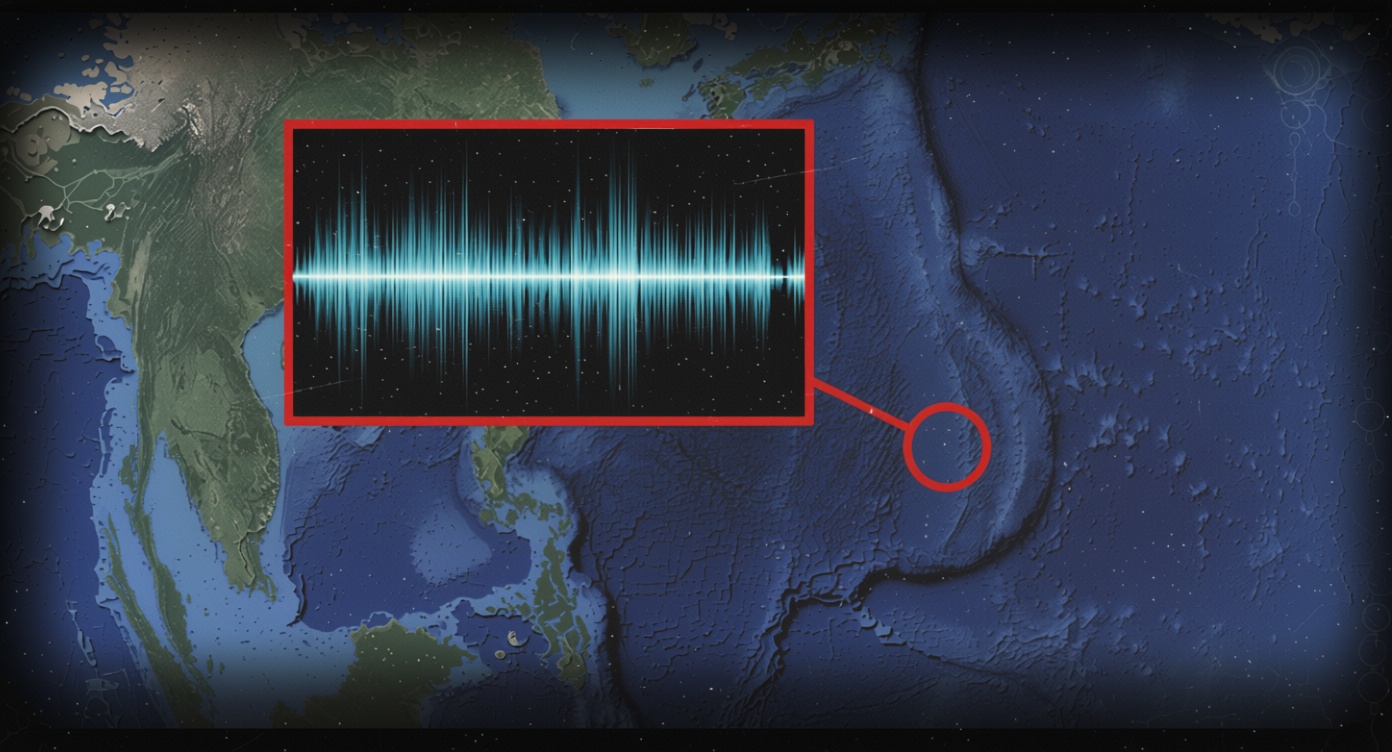
Scientists studying the Mariana Trench and nearby western Pacific waters say modern tools are helping them make sense of some of the ocean’s most puzzling noises, even as key mysteries remain. A report highlighted in the video traces decades of acoustic anomalies recorded by hydrophones and shows how advances in machine learning and marine bioacoustics are allowing researchers to identify sources that once fueled speculation about everything from hidden volcanic activity to sea monsters. The latest example is a sound known as the “Western Pacific Bio-Twang,” first captured in 2014 near Guam and the Mariana Trench, one of the most remote and least understood regions on Earth.
Decoding the “Bio-Twang”
The “Bio-Twang” drew attention because of its unusual structure: a 3.5-second sound that begins as a low-frequency moan around 30–38 Hz and rises into a high-pitched metallic screech near 8,000 Hz. For years, the signal resisted explanation, despite being recorded by autonomous hydrophone gliders operating in deep Pacific waters. According to the report, researchers at Oregon State University used AI models to scan years of archived audio, uncovering hundreds of similar signatures and cross-referencing them with whale surveys. That work led scientists in 2024 to conclude the sound came from a specific population of Bryde’s whales (Balaenoptera edeni), with the findings published in Frontiers in Marine Science.
Even with the source identified, the reason for the call remains uncertain. Researchers have suggested it could be a form of localized “cultural dialect” unique to whales in the Western North Pacific, or possibly a navigation-related acoustic behavior shaped by the complex topography of the Mariana Trench. In that sense, the discovery solved one question while opening another.
A History of Unexplained Deep-Ocean Sounds
The video also revisits several famous acoustic mysteries that once captured global attention. Among them is “The Bloop,” recorded in 1997 and heard across roughly 4,800 kilometers of the Pacific. Early speculation online imagined a giant creature, but NOAA later determined the sound was most likely a cryoseism, or icequake, linked to the fracturing of Antarctic ice sheets. Another signal, “Julia,” recorded in 1999 and described as a mournful groan, was eventually tied to a large iceberg grounding off Antarctica. Other signals, including “The Train” and “Slow Down,” were also categorized within the so-called Ice Family, associated with iceberg movement and ice-sheet breakup.
How the Ocean Carries Sound So Far
A key reason these sounds travel such extraordinary distances is the SOFAR channel—the Sound Fixing and Ranging channel—located roughly 3,000 feet below the surface. At that depth, the ocean’s pressure and temperature create a narrow acoustic corridor that can trap sound waves and carry them across entire ocean basins with surprising efficiency. The channel was once used by the U.S. Navy during the Cold War through the secret SOSUS network to track submarines, and later became an important tool for scientific monitoring of seismic activity and marine life.
What Still Remains Unknown
Despite these breakthroughs, not every signal has been explained. The report points to “Upsweep,” a seasonal narrow-band sound first detected in 1991 that sweeps upward in frequency and is heard across much of the Pacific. The leading theory is that it may be linked to underwater volcanic activity or magma movement, but scientists have not yet found a matching vent or source location. As the video emphasizes, identifying the sound is only part of the task; understanding what marine animals or geologic processes are doing, and why, remains far more difficult. For now, the deep ocean is becoming less mysterious—but it is still far from fully understood.