Overview
Skeptic Sharon Hill argues that cryptozoology has never produced meaningful evidence for its most famous creatures, saying the field has relied for decades on ambiguity, folklore and public fascination rather than verifiable proof. In a recent essay, Hill contends that the original promise of cryptozoology — that strange animal reports might eventually lead to an undiscovered species — never materialized. Instead, she writes, the evidence behind iconic monsters has remained so weak that it is “essentially worthless” outside of local legend, where stories can take on a life of their own.
Famous Creatures, Familiar Problems
Hill’s critique revisits some of the best-known examples in the cryptid canon, including the Loch Ness Monster, Bigfoot, and the Yeti. She notes that the “golden era” of cryptozoology ended by the late 1970s, when headline-making photos and footprints initially generated excitement but later came under serious suspicion. Many of those revelations, she argues, have been forgotten or ignored by believers. Hill points to the infamous Surgeon’s photograph of Nessie, which was later exposed as a hoax, as an example of how iconic images can survive in popular memory long after their credibility has collapsed.
Her broader point is that sensational stories tend to outlast corrections. Even when supposed evidence is debunked or shown to be a misidentification, the original narrative often persists. In Hill’s view, that pattern has become a defining feature of the field: the public remembers the mystery more readily than the resolution.
Weak Evidence and Strong Belief
Hill also examines newer and more localized cryptid claims, arguing that many contemporary sightings rest on a narrow and unstable foundation. A handful of strange reports, she says, can quickly grow into an entire legend once repeated by media coverage, tourism campaigns, or enthusiasts eager to connect unrelated incidents. Rather than building from evidence, the stories often expand through conjecture — with folklore, rumor and imagination filling the gaps.
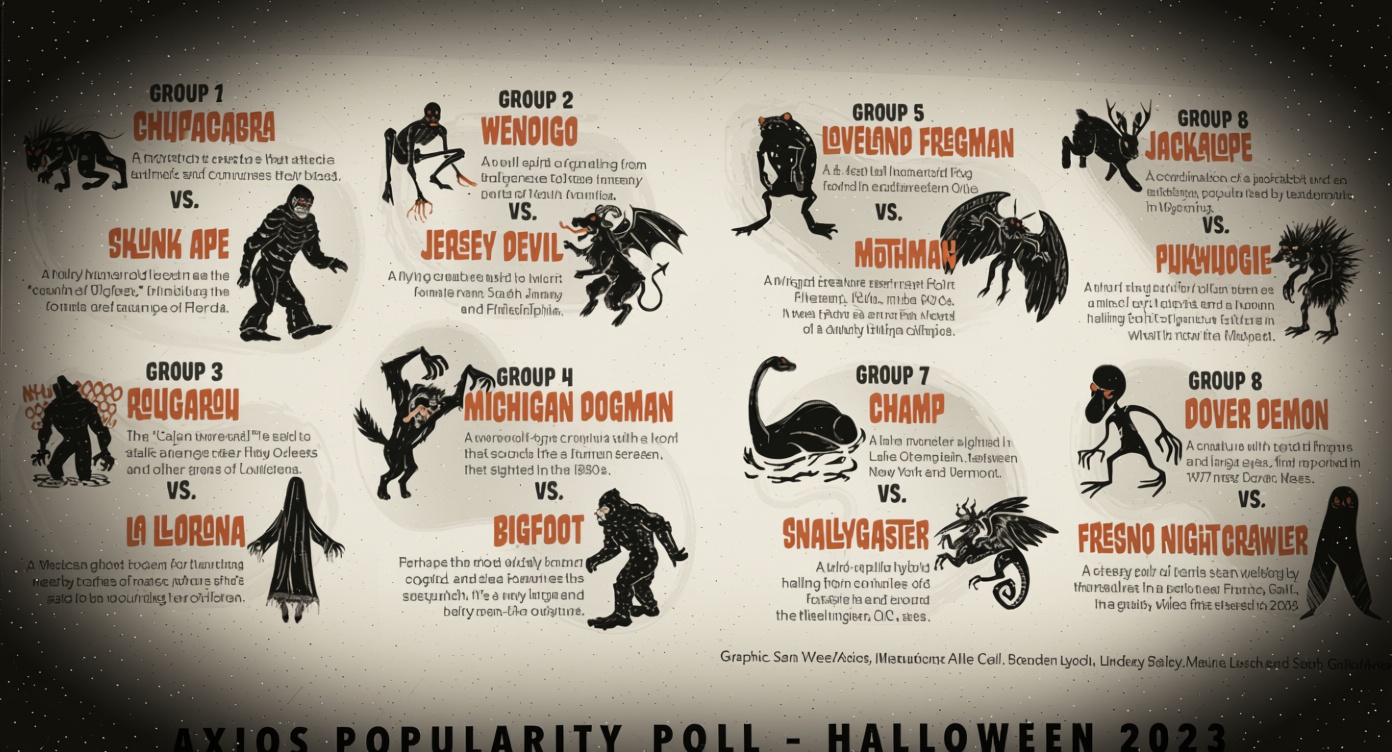
That dynamic is visible in cases such as the Fresno Nightcrawler, which Hill says gained attention from a single grainy video that was itself a copy of a copy of a low-resolution security recording. Despite the thinness of the source material, the image inspired merchandise, artwork and imitators who presented derivative clips as if they were new evidence. Hill describes the result as a poor substitute for proof, but one that is often enough to keep belief alive.
Folklore, Hoaxes and the Persistence of Mystery
Hill likewise dismisses the Van Meter Visitor, a winged beast associated with an Iowa coal town, as a product of sensational newspaper reporting rather than a documented encounter. And she critiques Mokele-mbembe, the Central African creature often imagined as a surviving sauropod, as a projection of outsiders’ hopes for a “lost world” more than a well-supported animal report. In her reading, the creature’s endurance owes less to field evidence than to outdated ideas about prehistoric Africa and later enthusiasm from creationist circles.
Ultimately, Hill argues that cryptozoology persists not because the evidence is strong, but because the idea is emotionally appealing. “There has never been solid evidence for one of the iconic cryptids,” she writes, “Yet, as we can observe today, that does not matter one whit. There will still be believers.” For Hill, the appeal lies in the sense that something magical may still be hiding just beyond the edge of certainty — even when, she says, the facts never supported that hope in the first place.