Overview
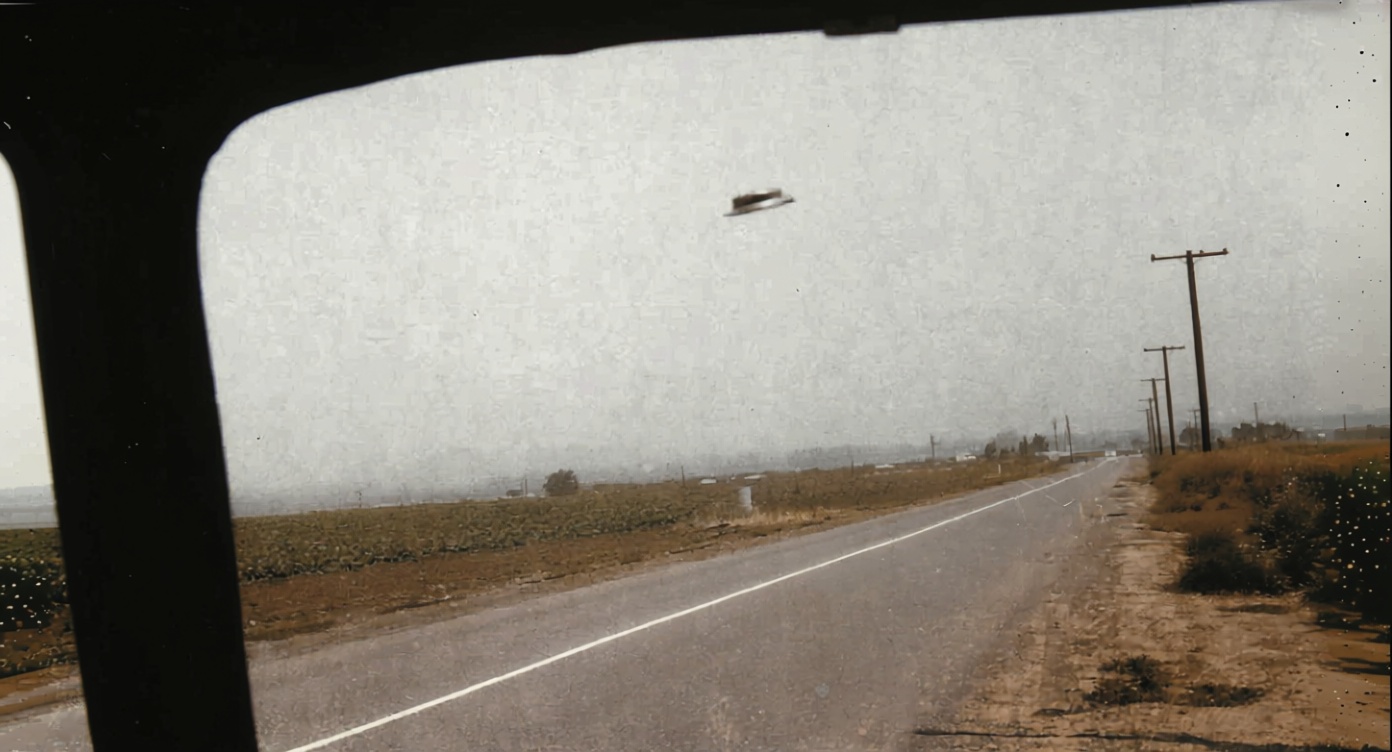
A Society for Scientific Exploration paper has revisited the controversial 1965 Heflin UFO photographs, a case centered on four Polaroid images taken by California highway worker Rex E. Heflin. The reanalysis, authored by UFO investigator Ann Druffel, scientist Robert M. Wood and researcher Eric Kelson, examines the photographs and the history of efforts to determine whether they depict a physical object or a photographic hoax. The 40-page paper was published in the Journal of Scientific Exploration in 2000 and was made available online in a document posted by TustinHistory.com.
The case dates to August 3, 1965, when Heflin reportedly stopped his work van near Santa Ana, California, at approximately 12:30 p.m. and photographed an object that appeared to pass close to his vehicle. The images became widely known among UFO researchers and were reproduced internationally. According to the paper, one photograph was even included in the 1968 edition of Encyclopaedia Britannica in a section concerning spacecraft.
A Case Surrounded by Questions
The Heflin photographs initially attracted support from investigators associated with the National Investigations Committee on Aerial Phenomena, or NICAP, and its Los Angeles subcommittee. The paper states that six photographic experts or investigative teams examined the images during the original inquiry. Those investigations reportedly concluded that Heflin’s character and account were credible, and the photographs were regarded by some researchers as among the strongest available evidence for a close-range UFO event.
Doubts emerged by 1968, however. The paper identifies several complications, including the fact that the original photographs were taken by Polaroid technology and that individuals posing as government personnel became involved in the handling of the images. The four original photographs subsequently disappeared from view, limiting the ability of independent researchers to conduct further testing. These circumstances left earlier objections unresolved for decades and contributed to continuing disagreement over the photographs’ authenticity.
Reanalysis After the Originals Resurfaced
The paper says that the original Polaroid photographs unexpectedly resurfaced in 1993, under circumstances the authors describe as mysterious. Their return allowed Druffel, Wood and Kelson to resume analysis using computer-enhancement techniques that were not available during the initial investigations. The authors argue that digital examination revealed additional information in the images and addressed earlier questions about their appearance, construction and photographic properties.
Among the issues discussed is whether the object could have been a comparatively ordinary item suspended in front of the camera, rather than a large craft at a distance. The paper also refers to possible comparisons involving vortex rings, a term associated with smoke or vapor structures that can form distinctive circular shapes. Its stated purpose is to evaluate objections raised by scientists and UFO researchers and to present the team’s interpretation of the enhanced photographic evidence.
Scientific Significance and Limitations
The authors frame photography as one of the few forms of evidence that could potentially demonstrate that UFO reports involve identifiable physical phenomena. At the same time, the history of UFO photography shows why individual images are difficult to authenticate. Objects in earlier cases have later been identified as Frisbees, hubcaps, balloons, reflections, lens flares or other conventional sources. Photographs can also be affected by perspective, exposure, optical distortion and unknown details about how an image was produced.
The reanalysis therefore represents an argument by its authors, not a broadly established scientific verdict. The paper concludes that its computer-enhancement work answers prior doubts and supports the photographs’ validity, but the source material provided does not indicate that the findings produced a consensus among independent photographic experts or the wider scientific community. The case remains historically important because it illustrates both the potential value of photographic evidence and the difficulties of evaluating imagery when chain-of-custody records, original documentation and complete investigative data are contested.


