Overview
The latest episode of The Safe Aerospace Podcast, hosted by former U.S. Navy pilot Ryan Graves, revisits the career and reported UAP encounter of Brian Binnie, the second private astronaut to fly SpaceShipOne. Graves was joined by Kevin Knuth, a cinematographer and documentarian who interviewed Binnie extensively, and Matt Steinmetz, a former lead engineer and program manager for SpaceShipOne and SpaceShipTwo. Their discussion examined Binnie’s professional reputation, the pressures surrounding the early private-spaceflight program, and an account of unusual lights and objects that Binnie kept largely private for years.
A Test Pilot Under Pressure
Binnie was a decorated Navy fighter pilot and experimental test pilot with advanced degrees from Brown University and Princeton. He joined Scaled Composites during its effort to win the Ansari X Prize, a competition that sought to demonstrate a privately developed spacecraft capable of reaching space more than once within a specified period. Steinmetz described the Mojave, California, operation as having a “Buck Rogers” atmosphere, with a small, highly integrated team relying heavily on real-world flight testing rather than the extensive simulations and wind-tunnel work typical of larger aerospace programs.
On December 17, 2003—the centenary of the Wright brothers’ first powered flight—Binnie piloted SpaceShipOne’s first powered test flight. Although the vehicle reached supersonic speed, its landing gear collapsed on touchdown, forcing the spacecraft to slide along the runway. Binnie was not injured, but he reportedly feared that the accident had ended his test-piloting career and jeopardized the program.
The Reported Encounter
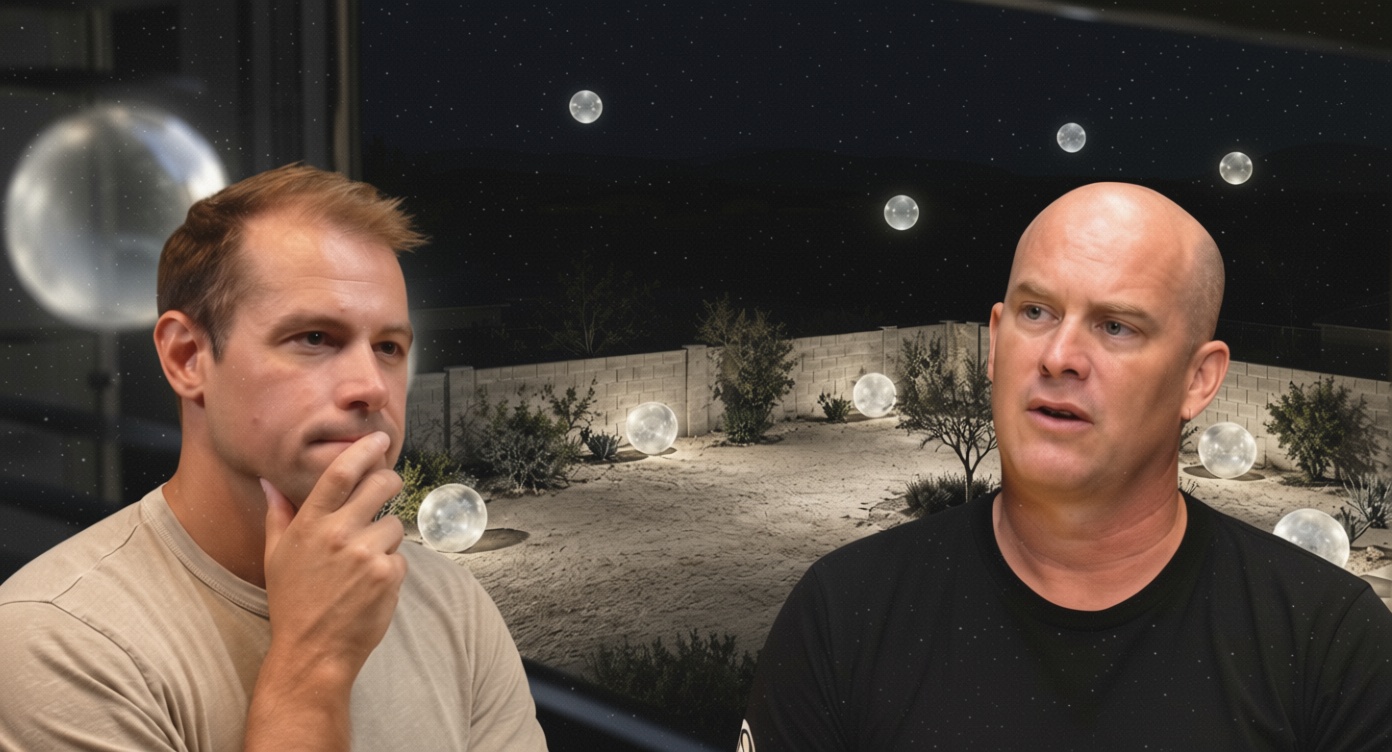
According to Knuth’s account, six days later, on December 23, Binnie woke at approximately 4 a.m. at his home in Rosamond, California, after noticing flickering lights. He reportedly saw his backyard illuminated by what he described as “manifested daylight,” while the surrounding area remained dark. Binnie said he observed roughly a dozen translucent spheres: six approximately the size of beach balls and six closer to the size of volleyballs.
The spheres appeared to emit light from their centers, although Binnie reportedly distinguished their glow from the broader illumination across the yard. He further claimed that two of the smaller objects passed through his bedroom window, hovered inside the room, and appeared to observe or “probe” him before leaving through the window. The event allegedly lasted more than a minute, with the lights and objects gradually fading from view. No independent physical evidence from the incident was presented in the podcast, and the account remains an unverified personal testimony.
Binnie’s Interpretation and Legacy
The guests said Binnie spent years considering conventional explanations, including atmospheric or optical phenomena, but did not find one that satisfied him. He interpreted the experience as a possible indication of a “non-human intelligence” and said it produced what the discussion characterized as an “ontological shift.” According to the podcast, the event gave him renewed confidence during a difficult period in the SpaceShipOne program.
Binnie reportedly avoided discussing the incident publicly for nearly 17 years because he feared being grounded by Scaled Composites founder Burt Rutan or damaging his professional standing. He eventually described it in his 2020 book, The Magic Menace of SpaceShipOne. The program’s final flight, piloted by Binnie roughly ten months after the encounter, helped secure the Ansari X Prize and established SpaceShipOne as a milestone in commercial spaceflight.
Broader UAP Discussion
Graves said Binnie’s description of localized or “directional” lighting and objects observed at close range resembles elements of other military and aviation UAP reports. The episode also placed the account alongside broader debates about proposed UFO disclosure, comparisons between human and hypothetical non-human intelligence, and scientific efforts to develop testable frameworks for studying UAP and possible technosignatures.
The participants did not present the sighting as proof of extraterrestrial activity. Instead, they argued that Binnie’s technical background and reputation warrant a careful hearing, while acknowledging that credibility alone cannot establish what occurred. His story, they concluded, illustrates the importance of documenting unusual reports without abandoning scientific standards—or assuming that every unexplained observation has a conventional or extraordinary explanation.