The 1965 Sighting
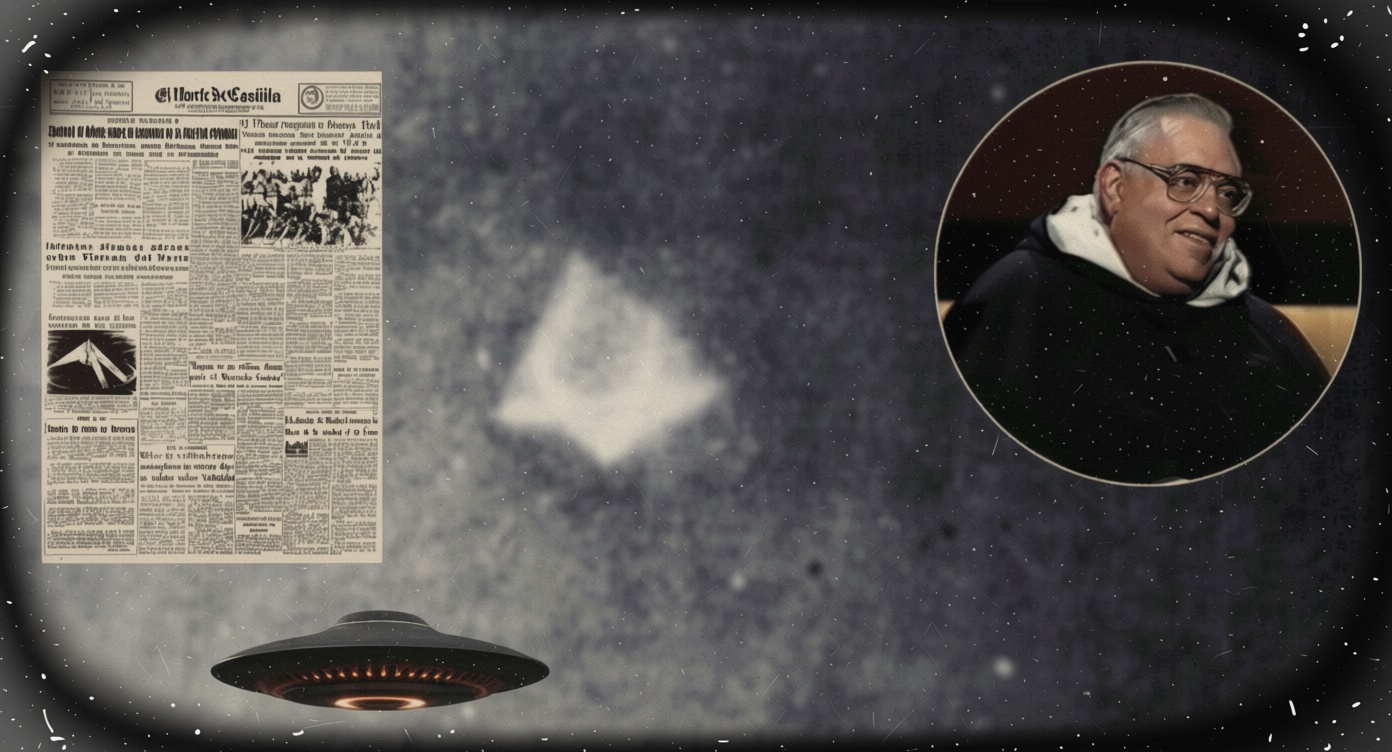
On Thursday, September 16, 1965, Valladolid was celebrating the San Mateo festivities when an unusual aerial sighting drew public attention away from the events on the ground. Residents reported seeing a large, luminous object above the city, described in many accounts as triangular, whitish or silvery, and apparently almost stationary. Witnesses said it moved only slightly, appearing to sway in the sky rather than travel rapidly across it.
Unlike a brief flash or an object seen by only a handful of people, the phenomenon reportedly remained visible for several hours. Accounts placed observers in Valladolid as well as in nearby communities, including Tudela de Duero and Boecillo, with reports extending into other parts of Castile. The exact start time remains uncertain: later reconstructions generally place it at around 4 p.m., while some accounts suggest it appeared closer to 5:30 p.m.
Newspaper Attention and Public Reaction
The incident received prominent coverage the following day, when El Norte de Castilla placed it on its front page. The newspaper reportedly received numerous calls from readers seeking information about the object and attempting to compare their observations with those of other residents. People were said to have gathered in streets, balconies and terraces to follow the phenomenon overhead.
A report later published by Semana magazine suggested that as many as 300,000 people may have seen the object from different locations. That figure should be treated cautiously. It was a contemporary journalistic estimate rather than the result of a documented census or systematic survey of witnesses. Nevertheless, the broad geographical distribution of reports helped turn the event into one of the most frequently cited episodes in Spanish ufological literature.
Descriptions and the Pilot Account
Later reconstructions described the object as having a metallic appearance, with a possible central dome or protrusion and small extensions at its points. Such details were reportedly especially noticeable to people who viewed it through optical instruments. The descriptions, however, were not entirely consistent, and the surviving accounts do not establish the object’s size, altitude or distance with precision.
One of the most prominent figures associated with the case was Heliodoro Carrión, a civil aviation pilot. According to accounts collected by later researchers, Carrión was flying near Tordesillas when he received a radio report from the Villanubla area concerning a bright, triangular object. He reportedly decided to approach it, making his testimony particularly influential in subsequent retellings. The available material does not, however, provide enough verified operational or radar data to independently assess the encounter.
A Case Without a Confirmed Explanation
The Valladolid report has remained part of a broader body of alleged unexplained aerial phenomena. The same review also refers to recurring lights filmed near Pergamino, Argentina; a pilot’s reported 35-minute encounter with lights near Salta; and a disputed photograph from Paraguay. These cases share a common limitation: witness accounts, images or recordings may document what people believed they observed, but they do not by themselves establish the objects’ identity or cause.
Six decades later, the 1965 Valladolid event remains historically significant because of its large number of reported witnesses, extended duration and contemporary newspaper coverage. Yet the evidence available in the cited material does not conclusively distinguish an unidentified aircraft from an astronomical, atmospheric, military or other conventional phenomenon. The case therefore remains unresolved—not proof of extraterrestrial visitation, but a notable example of how a puzzling sight in the sky can capture the attention of an entire city.